 Loading ...

Tuesday, January 21, 2025
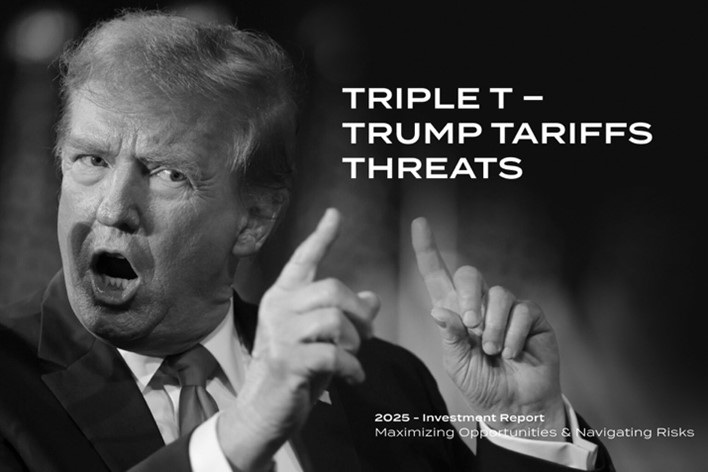
TRIPLE T – TRUMP TARIFFS THREATS
تم إعداد هذا المنشور من قبل سنشري للاستشارات
.png)
United States of America
The U.S. economy exhibited a stellar performance over the last two years. This is evident from the strong economic reports, upbeat corporate earnings, and the impressive performance of the stock market. Although the battle against inflation continues, considerable progress has been made in taming it over the last 18-month period. Headline inflation in the U.S. rose to 2.7% in November 2024, down from the eye-watering peak of 9.1% in June 2022. Meanwhile, Core CPI accelerated at 3.3% during the month. The Conference Board Economic Forecasts indicate inflation could potentially stabilise at the Fed’s 2% target in Q4’2025 instead of Q2’2025 projected earlier. The Federal Reserve slashed interest rates thrice in 2024, resulting in a cumulative 100 basis points of easing. As a result, the Fed Funds Target Rate fell from a peak of 5.25% and 5.50% to a range between 4.25% and 4.50%. Moving forward, the central bank has signalled just two more rate cuts in 2025, down from four rate cuts anticipated during the September FOMC meeting. The median dot plot anticipates a Fed Funds Target Rate of 3.9% by the end of 2025, 3.4% by the end of 2026, and 3.1% by 2027. Furthermore, the median dot for the longer-run neutral interest rates was revised upwards to 3.0%. The Fed’s cautious stance is warranted by the U.S. economy's persistent strength and anticipation of a potential revival in inflationary pressures under Trump’s administration. According to the U.S. Bureau of Economic Analysis, the final estimate of the third-quarter 2024 U.S. GDP was revised upwards to 3.1% from a previous estimate of 2.8%. It also marks a slight uptick from 3.0% in Q2’2024. Overall, Fed officials estimate real GDP growth of 2.5% in 2024. The economy is expected to continue expanding in 2025, albeit at a slower pace of 2.1% in 2025 and 2.0% in 2026.
.png)
Eurozone
The eurozone economy grappled with numerous issues in 2024, from political turmoil and subdued economic data to slowing growth and weakness in the manufacturing sector.
The extent of this impact hinges on the specifics of these policies, which should become more apparent once Trump takes office. A modest increase in tit-for-tat tariffs between the U.S. and China is expected in 2025, likely resulting in a relatively small net impact on GDP across most major EMs outside of China. However, significant downside risks remain, including the potential for tighter financial conditions due to trade-related uncertainties.
Aggregate growth in emerging economies is forecasted to slow to 3.8% in 2025 and 2026, down from 4.1% in 2024, with substantial regional and country-level variation. Rising trade protectionism and efforts by large economies to strengthen domestic industries have rendered external demand a less reliable catalyst for growth. Growth in EMs is expected to be supported by a rise in domestic and foreign demand as central banks ease monetary policies.
In Asia Pacific, economic growth is expected to remain the highest among EMs despite slowdowns in China and India. Meanwhile, Southeast Asia could benefit from shifts in global supply chains. An uptick in growth can be expected in the Middle East and Africa, particularly in Sub-Saharan Africa and Saudi Arabia. Resilient commodity demand alongside economic diversification initiatives is expected to propel these economies. Meanwhile, growth in Central and Eastern Europe and the Commonwealth of Independent States is forecasted to slow due to challenges in Russia and Turkey. Inflation is expected to ease in major EMs, with global central banks moving toward neutral monetary policies in 2025.
A struggling property sector and uncertainty around new fiscal and monetary measures impact China’s growth. In contrast, strong household consumption and a healthy private sector could support India's growth.
.png)
Emerging Markets
Trump’s trade protectionist policies may affect GDP growth in many emerging markets (EMs) over the next few years.
The extent of this impact hinges on the specifics of these policies, which should become more apparent once Trump takes office. A modest increase in tit-fortat tariffs between the U.S. and China is expected in 2025, likely resulting in a relatively small net impact on GDP across most major EMs outside of China. However, significant downside risks remain, including the potential for tighter financial conditions due to trade-related uncertainties.
Aggregate growth in emerging economies is forecasted to slow to 3.8% in 2025 and 2026, down from 4.1% in 2024, with substantial regional and country-level variation. Rising trade protectionism and efforts by large economies to strengthen domestic industries have rendered external demand a less reliable catalyst for growth. Growth in EMs is expected to be supported by a rise in domestic and foreign demand as central banks ease monetary policies.
In Asia Pacific, economic growth is expected to remain the highest among EMs despite slowdowns in China and India. Meanwhile, Southeast Asia could benefit from shifts in global supply chains. An uptick in growth can be expected in the Middle East and Africa, particularly in Sub-Saharan Africa and Saudi Arabia. Resilient commodity demand alongside economic diversification initiatives is expected to propel these economies. Meanwhile, growth in Central and Eastern Europe and the Commonwealth of Independent States is forecasted to slow due to challenges in Russia and Turkey. Inflation is expected to ease in major EMs, with global central banks moving toward neutral monetary policies in 2025.
China’s growth is impacted by a struggling property sector and uncertainty around new fiscal and monetary measures, while India’s growth could remain supported by strong household consumption and a healthy private sector.
.png)
2025 EARNINGS SNAPSHOT
U.S. - Solid Core Fundamentals
The global markets are entering 2025 with a relatively solid fundamental backdrop. The recent Q4 US earnings show an average y-o-y growth rate for the benchmark SPX500 index at 11.9%. This growth rate would be, in fact, one of the highest seen over the last 4 years. Markets now expect SPX 500 to report double-digit earnings growth for 2025. The expected earnings growth rate is 14.8%, higher than the trailing 10-year annual average of 8% (2014 – 2023 cycle). One of the major reasons for such an optimistic number is that analysts expect earnings growth to be broader based (beyond the Mag 7 components).
While Mag 7 growth is expected at 21%, the other 493 companies are expected to report growth from 12% to 14% range. On a most optimistic basis, based on the expected SPX 500 growth rate trend range of 12.5 % to 15%, the estimated 2025 year-end target for the index is now pegged at the 6,500 range. It is based on the average P/E of 24.30 (taken near the end of the last 5-year P/E range of 19 to 24.50).
Europe – Likely to be Pressured by Domestic Issues and Trump Tariff Threats
At a combined regional level, the eurozone GDP growth is pegged at 1.2 % for 2025, better than the 2023 & 2024 average GDP rate of 0.6%. Earnings-wise, the actual growth rate is now estimated in the 8% range for the following year. However, it should be noted that the region faces major threats, including political instability among its key members – France and Germany- the likely trade tariff rhetoric and any imposition of the actual tariffs. Even leaving aside the exogenous factors, the risk towards the Eurozone earnings outlook seems to be tilted towards the downside. Any rebound is likely to be slow and shallow as tariff threats and cyclical slag would negatively impact a few sectors. For the earnings outlook, one of the biggest tailwinds could be any sharp reduction in the interest rates by the ECB should any major labor market slack off or a slowdown in inflation materializes.
Japan is currently experiencing an inflationary environment, leaving behind its three-decade-old disinflationary spiral. While this can be healthy for further economic and wage growth, investors also need to watch out for heightened depreciation in the yen, which could adversely impact the economy’s growth dynamics.
Disclaimer:Century Financial Consultancy LLC (CFC) is duly licensed and regulated by the Securities and Commodities Authority of UAE (SCA) under license numbers 20200000028, 20200000081 and 301044 to practice the activities of Trading broker in the international markets, Trading broker of the OTC derivatives and currencies in the spot market, Introduction, Financial Consultation and Financial Analysis, and Promotion. CFC is a Limited Liability Company incorporated under the laws of UAE and registered with the Department of Economic Development of Dubai (registration number 768189). CFC has its registered office at 601, Level 6, Building no. 4, Emaar Square, Downtown, Dubai, UAE, PO Box 65777.
PLEASE READ THE FOLLOWING TERMS AND CONDITIONS OF ACCESS FOR THE PUBLICATION BEFORE THE USE THEREOF.
Please carefully read the terms and conditions before using the Publication (which means and includes this document/flyer, charts, diagrams, illustrations, images, and all of its contents) ("Publication"). By accessing and continuing to use the Publication, you acknowledge and accept the terms and conditions outlined in this Disclaimer ("Disclaimer"). CFC holds the right to modify or update the Publication and the Disclaimer at any time without any prior notice. Your access and usage of the Publication post the modifications or updates to the Disclaimer will constitute your agreement to abide by the revised terms and conditions. If you do not agree with the contents of this Disclaimer please refrain from using the Publication. Any terms and conditions you propose that may contradict this Disclaimer are liable to be rejected by CFC and shall be considered null and void.
This Publication is a marketing material. It has not been prepared in accordance with legal requirements intended to promote the independence of investment research and, therefore, is a straightforward marketing communication. This Publication's opinions, news, research, analysis, prices, and other information comprise a general market commentary and do not represent the opinion or advice of CFC or any form of personalized or investment advice. Accordingly, CFC is not liable for any loss or damage, including but not limited to any loss of profit, that may arise directly or indirectly from using or relying on this Publication.
The information in this Publication cannot disclose everything about the nature and risks of the abovementioned data/information. Therefore, this is not an exhaustive list of the risks involved. Please refer to our website for the complete Risk Disclosure Statement.
Charts, graphs, tables, calculations of profit and loss, leverage, scenario analysis, other numbers and calculations and related data or information provided in this Publication are intended for illustrative purposes only. The information contained in this Publication is prepared as of a particular date and time and will not reflect subsequent changes in the market or any other factors relevant to their determination. All statements as to future matters are not guaranteed to be accurate. CFC disclaims any obligation to amend or revise any forward-looking statements to reflect new information, events, or circumstances after the date of this Publication or to reflect the occurrence of unanticipated events. The Publication may contain forward-looking statements and projections based on current market conditions and an assessment of future trends. Actual results may differ materially from those projected. CFC does not guarantee the accuracy or reliability of any such statements.
No information given in this Publication should be construed as an endorsement of any particular security, company, or industry, offer, recommendation, or solicitation to purchase or dispose of any securities/financial instruments/products or to enter into any transaction or adopt any hedging, trading or investment strategy. The data/information contained in the Publication is not designed to initiate or conclude any transaction. Neither this Publication nor anything contained herein shall form the basis of any contract or commitment whatsoever. Distribution of this Publication does not oblige CFC to enter into any transaction.
The Publication should not be considered legal, regulatory, credit, tax, or accounting advice. Anyone proposing to rely on or use the information contained in the Publication should independently verify and check its accuracy, completeness, reliability, and suitability and obtain independent professional advice. The Publication does not take into account the investment objectives, financial situations, and specific needs of recipients. The recipient of this Publication must make independent decisions regarding whether this communication and any securities or financial instruments mentioned herein are appropriate in the light of their investment objectives, investment experience, financial situation, existing portfolio holdings and/or investment needs. Recipients will need to decide on their own as to whether or not the contents of this Publication are suitable for them.
Information contained in this Publication is based on various sources, including but not limited to public information, annual reports, and statistical data that CFC believes to be reliable. However, CFC makes no representation or warranty as to the accuracy or completeness of any report or statistical data made in or in connection with this Publication and accepts no responsibility whatsoever for any loss or damage caused by any act or omission taken as a result of the information contained in this Publication. In addition, the names used to describe various financial products or instruments in this Publication may vary from the ones used on different trading platforms.
All views expressed in all reports, analysis and documents are subject to change without notice. CFC may have issued other reports, analysis, or other documents expressing different views from this Publication. In addition, staff members/employees of CFC may provide/present oral or written market commentary or analysis to you that reflect opinions contrary to the opinions expressed in this research and may contain insights and reports inconsistent with the views expressed in this Publication. Neither CFC nor any of its affiliates, group companies, directors, employees, agents, or representatives assume any liability, nor shall they be made liable for any damages, whether direct, indirect, special, or consequential, including loss of revenue or profits that may arise from or in connection with the use of the information provided in this Publication.
Information or data provided by means in this Publication may have many inherent limitations, like module errors or lack of accuracy in its historical data. In addition, data included in the Publication may rely on models that do not reflect or consider all potentially significant factors such as market risk, liquidity risk, interest risk, credit risk etc.
CFC and its affiliates reserve the right to act upon or use the contents hereof at any time. The use of our information, products and services should be on your own due diligence and you agree that CFC is not liable for any failure to achieve the desired return on investment that is in any manner related to availing of services or products of CFC and use of our information, products and services. You acknowledge and agree that past investment performance is not indicative of the future performance results of any investment and that the information contained in this Publication is not to be used as an indication for the future performance of any investment activity. Any prices provided in this Publication are indicative only and do not represent firm quotes as to either price or size.
This Publication is being furnished to you solely for your information and neither it nor any part of it may be used, forwarded, disclosed, distributed or delivered to anyone else. You may not copy, reproduce, display, modify or create derivative works from any data or information contained in this Publication. This document may not be published, circulated, reproduced, or distributed in whole or part to any other person (whether within or in a jurisdiction outside UAE) without the prior written consent of CFC.
Declaration of the Financial Analyst: The Analyst(s) who prepared this report certifies that the opinions contained herein exclusively reflect his or her views. The Analyst further undertakes that he or she has taken reasonable care to maintain independence and objectivity in respect of the opinions herein. The Analyst(s) who wrote this report does not hold securities in the Company mentioned in the report (“Company”). The Analyst(s) confirms that he or she and his / her Associates do not serve as directors or officers of the Company, and the Company or other third parties have not provided or agreed to provide any compensation or other benefits to the Analyst(s) in connection with this report. An “Associate” is defined as the spouse, parent or step-parent, or any minor child (natural or adopted) or minor step-child of the Analyst. The Analyst(s) receives a fixed compensation from CFC. No part of his or her compensation was, is, or will be directly or indirectly related to the inclusion of specific recommendations or views in this report. The business solicitation or marketing departments of CFC are separate and independent from the reporting line of the Analyst(s).
Trading in financial products carries risk. Trading in leveraged Over-The-Counter (OTC) Derivative products including Contracts for Difference (CFDs) and spot foreign exchange contracts involves a significant risk of loss which can exceed deposits and may not be suitable for all investors. OTC Derivative products / CFDs are complex financial instruments that do not confer any claim or right to the underlying financial instrument. Transactions in these instruments are very risky, and you should trade only with the capital you can afford to lose. Before deciding to trade on these products, you should consider your investment objectives, risk tolerance, and your level of experience. Accordingly, you should ensure that you understand the risks involved and seek independent advice from professionals, if necessary.






تنظمها هيئة الأوراق المالية والسلع
سنشري للاستشارات المالي ش.ذ.م.م


تصل إلينا:
-
دبي
الطابق رقم 6, مبنى رقم 4, ساحة إعمار دبي
وسط مدينة دبي، ص.ب: 65777،
دبي، الإمارات العربية المتحدة -
Abu Dhabi
27th Floor, Office 2701,
Shining Towers, Abu Dhabi, UAE -
Sharjah
29th Floor, Office 2905,
The Business Tower, Sharjah, UAE - +971 (4) 356 2800
- info@century.ae

Century Financial is the presenting sponsor of

ينطوي التداول في المنتجات المالية على مخاطر كبيرة. فالاعتماد على المشتقات المالية المتاحة للتداول خارح البورصة، مثل عقود الفروقات وتداول العملات الأجنبية (الفوركس) الفوري، قد يتسبب في خسائر تتجاوز قيمة الإيداعات الأولية، مما يجعلها غير ملائمة لجميع المستثمرين. فهذه الأدوات المالية المعقدة لا تمنح ملكية مباشرة للأصول الأساسية. لذا، ينبغي للمستثمرين الاحتراز عند تحديد أهدافهم الاستثمارية ومراعاة مستوى المخاطرة المتوقَع، واللجوء إلى الاستشارة المهنية المتخصصة عند الضرورة.
سنشري للإستشارات والتحليل المالي ش.ذ.م.م (الشركة)، شركة مرخّصة ومنظمة من هيئة الأوراق المالية والسلع في دولة الإمارات العربية المتحدة، بموجب الترخيص رقم (20200000028) و(301044) لتولي أعمال الوساطة في الأسواق الدولية، وتداول المشتقات المالية والعملات المتاحة للتداول خارج البورصة في سوق التداول الفوري، بالإضافة إلى تقديم الخدمات الاستشارية والترويجية. تأسست الشركة بموجب قوانين دولة الإمارات العربية المتحدة، وهي مسجلة لدى دائرة التنمية الاقتصادية بدبي (رقم: 768189)، حيث يقع مكتبها المسجّل في 601، الطابق السادس، المبنى رقم 4، ميدان إعمار، وسط مدينة دبي، دولة الإمارات العربية المتحدة، ص.ب. 65777.
لا يُعرَض محتوى هذا الموقع الإلكتروني إلا لأغراض تعريفية تثقيفية بحتة، فلا يمثل عرضًا ولا توصيةً ولا دعوةً لشراء أو بيع أي أوراق مالية أو منتجات مالية.
لا تنوي الشركة استخدام أو توزيع منتجاتها وخدماتها في أي ولاية قضائية حيث يُشكِّل هذا الاستخدام أو التوزيع انتهاكًا للقوانين المحلية أو اللوائح التنظيمية.
