 Loading ...

Monday, April 20, 2026
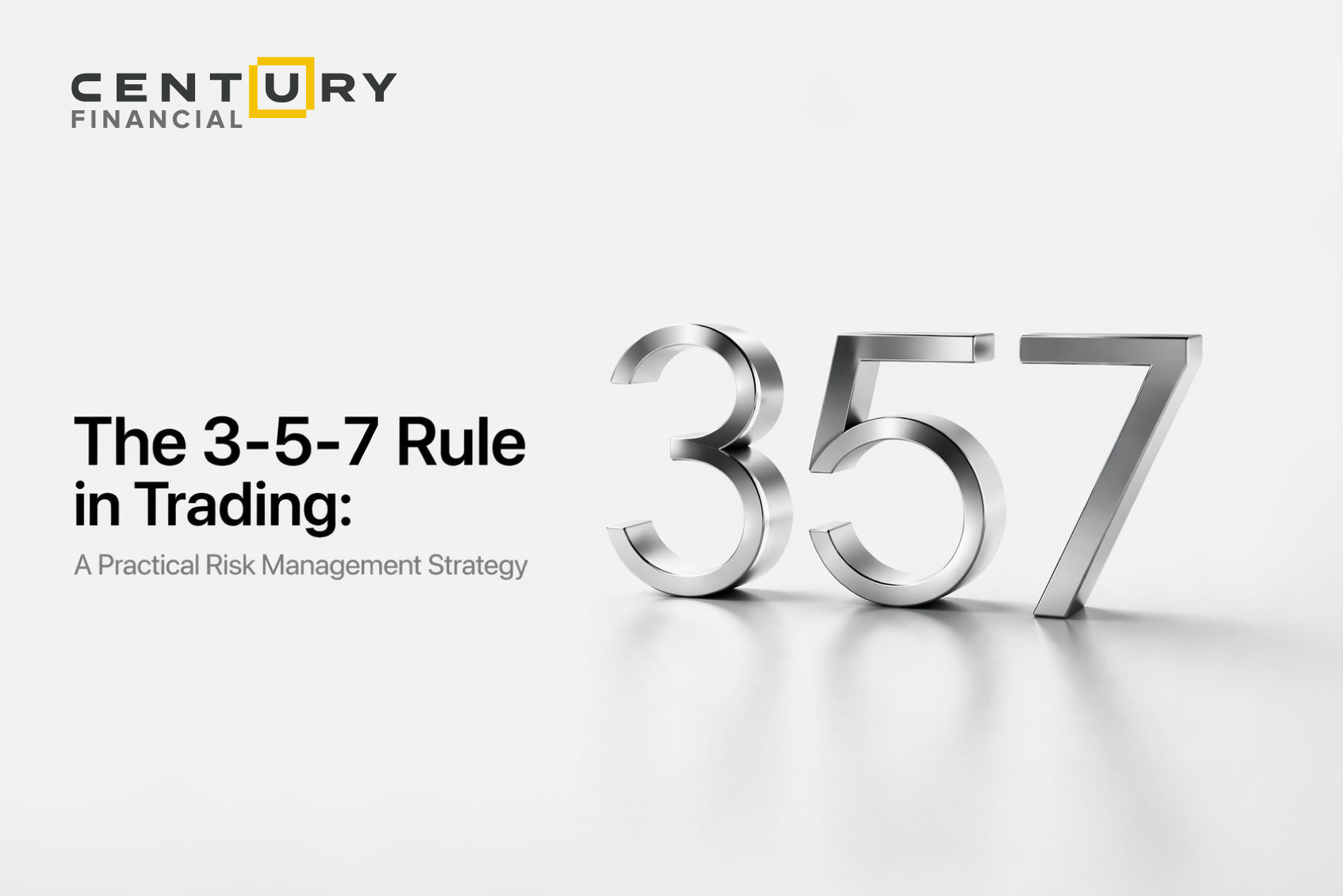
The 3-5-7 Rule in Trading: A Practical Risk Management Strategy Every Trader Should Know
By Century Financial in 'Blog'
.jpg)
In trading, profits tend to get all the attention. Screenshots of winning trades, bold predictions, and flashy strategies dominate social media. Yet behind every trader who lasts more than a few months is something far less exciting but infinitely more important: risk management.
One of the simplest and most effective approaches to controlling risk is the 3-5-7 rule in trading. It’s not a secret strategy or a guaranteed formula. It is a structured way to manage exposure, protect capital, and trade with clarity rather than emotion.
Whether you’re trading stocks, forex, or cryptocurrency, the 3-5-7 rule provides a realistic framework that helps traders stay consistent in unpredictable markets.
Why Risk Management is as Important as Trading Strategy
The 3-5-7 rule exists to prevent the most common trading mistake: overexposure. Many beginners believe success in trading comes from finding the perfect entry or mastering complex indicators. Even the most advanced strategies experience losses. Markets change, volatility spikes, and no setup works every time.
Risk management separates consistent traders from those who burn out. Proper risk management has a few different factors:
- Protects your trading account from large drawdowns.
- Reduces emotional decision-making.
- Helps maintain discipline during losing streaks.
- Allows steady growth over time.
Understanding the 3-5-7 Rule in Trading
With this rule, instead of asking, “How much can I make on this trade?” you ask yourself, “How much can I afford to lose and still trade tomorrow?” The 3-5-7 rule is a trading risk management strategy built around three limits:
- Risk no more than 3% of your account on a single trade.
- Risk no more than 5% on a single market or asset.
- Risk no more than 7% total across all open trades.
The rule shifts your focus from chasing returns to capital preservation, which is the foundation of long-term trading success.
The 3% Rule: How Much to Risk Per Trade
The first pillar of the 3-5-7 rule is limiting risk per trade.
You should never risk more than 3% of your total trading account in a single position. This does not refer to position size, but the amount you lose if your stop-loss is triggered.
- For example, if your account balance is $2,000, your maximum risk per trade is $60. Whether you trade one share or one thousand, the loss should never exceed that amount.
This approach protects you from the emotional shock of large losses and ensures that a string of losing trades doesn’t end your trading career.
Many professional traders risk less than 3%, but this figure is often viewed as the upper boundary for disciplined retail traders.
The 5% Rule: Avoiding Overexposure to One Market
The second part of the 3-5-7 rule limits how much risk you take within a single market or asset class.
You should never risk more than 5% of your account in one market at the same time.
This is especially important because markets are often correlated. Trades may appear diversified but still react the same way to news or sentiment. Tech stocks tend to move together. Crypto assets usually rise and fall as a group. Forex pairs tied to the same currency are closely connected.
By capping market exposure at 5%, you avoid putting all your eggs in one basket. Even if several setups look strong, discipline means knowing when not to trade.
The 7% Rule: Setting Meaningful Profit Targets
This is where the 3-5-7 rule is often misunderstood and where it truly stands apart.
The 7% rule refers to your profit target, not additional risk.
When you take a trade, you should aim for a minimum profit of 7% on winning trades. This ensures that your reward meaningfully outweighs your risk.
Using the earlier example:
- Risking 3% ($300)
- Targeting 7% ($700)
This creates a risk-to-reward ratio greater than 2:1, which is critical for long-term profitability. Even if you win less than half of your trades, this structure allows your winners to compensate for your losers.
How the 3-5-7 Rule Creates Balance
When combined, the three components form a complete trading framework:
- The 3% rule controls individual trade risk.
- The 5% rule controls portfolio exposure.
- The 7% rule ensures profitable trades matter.
This balance is what many traders miss. Limiting losses without demanding proper rewards often results in breakeven. Chasing rewards without managing risk leads to blowups.
The 3-5-7 rule addresses both sides of the equation.
A Real-World Example of the 3-5-7 Rule in Effect
Imagine a trader with a $10,000 account.
- Maximum risk per trade: $300
- Maximum total exposure: $500
- Minimum profit target per winner: $700
The trader opens one position, risking $300. Another setup appears, but adding it would push total exposure beyond $500, so it’s skipped.
The trade either:
- Loses $300, which is manageable.
- Or wins $700, which more than offset two losing trades.
This approach prioritizes quality over quantity and builds consistency over time.
The Psychological Edge of Proper Risk Management
One of the most overlooked benefits of the 3-5-7 rule is its effect on trading psychology.
When traders know their downside is limited:
- They stop obsessing over short-term price fluctuations.
- They follow their trading plan more consistently.
- They accept losses without panic or revenge trading.
Confidence in trading doesn’t come from being right all the time. It comes from knowing that being wrong won’t ruin you.
Common Mistakes When Applying the 3-5-7 Rule
One frequent mistake is treating the 7% target as optional. Cutting winners short undermines the rule's entire purpose.
Another error is confusing position size with risk. A small position can still violate the 3% rule if the stop-loss is poorly placed. Some traders also ignore the 5% exposure limit, stacking highly correlated trades. When markets move against them, losses compound quickly.
The 3-5-7 rule only works when all three components are respected together.
Why Simple Trading Rules Often Work Best
In a world filled with complex indicators and overengineered strategies, simplicity is often the real advantage.
The 3-5-7 rule works because it is:
- Easy to remember.
- Easy to apply.
- Hard to misuse when followed correctly.
It removes emotion from decision-making and replaces it with structure.
Conclusion
The 3-5-7 rule is not a shortcut to profits. It’s a framework for sustainability. By risking no more than 3% per trade, limiting total exposure to 5%, and demanding at least 7% on winning trades, you create a system where losses are manageable, and winners do the heavy lifting.
In trading, survival comes first. Growth comes second. The 3-5-7 rule helps ensure you achieve both.
FAQs
Q1. What is the 3-5-7 rule in trading?
A: The 3-5-7 rule is a risk management principle where you risk no more than 3% per trade, keep total exposure under 5%, and ensure winning trades return at least 7% to maintain a healthy reward-to-risk ratio.
Q2: Is the 3-5-7 rule meant for beginners or experienced traders?
A: It's useful for both. Beginners benefit from its clear structure to build discipline, while experienced traders use it as a consistent framework to protect capital during volatile markets.
Q3: Can the 3-5-7 rule be used across different markets and asset classes?
A: Yes, the rule is market-agnostic and can be applied to stocks, forex, crypto, commodities, and more, as it's based on percentage-based risk rather than asset-specific conditions.
Q4. Does the 3-5-7 rule limit profit potential?
A: Not necessarily because while it caps risk exposure, it's designed to let winning trades outpace losses, preserving long-term profitability without requiring you to over-leverage positions.
Q5. Do short-term and long-term traders use the 3-5-7 rule differently?
A: Short-term traders apply it trade-by-trade to manage frequent exposure, while long-term traders use it to size positions across a broader portfolio over extended holding periods.
This marketing and educational content has been created by Century Financial Consultancy LLC (“Century”) for general information only. It does not constitute investment, legal, tax, or other professional advice, nor does it constitute a recommendation, offer, or solicitation to buy or sell any financial instrument. The material does not take into account your investment objectives, financial situation, or particular needs.
The opinions expressed by the hosts, speakers, or guests are their own and may change without notice. Information is based on sources we consider to be reliable; however, Century does not guarantee its accuracy, completeness, or timeliness and accepts no liability for any loss arising from reliance on this content.
Trading and investing involve significant risk, and losses may exceed initial deposits. Past performance is not indicative of future results. CFDs and other leveraged products are complex instruments that may not be suitable for all investors. Please ensure you understand how these products work, the associated risks, and seek independent professional advice if necessary.
Century is licensed and regulated by the UAE Capital Market Authority (CMA) under License Nos. 20200000028 and 301044.
Please refer to the full risk disclosure mentioned on our website.





Regulated by CMA
Century Financial Consultancy LLC


.png)


.png)
.png)

Reach us:
-
Dubai
6th Floor, Emaar Square Building 4,
Downtown, Dubai, P.O. Box 65777,
Dubai, United Arab Emirates -
Abu Dhabi
27th Floor, Office 2701,
Shining Towers, Abu Dhabi, UAE -
Sharjah
29th Floor, Office 2905,
The Business Tower, Sharjah, UAE - +971 (4) 356 2800
- info@century.ae

Disclaimer: Trading in financial products carries substantial risk. Leveraged over-the-counter (OTC) derivatives, such as Contracts for Difference (CFDs) and spot forex, may result in losses exceeding initial deposits and may not be suitable for all investors. These complex instruments do not confer ownership of the underlying assets. Investors should carefully consider their investment objectives and risk appetite, and seek independent professional advice if necessary.
Century Financial Consultancy LLC (CFC) is licensed and regulated by the Capital Market Authority (CMA) of the UAE under license numbers 20200000028 and 301044 to carry out the activities of Financial Products dealer, Trading Broker in international markets, Trading Broker of OTC derivatives and currencies in the spot market, Introduction, Financial Consultations, and Promotion. CFC is incorporated under UAE law, registered with the Dubai Economic Department (No. 768189), with its office at 601, Level 6, Building No. 4, Emaar Square, Downtown Dubai, UAE, PO Box 65777.
The content on this website is provided solely for informational and educational purposes and does not constitute an offer, recommendation, or solicitation to buy or sell any securities or financial products.
Products and services offered by CFC are not intended for use in any jurisdiction where such use or distribution would breach local laws or regulatory requirements.
⚠️ Alert: Fraudulent Activity Notice
Century Financial Consultancy LLC (“Century”) has become aware of fraudulent individuals and entities impersonating our firm through unofficial websites, social media channels, and messaging applications such as Telegram, WhatsApp, and Discord.
Please be advised:
- Century does not manage investments on behalf of clients.
- Century does not solicit funds or guarantee investment returns.
- Century does not accept or make payments in cash, cryptocurrency, or digital assets.
- We do not conduct business via social media or messaging platforms.
Our only official website is www.century.ae, and all communication is conducted exclusively through verified channels.
We strongly urge the public to remain vigilant, verify the authenticity of any communication claiming to be from Century, and report any suspicious activity. Century disclaims any responsibility for losses arising from dealings with unauthorised or fraudulent parties.
