Loading ...

Immediate responders:
Oil prices drop sharply as supply premium deflates. Gold softens as safe-haven demand cools. Broad equity indices rebound on improved risk sentiment.
Tuesday, March 31, 2026
By Century Financial in 'Blog'
.jpg)
Not everything that moves markets makes the front page. Sometimes the most consequential developments happen in private meetings, through back channels, and in conversations that officials will only discuss on condition of anonymity.
While the conflict dominates headlines, a parallel story has been quietly building. Gulf states are not passive observers here. They are active, strategic actors working hard to limit the damage, both geopolitically and economically. Understanding what they're doing and what a diplomatic resolution could actually trigger in markets is arguably more useful for investors right now than tracking daily volatility.
So let's dig into what's actually happening and what investors may consider before investing.
.jpg)
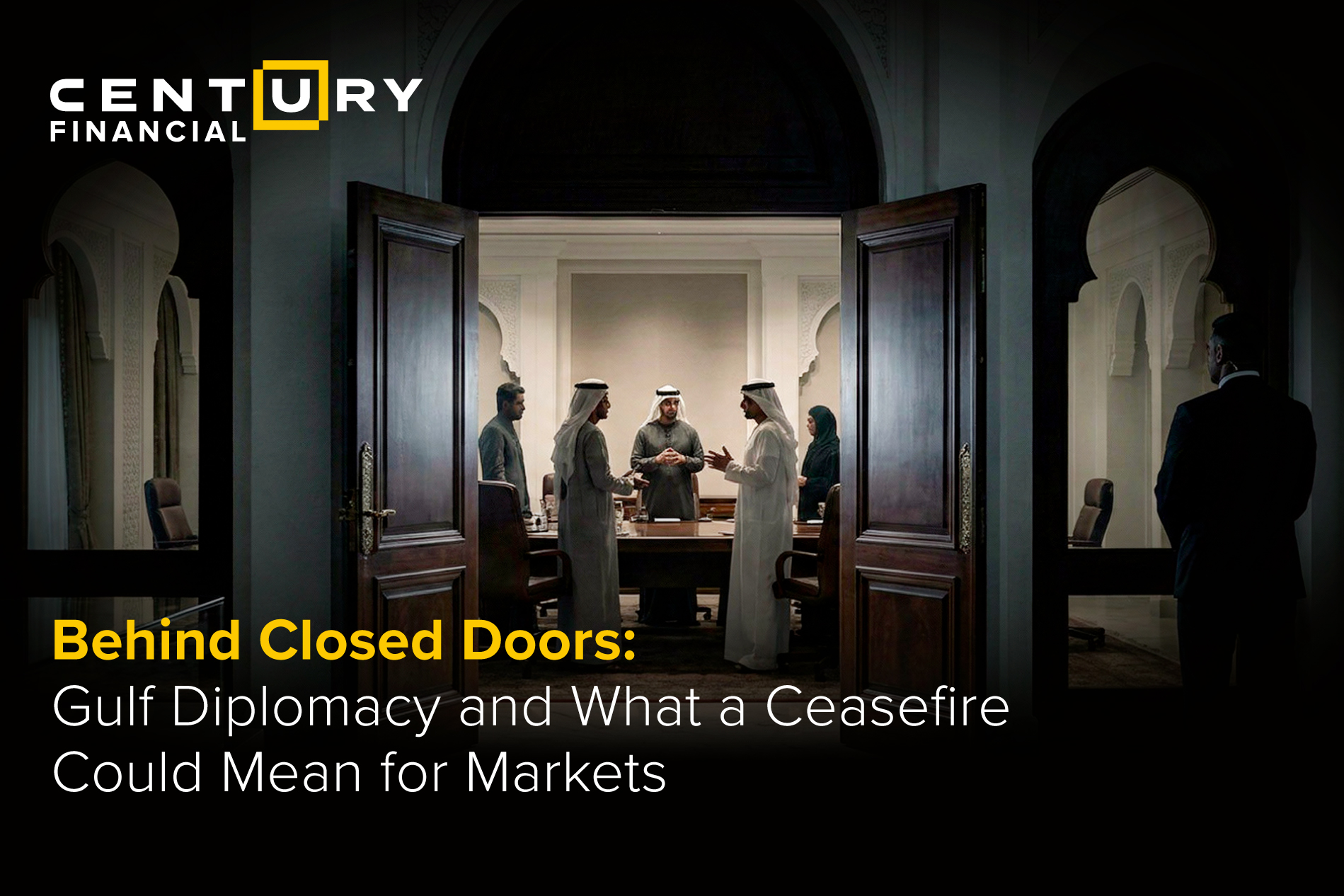
The UAE and Qatar are privately lobbying allies to help persuade President Donald Trump to reach for an off-ramp that would keep US military operations against Iran short. The countries are seeking to build a wide coalition to advance a swift and diplomatic end to the conflict in order to prevent regional escalation and a prolonged energy price shock. This isn't rumor. It was reported by Bloomberg, citing multiple people familiar with the matter.
What makes this diplomatically significant and financially relevant is the leverage they carry, as Gulf sovereign wealth funds hold over $2 trillion in US assets spanning real estate, technology, and Treasury bonds.
A ceasefire isn't inevitable. But the diplomatic architecture being assembled suggests it's being actively pursued. Market participants have historically found it useful to consider a range of potential scenarios rather than positioning around a single outcome — particularly in periods where geopolitical developments remain fluid.
When conflict breaks out, markets don't just reprice for immediate damage. They reprice for what might happen next. That extra layer of uncertainty is what analysts call the geopolitical risk premium.
You see this most clearly in oil. Prices aren't just reflecting current supply disruptions. They're pricing in the possibility of the Strait of Hormuz remaining closed, of further infrastructure strikes, of escalation scenarios that haven't materialized yet. The premium can significantly overshoot the fundamental impact of the conflict itself.
.jpg)
Here's something counterintuitive that experienced traders understand well: markets often handle bad news better than ongoing uncertainty. A defined, known bad outcome is priceable. Unresolved tension, where the range of possible outcomes stretches from diplomatic resolution to regional escalation, is not.
The moment clarity begins to emerge, the risk premium starts compressing, and assets start recovering—sometimes even before the conflict officially ends. Historically, geopolitical risk premiums have shown sensitivity to shifts in diplomatic momentum, not only confirmed outcomes. How and when premiums adjust has varied considerably across past episodes.
A ceasefire announcement doesn't just flip a switch. It may set off a sequenced market response that plays out over days, weeks, and months.
In past conflict resolution scenarios, risk assets that had been under pressure sometimes saw rapid repricing once uncertainty began to ease. Oil, equities, and safe-haven instruments have each responded differently to the event, in patterns that have not been uniform across historical episodes.
Not every asset recovers at the same pace. The investors positioned across multiple asset classes capture multiple stages of that recovery. Those concentrated in one area capture only one. In a Gulf conflict resolution scenario, the sequencing typically looks like this:
Oil prices drop sharply as supply premium deflates. Gold softens as safe-haven demand cools. Broad equity indices rebound on improved risk sentiment.
Aviation, hospitality, and regional tourism stocks recover as operational disruptions ease and bookings resume. Shipping and logistics names reprice as Strait of Hormuz passage normalizes.
UAE property, regional banking stocks, and businesses dependent on foreign direct investment take longer as institutional confidence rebuilds gradually and not overnight.
.jpg)
The 1991 Gulf War resolution is the most instructive parallel available. Once the scope of the conflict became clearer and military operations progressed, markets stabilized, the US economy entered the early 1990s recovery, and equities rallied nearly 100% in the three years following initial strikes.
The pattern has been repeated across subsequent Middle East conflicts. Resolution doesn't just stop the bleeding. It tends to release compressed demand for risk assets that had been held back by uncertainty. In some historical instances, the compression of a geopolitical risk premium following conflict resolution has coincided with notable asset price adjustments. Past patterns have varied significantly, but still, there are insights to be learned and understood.
Periods of geopolitical uncertainty have historically prompted market participants to re-examine portfolio concentration. Past episodes offer some observable patterns.
Defensive rotations are a historically common conflict-period response. They can also introduce new risks if conditions shift.
Concentration and leverage have historically been the two factors that complicated portfolio adjustment most during volatile periods.
Currency dynamics and asset class composition have both behaved differently across past geopolitical episodes.
Market participants have historically examined the role of portfolio diversification in scenarios of geopolitical uncertainty. Research on past conflict episodes has noted that exposure concentrated in a single outcome has, in some cases, introduced adjustment challenges when conditions evolved. How individual portfolios are structured is a personal decision best made with analysis and understanding of the current events.
This is where the structure of your trading infrastructure matters as much as your analytical view. If your portfolio is scattered across different platforms and portals, rebalancing in response to a fast-moving diplomatic development becomes operationally cumbersome.
Century Financial's multi-asset platform gives UAE-based investors access to oil CFDs, gold instruments, regional and global equities, ETFs, indices, and treasuries from a single interface. Whether the next significant development is escalation or resolution, the ability to adjust positioning across asset classes quickly and from one place is a practical advantage, not just a feature on a product sheet.

Gulf officials are working, carefully and urgently, to find a diplomatic exit from a conflict that is costing everyone involved. That doesn't mean a ceasefire is imminent. It means the probability of one is real, active, and being worked on by serious people with significant leverage. Investors considering varied outcomes across different asset classes may find themselves positioned in a balanced way in this tumultuous scenario.
Being ready for resolution is not optimism. It's the other half of disciplined risk management. Right now, it's the half that most investors have overlooked.
A: Historical data shows oil prices have, in some past instances, declined as conflict-related supply premiums eased following resolution. The degree and speed of any such movement have varied, hence they have to be studied closely before any decisions are implemented.
A: A geopolitical risk premium refers to the additional return markets have historically demanded for assets exposed to political instability. It's worth remembering that the premium is often priced in scenarios that might never materialize.
A: Not aggressively. Research on past episodes suggests market participants have examined portfolio concentration, scenario range, and liquidity conditions during periods of geopolitical uncertainty, and adjusted to fit the situation and risk temperament.
A: Past performances are not a prediction. When positive news comes, such as a ceasefire, the market may drop because participants have already priced this outcome in.
A: Market data have documented varied asset price behavior following conflict resolution, with some episodes showing rapid initial adjustments and more gradual broader normalization.
This marketing and educational content has been created by Century Financial Consultancy LLC (“Century”) for general information only. It does not constitute investment, legal, tax, or other professional advice, nor does it constitute a recommendation, offer, or solicitation to buy or sell any financial instrument. The material does not take into account your investment objectives, financial situation, or particular needs.
The opinions expressed by the hosts, speakers, or guests are their own and may change without notice. Information is based on sources we consider to be reliable; however, Century does not guarantee its accuracy, completeness, or timeliness and accepts no liability for any loss arising from reliance on this content.
Trading and investing involve significant risk, and losses may exceed initial deposits. Past performance is not indicative of future results. CFDs and other leveraged products are complex instruments that may not be suitable for all investors. Please ensure you understand how these products work, the associated risks, and seek independent professional advice if necessary.
Century is licensed and regulated by the UAE Capital Market Authority (CMA) under License Nos. 20200000028 and 301044.
Please refer to the full risk disclosure mentioned on our website.



.png)
.png)
.png)
.png)


Disclaimer: Trading in financial products carries substantial risk. Leveraged over-the-counter (OTC) derivatives, such as Contracts for Difference (CFDs) and spot forex, may result in losses exceeding initial deposits and may not be suitable for all investors. These complex instruments do not confer ownership of the underlying assets. Investors should carefully consider their investment objectives and risk appetite, and seek independent professional advice if necessary.
Century Financial Consultancy LLC (CFC) is licensed and regulated by the Capital Market Authority (CMA) of the UAE under license numbers 20200000028 and 301044 to carry out the activities of Financial Products dealer, Trading Broker in international markets, Trading Broker of OTC derivatives and currencies in the spot market, Introduction, Financial Consultations, and Promotion. CFC is incorporated under UAE law, registered with the Dubai Economic Department (No. 768189), with its office at 601, Level 6, Building No. 4, Emaar Square, Downtown Dubai, UAE, PO Box 65777.
The content on this website is provided solely for informational and educational purposes and does not constitute an offer, recommendation, or solicitation to buy or sell any securities or financial products.
Products and services offered by CFC are not intended for use in any jurisdiction where such use or distribution would breach local laws or regulatory requirements.
Century Financial Consultancy LLC (“Century”) has become aware of fraudulent individuals and entities impersonating our firm through unofficial websites, social media channels, and messaging applications such as Telegram, WhatsApp, and Discord.
Please be advised:
Our only official website is www.century.ae, and all communication is conducted exclusively through verified channels.
We strongly urge the public to remain vigilant, verify the authenticity of any communication claiming to be from Century, and report any suspicious activity. Century disclaims any responsibility for losses arising from dealings with unauthorised or fraudulent parties.