 Loading ...

Wednesday, April 08, 2026
CFD Trading vs Stocks: Which is Right for You?
By Century Financial in 'Blog'
.jpg)
Introduction: Why Compare CFD vs Stock Trading?
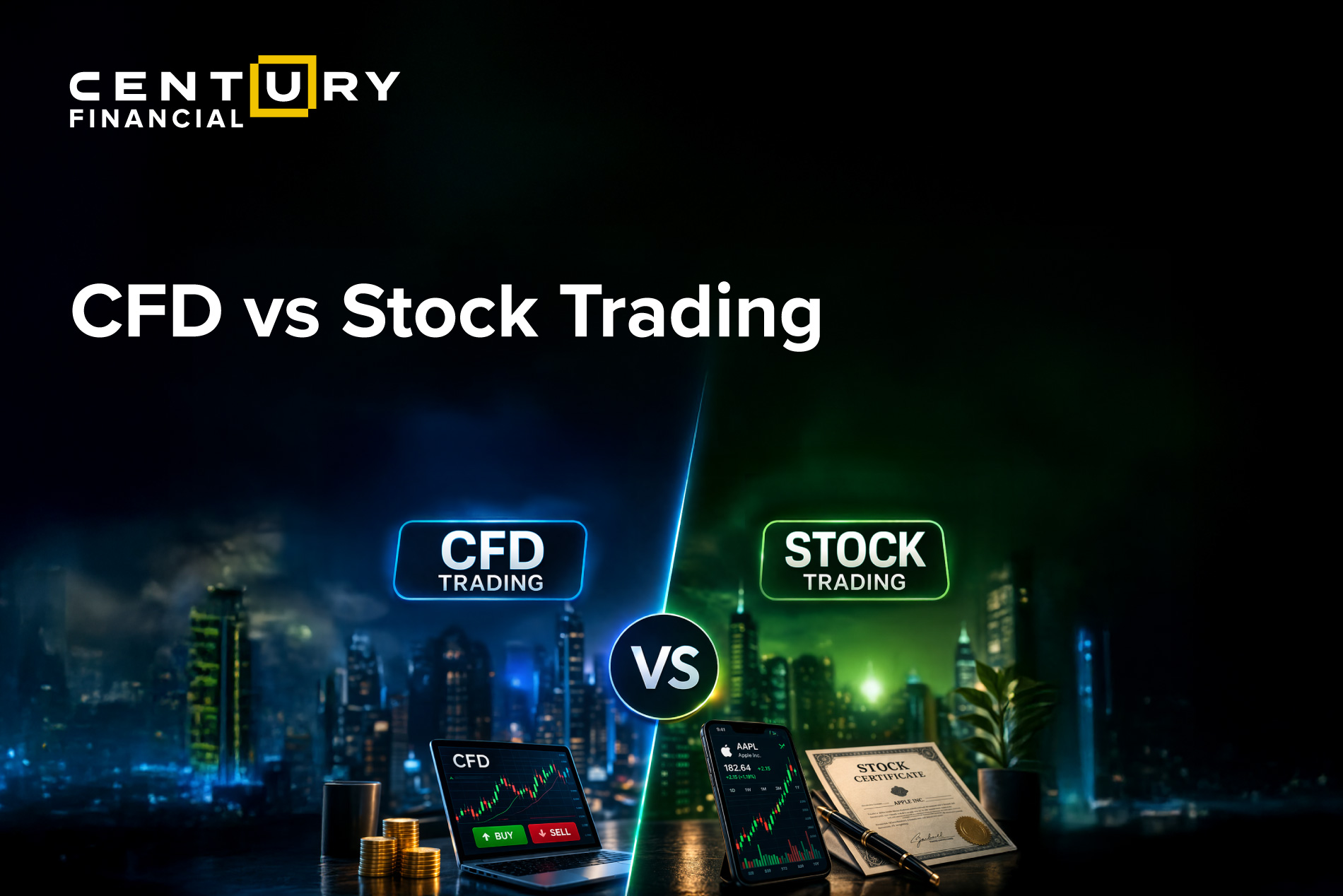
Two routes exist for participating in equity markets: buying shares directly or trading derivatives, such as contracts for difference, on those shares. CFD trading vs stock trading isn't about one being universally better. Each technique serves different objectives. Ownership, leverage, costs, and regulatory treatment differ considerably between buying shares and trading contracts on those shares.
Neither strategy inherently outperforms the other across all situations. Long-term investors building retirement portfolios favor direct stock ownership. Active traders seeking leveraged short-term exposure prefer CFDs. The comparison matters because choosing the wrong instrument for your objectives creates unnecessary costs, risks, or limitations that proper selection would avoid.
What Is CFD Trading?
CFD trading involves contracts for difference, which are derivative agreements where you exchange the price difference of an underlying asset between opening and closing the contract.
When you trade a CFD on Apple stock, you don't own Apple shares. You hold a contract with your broker that tracks Apple's price movements. If Apple rises from $180 to $185, your CFD position gains $5 per share contracted. If it falls to $175, you lose $5 per share. The contract settles in cash based on the difference, hence the name.
CFD trading vs stock trading diverges primarily in ownership and leverage. This structure delivers flexibility. You can short-sell as easily as going long, and profit from falling markets without borrowing shares. The advantages of trading CFDs center on capital efficiency and flexibility, but these come with elevated risk that requires disciplined management.
What Is Equity or Stock Trading?
Equity or stock trading means buying and selling ownership stakes in publicly traded companies. When you purchase shares, you acquire partial ownership with accompanying rights and benefits.
Stock ownership provides several features that CFDs don't. You receive dividends when companies distribute profits to shareholders. You gain voting rights on corporate matters proportional to your shareholding. Your shares can be held indefinitely without rollover costs. The asset itself holds value beyond price speculation as it represents a claim on the company’s earnings and assets.
The capital requirement differs from CFDs. Buying 100 Apple shares at $180 requires $18,000. This structure limits potential losses to your invested capital and any margin debt, whereas with CFDs, leverage can result in losses exceeding your initial deposit
CFD Trading vs Stocks: Key Differences
Understanding CFD trading vs stocks calls for examining how each instrument operates across multiple dimensions. The table below outlines core distinctions.
| Feature | CFD Trading | Stock Trading |
|---|---|---|
| Ownership | No ownership; derivative contract | Direct ownership of shares |
| Leverage | High leverage available | Limited to margin lending |
| Dividends | Adjusted in contract | Receive actual dividend payments |
| Voting Rights | None | Proportional to shareholding |
| Short Selling | Easy, no borrowing required | Requires locating and borrowing shares |
| Counterparty Risk | Exposed to broker solvency | Shares held separately, protected by regulation |
Pros & Cons of CFD Trading
CFD vs stock considerations start with understanding what each instrument does well and where limitations exist. CFDs provide specific advantages alongside inherent disadvantages. Here are the pros and cons of CFD trading for deeper analysis.
Advantages
Leverage allows controlling larger positions with less capital. For example, a $5,000 account with 20:1 leverage accesses $100,000 in market exposure. This capital efficiency helps diversification across multiple positions that direct stock purchase couldn't achieve with the same funds.
When you identify bearish setups, you can short a contract and benefit from the downtrend. Execution is as straightforward as bullish trades. This two-way ease suits active trading strategies that capitalize on both rising and falling markets.
Market access goes beyond local exchanges through a single account. Trade U.S. stocks, European indices, Asian commodities, and forex pairs without multiple brokerage relationships. Trading CFDs in volatility helps capitalize on price movements across global sessions when opportunities arise.
Lower capital requirements make meaningful trading viable for smaller accounts. Rather than saving for months to buy 100 shares at full price, you can begin trading with positions sized appropriately for your capital level.
Disadvantages
The risk of trading in CFD stems largely from the same features that create advantages. Leverage amplifies losses equally with gains. A 5% adverse move on 20:1 leverage produces a 100% account loss. That’s why risk management becomes critical rather than optional in trading with leverage.
Holding costs accumulate on leveraged overnight positions. Daily financing charges indicate the borrowed capital component of leveraged positions. These costs erode profits on longer-term holds, making CFDs less suitable for buy-and-hold approaches.
Counterparty risk exists with your broker, as CFDs are contracts between you and your broker, not exchange-traded instruments. Hence, choosing a regulated broker like Century Financial, which offers fund protection and segregation, also matters.
Compared to stocks, CFDs offer no ownership benefit. You don't receive actual dividends (though some contracts adjust for them), gain voting rights, or build long-term assets.
Pros & Cons of Stock Trading
CFD vs stock analysis requires examining the strengths and weaknesses of equity trading as well. Here's a quick comparison of the advantages and disadvantages of trading in stocks.
| Aspect | Advantages | Disadvantages |
|---|---|---|
| Ownership | Asset ownership, voting rights, transferable | Higher capital required for positions |
| Dividends | Receive actual payments, reinvest for compounding | May owe taxes on dividends received |
| Leverage | Lower risk from limited leverage | Limited position sizes for smaller accounts |
| Holding Period | No daily financing charges | Opportunity cost of capital tied up |
| Tax Treatment | Favorable long-term capital gains rates | Gains taxed, though potentially at lower rates |
| Regulation | Strong investor protections, transparent | More regulatory requirements, restrictions |
Which One Should You Choose?
Selecting between instruments depends on your objectives, timeframe, and trading style. No universal answer exists; context determines fit. But here are some points to make the decision easier.
For Beginners
In CFD vs equity considerations, beginners benefit from starting with direct stock ownership in most cases because ownership is more intuitive, and leverage risks are constrained.
Share trading and investment structure forgives learning mistakes that leverage would magnify into account-eliminating losses. Starting with stock trading would help understand price movements, manage positions, and develop discipline.
Beginners should build foundational skills through trading basics before introducing leverage. Master position sizing, stop-loss placement, and risk management on unleveraged positions first. Once consistent profitability emerges, they can transition to leveraged instruments.
For Active Traders
Active traders often find CFDs better suited to their strategies. Learn CFD trading when the approach consists of frequent transactions, short-term holds, or bidirectional trading.
Capital efficiency matters for managing multiple positions simultaneously. If your strategy entails holding 10-15 positions throughout multiple markets, leverage allows meaningful exposure across all positions that a direct stock purchase couldn't achieve with typical account sizes.
Day trading and scalping clearly favor CFDs. The ability to go short easily, hold positions overnight without settlement delays, and access extended hours creates operational advantages. Transaction costs on CFDs are often lower for high-frequency trading than accumulated stock commissions and wider bid-ask spreads.
For Investors
Long-term investors building wealth favor direct stock ownership. The objective is to accumulate assets that generate returns through business performance.
Dividend reinvestment compounds returns over decades, and the tax advantages of long-term capital gains and qualified dividends create meaningful economic benefits. Building a long-term portfolio is about balance, too, so diversification into commodities, bonds, and tangible assets like real estate will also become a part of it.
CFDs can be a useful tool for hedging your long-term portfolio if bearish trends are looming. Leverage, in this case, affords a position large enough to cover the long-term portfolio exposure with limited capital requirements.
How to Trade CFDs and Stocks with Century Financial
Century Financial provides access to global equity markets through multiple pathways. Share trading online includes both direct stock ownership and CFD trading on major shares, indices, and other instruments. This flexibility lets you select the appropriate instrument for each strategy without maintaining multiple broker relationships.
Platform features support both stock and CFD trading. With options that include Century Trader, MT5, TWS, and CQG, you can access real-time quotes, charting tools, order management, and risk control functions across instrument types. Demo accounts let you test both CFDs and stocks in simulated environments before committing capital.
Risk Management Strategies
Both CFD and stock approaches require disciplined risk management, even though specific techniques vary by instrument characteristics.
Setting Stop‑Loss & Take‑Profit
Stop-loss orders limit downside on both CFDs and stocks. Place stops based on technical levels, volatility measures, or percentage-of-capital limits. Take-profit orders automate exits at target prices. Market trading hours, news, and technical factors impact the price levels of both instruments.
Position Sizing & Leverage Use
CFD vs equity position sizing follows different frameworks. For stocks, position size is typically expressed as a percentage of account value. CFD position sizing accounts for leverage amplification. Maximum available leverage tempts oversized positions. Limit leverage and keep a close eye on margins.
Demo, Practice and Backtesting
Demo accounts provide risk-free environments for testing both instruments. Practice CFD vs equity strategies before committing capital. Understanding CFD and equity trading mechanics through practice builds competence before capital is at risk. Both instruments benefit from in-depth preparation.
Conclusion
Your objectives determine the appropriate instrument. Building retirement portfolios favors stocks. Capitalizing on short-term price movements suits CFDs. Many traders use both: stocks for long-term core holdings and CFDs for active trading strategies around those positions.
The comparison matters because using the wrong instrument for your goals can lead to unnecessary costs or risks. Neither instrument guarantees success. Both require knowing market dynamics, managing risk properly, and maintaining discipline. Analyze and understand the structural differences and select instruments aligned with your trading timeframe, capital level, and goal.
FAQs
Q1. What are CFDs compared to stocks?
A: CFD vs equity differs primarily in ownership—CFDs are derivative contracts that track stock prices without ownership, while stocks represent actual company shares.
Q2: Can UAE residents trade CFDs or stocks?
A: Yes, UAE residents can trade CFDs and stocks through CMA-regulated brokers such as Century Financial. CFD trading falls under derivatives regulation, whereas direct stock trading includes access to international exchanges.
Q3: Is CFD trading riskier than stock trading?
A: CFD trading vs stock trading risk depends largely on leverage usage. CFDs with high leverage amplify losses quickly and can exceed deposits, while direct stock ownership limits losses to invested capital.
Q4. How much capital do I need for CFDs vs stocks?
A: CFDs require less capital due to leverage, while stocks require the full purchase price. However, capital is at greater risk with CFDs if leverage isn't managed properly.
Q5. Do I earn dividends when trading CFDs on shares?
A: CFD positions typically adjust for dividends through cash adjustments. These adjustments appear as account credits or debits rather than actual dividend payments.
This marketing and educational content has been created by Century Financial Consultancy LLC (“Century”) for general information only. It does not constitute investment, legal, tax, or other professional advice, nor does it constitute a recommendation, offer, or solicitation to buy or sell any financial instrument. The material does not take into account your investment objectives, financial situation, or particular needs.
The opinions expressed by the hosts, speakers, or guests are their own and may change without notice. Information is based on sources we consider to be reliable; however, Century does not guarantee its accuracy, completeness, or timeliness and accepts no liability for any loss arising from reliance on this content.
Trading and investing involve significant risk, and losses may exceed initial deposits. Past performance is not indicative of future results. CFDs and other leveraged products are complex instruments that may not be suitable for all investors. Please ensure you understand how these products work, the associated risks, and seek independent professional advice if necessary.
Century is licensed and regulated by the UAE Capital Market Authority (CMA) under License Nos. 20200000028 and 301044.
Please refer to the full risk disclosure mentioned on our website.




Regulated by CMA
Century Financial Consultancy LLC


.png)
.png)
.png)
.png)
.png)

Reach us:
-
Dubai
6th Floor, Emaar Square Building 4,
Downtown, Dubai, P.O. Box 65777,
Dubai, United Arab Emirates -
Abu Dhabi
27th Floor, Office 2701,
Shining Towers, Abu Dhabi, UAE -
Sharjah
29th Floor, Office 2905,
The Business Tower, Sharjah, UAE - +971 (4) 356 2800
- info@century.ae

Disclaimer: Trading in financial products carries substantial risk. Leveraged over-the-counter (OTC) derivatives, such as Contracts for Difference (CFDs) and spot forex, may result in losses exceeding initial deposits and may not be suitable for all investors. These complex instruments do not confer ownership of the underlying assets. Investors should carefully consider their investment objectives and risk appetite, and seek independent professional advice if necessary.
Century Financial Consultancy LLC (CFC) is licensed and regulated by the Capital Market Authority (CMA) of the UAE under license numbers 20200000028 and 301044 to carry out the activities of Financial Products dealer, Trading Broker in international markets, Trading Broker of OTC derivatives and currencies in the spot market, Introduction, Financial Consultations, and Promotion. CFC is incorporated under UAE law, registered with the Dubai Economic Department (No. 768189), with its office at 601, Level 6, Building No. 4, Emaar Square, Downtown Dubai, UAE, PO Box 65777.
The content on this website is provided solely for informational and educational purposes and does not constitute an offer, recommendation, or solicitation to buy or sell any securities or financial products.
Products and services offered by CFC are not intended for use in any jurisdiction where such use or distribution would breach local laws or regulatory requirements.
⚠️ Alert: Fraudulent Activity Notice
Century Financial Consultancy LLC (“Century”) has become aware of fraudulent individuals and entities impersonating our firm through unofficial websites, social media channels, and messaging applications such as Telegram, WhatsApp, and Discord.
Please be advised:
- Century does not manage investments on behalf of clients.
- Century does not solicit funds or guarantee investment returns.
- Century does not accept or make payments in cash, cryptocurrency, or digital assets.
- We do not conduct business via social media or messaging platforms.
Our only official website is www.century.ae, and all communication is conducted exclusively through verified channels.
We strongly urge the public to remain vigilant, verify the authenticity of any communication claiming to be from Century, and report any suspicious activity. Century disclaims any responsibility for losses arising from dealings with unauthorised or fraudulent parties.
