 Loading ...

Thursday, March 12, 2026
Hedging in the Time of Crisis: Protecting Your Real Estate Investments Amid Middle East Volatility
By Century Financial in 'Blog'
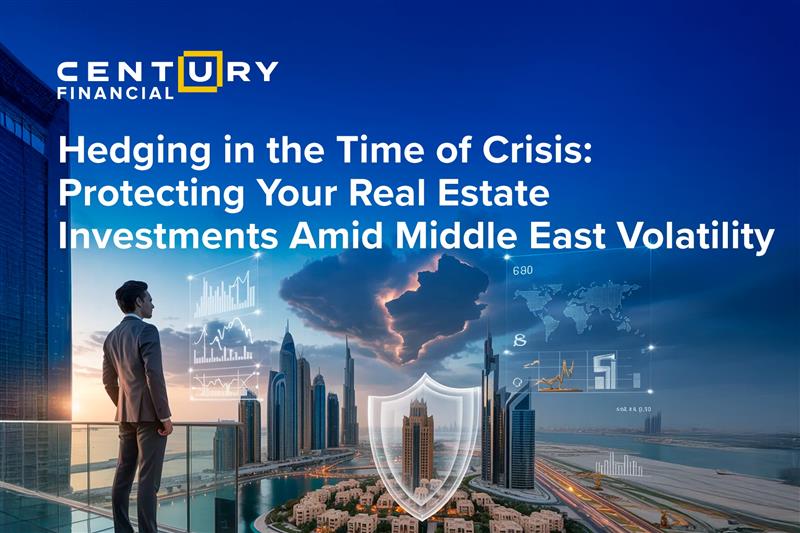

There is a particular kind of unease that sets in when a region you have invested in starts making international headlines for the wrong reasons. Markets do not wait for clarity. Prices move, sentiment shifts, and investors who were perfectly comfortable last month suddenly find themselves staring at positions they are not sure how to hold.
If your wealth is tied to Middle Eastern real estate, that feeling is familiar right now. The question worth asking is not whether volatility will come. As of March 2026, it already has. The question is whether your portfolio was built to absorb it.
The Current Landscape: Oil and Real Estate in Tension
Oil and real estate in the UAE have a long, intertwined history. The revenues from energy exports funded the infrastructure, the institutions, and the scale of development that turned Dubai into a global city. But that was then.
Today, Dubai’s property market runs on something different. Buyer demand, diversified ownership, long-term residency, and genuine end-user activity now drive the market far more than oil revenues do. That shift has made the market meaningfully more resilient than it was in 2008, when the foundations were far less stable.
That said, geopolitical tension operates differently from a financial shock. It does not undermine fundamentals directly. What it does is freeze sentiment, and sentiment is its own kind of pressure.
Real Estate: Where Caution Sets In
When conflict escalates nearby, buyers pause. Travel slows. Decision timelines stretch. Deals that were close to signing get quietly shelved until there is a clearer picture. Valuations do not necessarily collapse, but transaction volumes fall, and that has its own cost.
Regional banking stocks told part of that story in March 2026, declining 5-10% as risk premiums across the Gulf began to climb.
Oil: Where Tension Pays a Premium
The Strait of Hormuz is not a distant abstraction. It handles roughly 20% of the world’s oil supply, and any serious threat to its operations moves markets immediately. Traders call it a war premium, and it manifests quickly.
Brent Crude rose around 24.5% in the first week of March 2026, trading near $88 per barrel (as of March 10). Analysts have outlined scenarios where a sustained blockade could push prices toward $100 to $133. For investors with exposure to oil instruments, that premium is doing meaningful work while their property sits still.
Why Oil Operates as a Natural Hedge for Property Investors
When you hold a large amount of Middle Eastern real estate, your portfolio is essentially a bet on regional calm. When that calm is disrupted, the bet weakens. Oil offers a counterbalance.
The logic is straightforward. Rising geopolitical risk tends to soften property demand while pushing oil prices upward. The two move in opposite directions under the same conditions, which is exactly what you want from a hedge.
The Liquidity Difference
There is another dimension to this that matters just as much as correlation. Real estate does not move quickly. You cannot decide on a Tuesday that you want to reduce your property exposure and be done by Thursday. The process takes months, and in a distressed market, the price you accept may be far from where you started.
Oil instruments are a different story entirely. CFDs and energy ETFs, available through brokers like Century Financial, can be entered and exited within hours. When conditions are deteriorating and the window for action is narrow, that speed matters enormously.
The practical outcome is that an investor can hold their property and use oil positions to generate liquid returns that offset whatever stagnation or short-term decline is showing up on paper. Nothing needs to be sold. The underlying asset stays intact.
The Repatriation Strategy for NRI and International Investors
For non-resident Indian investors and international property holders based in Dubai, there is a currency dimension to all of this that often goes underappreciated.
When global instability rises, the US Dollar tends to strengthen. Because the AED is pegged to the Dollar, gains held in Dubai retain their dollar-denominated value even while other regional assets soften. When those gains are eventually repatriated to India, a stronger Dollar-to-Rupee exchange rate means more local currency arriving at the other end than would have been the case during calmer times.
An investor who hedges in oil, realises gains in AED, and converts to INR at the right moment is compounding the advantage of the crisis period rather than absorbing its downside.
The catch, and it is an important one, is timing. Currency windows do not stay open indefinitely. Once markets fully price in a prolonged conflict, the opportunity narrows. This is a strategy that rewards preparation, not reaction.
Constructing a Resilient Crisis Portfolio: Beyond Oil
Oil is the most reactive and direct hedge available in a Middle East crisis scenario. But leaning on a single instrument is its own form of vulnerability. A genuinely resilient crisis portfolio spreads its protection across several assets, each doing a different job.
| Asset Class | Role in a Crisis | Why It Matters |
|---|---|---|
| Gold | Safe Haven | Gold rose around 2.5% in the same week that equities and regional banking stocks fell. It has served as the world’s primary fear hedge for centuries, and that function has not changed. |
| US Treasuries | Capital Preservation | When institutions panic, they move into US government debt. Short-duration Treasuries offer individual investors a stable anchor without locking up capital for years. |
| Defense Stocks | Tactical Growth | Escalating conflict translates directly into order books for global aerospace and defense firms. These equities often rise precisely when broader markets are retreating. |
| USD/INR Position | Currency Protection | Maintaining exposure to USD against INR ensures that purchasing power in India remains intact even as the Rupee softens under global risk-off pressure. |
The Cost of Emotional Liquidation
There is a predictable arc to how investors behave during prolonged uncertainty. Confidence erodes. The paper losses start to feel permanent. And the temptation to sell, to just get out and stop watching, grows stronger by the week.
It is worth being clear about what that decision actually costs. Selling real estate at a discount during a temporary crisis is not a recovery strategy. The loss is real, the asset is gone, and any subsequent rebound benefits the buyer. The original investor is left with less capital and no position.
Tactical hedging is a way of enduring the uncertainty without making that trade. By maintaining core property holdings while opening positions in oil, precious metals, and defensive equities, an investor can offset the financial pressure of the crisis period without surrendering anything permanent.
The goal here is not to profit from instability. It is to protect what you have built from decisions that feel rational under pressure but carry consequences that outlast the crisis itself.
Conclusion: Steadiness Over Reaction
Crises do not follow a schedule, and they rarely resolve cleanly. They stretch, they escalate, they pause and then resume. The investors who come through them in the best shape are rarely those who moved the fastest. They are the ones who thought through the scenarios in advance and had a structure in place before conditions deteriorated.
Dubai’s property market has proven, more than once, that it can absorb regional shocks without losing its underlying value. The wealth that gets eroded in these moments tends to disappear not because of the crisis itself, but because of the decisions made in its shadow: the panicked sale, the ignored currency exposure, the portfolio with no hedge and no plan.
The instruments discussed in this piece are not exotic. Used proportionately and with proper guidance, they serve a single, modest purpose: keeping your financial position intact long enough for stability to return.
It always has. The task is to still be standing when it does.
Elevate your
trading experience with
Century Trader App
Elevate your trading
experience with
Century Trader App

Frequently Asked Questions
Q1. Why is oil considered a natural hedge for Middle Eastern real estate?
A: When geopolitical risk rises in the region, property demand tends to soften while oil prices climb in response to supply concerns. Because they typically move in opposite directions under the same crisis conditions, oil instruments provide a built-in counterbalance to property exposure.
Q2: How significant is the Strait of Hormuz to global oil prices?
A: The Strait carries around 20% of the world’s oil supply. A credible threat to its operation is enough to trigger an immediate upward repricing in energy markets globally, reflecting the risk of tighter supply reaching consumers.
Q3: What are oil CFDs, and who are they suitable for?
A: A CFD, or contract for difference, lets investors gain exposure to oil price movements without owning physical barrels. They work well for investors who want liquid, short-term positions, though they carry leverage risk and are best approached with professional guidance.
Q4. How does currency hedging benefit NRI investors during a crisis?
A: The Dollar typically strengthens during global instability, and since the AED is pegged to it, Dubai-based gains hold their value. When those funds are converted to INR on repatriation, a stronger exchange rate means more Rupees received, effectively amplifying purchasing power in India.
Q5. How quickly can oil instruments be traded compared to property?
A: CFDs and energy ETFs can be entered or exited within minutes on a liquid platform. Selling a Dubai property, even under favourable conditions, typically takes weeks to months. That gap in response time is a significant practical advantage when markets are moving fast.
This marketing and educational content has been created by Century Financial Consultancy LLC (“Century”) for general information only. It does not constitute investment, legal, tax, or other professional advice, nor does it constitute a recommendation, offer, or solicitation to buy or sell any financial instrument. The material does not take into account your investment objectives, financial situation, or particular needs.
The opinions expressed by the hosts, speakers, or guests are their own and may change without notice. Information is based on sources we consider to be reliable; however, Century does not guarantee its accuracy, completeness, or timeliness and accepts no liability for any loss arising from reliance on this content.
Trading and investing involve significant risk, and losses may exceed initial deposits. Past performance is not indicative of future results. CFDs and other leveraged products are complex instruments that may not be suitable for all investors. Please ensure you understand how these products work, the associated risks, and seek independent professional advice if necessary.
Century is licensed and regulated by the UAE Capital Market Authority (CMA) under License Nos. 20200000028 and 301044.
Please refer to the full risk disclosure mentioned on our website.


Regulated by CMA
Century Financial Consultancy LLC


.png)
.png)
.png)
.png)

Reach us:
-
Dubai
6th Floor, Emaar Square Building 4,
Downtown, Dubai, P.O. Box 65777,
Dubai, United Arab Emirates -
Abu Dhabi
27th Floor, Office 2701,
Shining Towers, Abu Dhabi, UAE -
Sharjah
29th Floor, Office 2905,
The Business Tower, Sharjah, UAE - +971 (4) 356 2800
- info@century.ae
Disclaimer: Trading in financial products carries substantial risk. Leveraged over-the-counter (OTC) derivatives, such as Contracts for Difference (CFDs) and spot forex, may result in losses exceeding initial deposits and may not be suitable for all investors. These complex instruments do not confer ownership of the underlying assets. Investors should carefully consider their investment objectives and risk appetite, and seek independent professional advice if necessary.
Century Financial Consultancy LLC (CFC) is licensed and regulated by the Capital Market Authority (CMA) of the UAE under license numbers 20200000028 and 301044 to carry out the activities of Financial Products dealer, Trading Broker in international markets, Trading Broker of OTC derivatives and currencies in the spot market, Introduction, Financial Consultations, and Promotion. CFC is incorporated under UAE law, registered with the Dubai Economic Department (No. 768189), with its office at 601, Level 6, Building No. 4, Emaar Square, Downtown Dubai, UAE, PO Box 65777.
The content on this website is provided solely for informational and educational purposes and does not constitute an offer, recommendation, or solicitation to buy or sell any securities or financial products.
Products and services offered by CFC are not intended for use in any jurisdiction where such use or distribution would breach local laws or regulatory requirements.
⚠️ Alert: Fraudulent Activity Notice
Century Financial Consultancy LLC (“Century”) has become aware of fraudulent individuals and entities impersonating our firm through unofficial websites, social media channels, and messaging applications such as Telegram, WhatsApp, and Discord.
Please be advised:
- Century does not manage investments on behalf of clients.
- Century does not solicit funds or guarantee investment returns.
- Century does not accept or make payments in cash, cryptocurrency, or digital assets.
- We do not conduct business via social media or messaging platforms.
Our only official website is www.century.ae, and all communication is conducted exclusively through verified channels.
We strongly urge the public to remain vigilant, verify the authenticity of any communication claiming to be from Century, and report any suspicious activity. Century disclaims any responsibility for losses arising from dealings with unauthorised or fraudulent parties.
