 Loading ...

Thursday, March 26, 2026
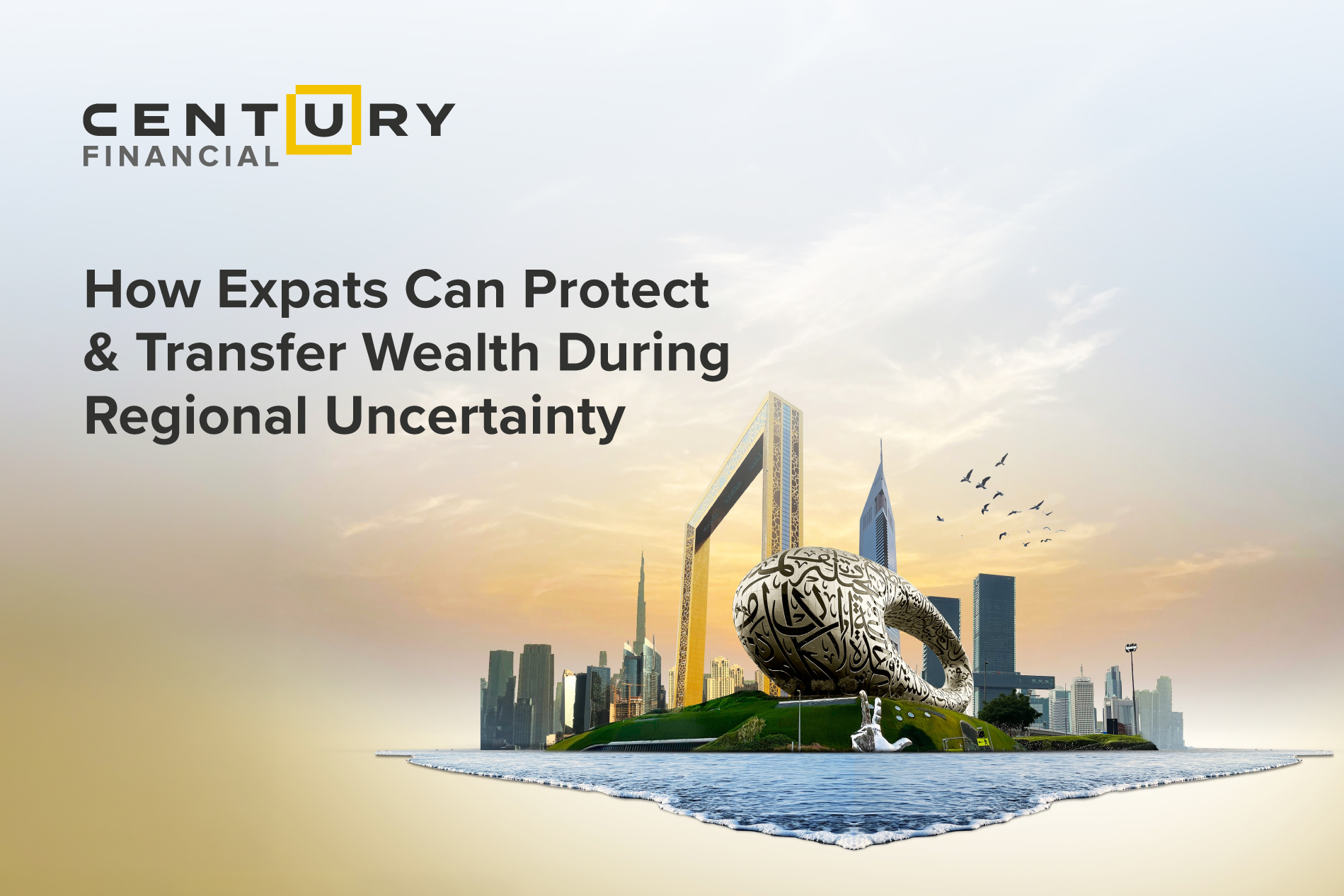
How Expats Can Protect & Transfer Wealth During Regional Uncertainty
By Century Financial in 'Blog'
.jpg)
Introduction
Decades of deliberate infrastructure, regulatory strength, and economic vision have made the UAE home to millions of expatriates who came here with ambition and built something real. What moments of regional uncertainty do, however, is invite a useful question: is the wealth you've built here portable?
For most expats, the honest answer is 'partially.' A salary, savings, maybe a property—all real assets, built through real effort, all tied to the same economy. The goal of this guide isn't to suggest that any of that is at risk. It's to show you how a few deliberate structural choices can make your wealth genuinely follow you, wherever your life leads next. Accessible from anywhere, transferable on your terms, and built to last beyond crisis in any single geography.
Wealth Concerns for an Expat
Living and working in the UAE comes with genuine financial advantages. Low taxes. Strong salaries. A relatively stable, dollar-pegged currency. A financial infrastructure that has, for decades, functioned like clockwork.
Here, the problem isn't the UAE itself but the structure.
The Concentration Risk Problem
Concentration risk refers to the danger of having too much of your financial exposure tied to a single geography, asset class, or institution. For expats in the Gulf, concentration risk tends to look like this: a salary paid into a local bank account, savings sitting in that same account, a property investment in Dubai or Abu Dhabi, and a pension or DEWS (End of Service Benefit) that can only be accessed at departure. Together, they create a portfolio that is deeply illiquid the moment travel, banking access, or property markets are disrupted.
Historical Wake-Up Calls
Regional disruption affecting expat wealth isn't theoretical. It has happened before, and the patterns are worth understanding.
Kuwait 1990
When Iraq invaded Kuwait in August 1990, approximately hundreds of thousands of expatriates were living and working in the country. Many had significant savings in Kuwaiti banks, property interests, and employment contracts. Within days, access to banking was severely disrupted. The Kuwaiti dinar briefly became non-convertible.
Lebanon 2019-2020
Lebanon's financial crisis starting in late 2019 offers a more prolonged version of the same lesson. Banks imposed informal capital controls, limiting withdrawals to a few hundred dollars per week regardless of account balances. Expats and locals alike watched savings become functionally inaccessible overnight. Property values collapsed in dollar terms. This wasn't a war scenario, just a financial system failure, but the mechanism of wealth becoming stranded was identical.
COVID-19 Evacuation Flights
Hundreds of thousands of expats across the Gulf were retrenched and, in many cases, had to leave quickly. End-of-service gratuities were delayed or disputed. Savings held in local bank accounts were accessible but not always easily transferable internationally. Properties couldn't be sold on a two-week timeline.
Making Wealth Portable
Wealth portability isn't about moving money out of the UAE. It's about ensuring that a meaningful portion of your wealth can be accessed, transferred, or liquidated from anywhere, in any condition. That requires thinking about your portfolio differently from how most of us are taught to think about saving.
Why Traditional Solutions Don't Work
The instinct during periods of uncertainty is to reach for familiar, tangible things—cash, gold, property, a trusted local bank—but in practice, each of these "solutions" might weaken in crisis scenarios.
Physical Cash
Holding cash feels safe, but large cash holdings depreciate through inflation. Not to forget, they create security risks if held physically. They face currency conversion friction at borders. And in a genuine emergency, exchange offices and airport counters apply higher rates during crises. Though modest emergency reserves are essential, as a primary wealth protection strategy, cash falls short.
Physical Gold
Gold is a genuine store of value, and we'll discuss the gold solution in depth later. Physical gold, specifically, is the problematic version. Bars and coins must be stored securely, insured, and transported; customs declarations are required in airports. Liquidity at the other end depends entirely on who is buying and at what spreads.
Local Bank Accounts
Local savings accounts are your primary access to daily liquidity, and that role is irreplaceable. But when Iran threatened Gulf banking interests, major international banks moved staff to remote operations almost immediately. Even if the banks themselves remained functional, the psychological signal was clear: physical banking infrastructure in a crisis zone is not the same as safe, accessible wealth. Regulatory capital controls, transfer limits, or simply bank closures can all intervene between your account balance and your actual access to funds.
Real Estate
Selling property under pressure, in a market where risk sentiment has shifted, means accepting discounts. JPMorgan analysts, in the wake of the current conflict, cut their growth forecasts for non-oil sectors by 2.3 percentage points for the UAE, the steepest revision in the GCC. Property in a risk-elevated environment doesn't disappear, but it becomes harder to exit on your terms.
What Expats Actually Need
What the above reveals is a gap between the assets most expats hold and the qualities those assets need to have under stress. The missing qualities are cross-border transferability, digital liquidity, and value stability during regional uncertainty.
Paper Gold As Mobile Wealth
What is Paper Gold?
Paper gold refers to financial instruments that track the price of gold without requiring you to hold the physical metal. The most common forms are gold ETFs (Exchange Traded Funds), gold CFDs (Contracts for Difference), and gold futures. When you hold a position in paper gold, your exposure to gold's price movement is real without the risk that physical gold brings. This distinction, which sounds technical, turns out to be enormously practical for expats.
Why Paper Gold is a Good Solution
Gold has historically functioned as a safe-haven asset during periods of geopolitical uncertainty. Gold is denominated in USD globally, is recognized across all markets, and tends to appreciate when regional risk sentiment deteriorates. During the current Gulf conflict, gold prices have reflected exactly this dynamic, with investors rotating toward the metal as equities and regional assets faced pressure.
Paper gold captures this appreciation without the logistical burden of physical ownership. You can open a position, hold it across any time horizon, and close it from anywhere in the world. There are no customs declarations, no storage fees per kilogram, no spread charged by a coin dealer. For an expat whose wealth protection strategy needs to be executable from Bangalore, Lagos, or London at short notice, the accessibility advantage is significant.
Century Financial’s platforms, including MT5, TWS, CQG, and the Century Trader, provide direct access to gold instruments for UAE-based traders.
The Transfer Mechanism
When you close a gold position, the proceeds are credited to your trading account in USD. From there, they can be transferred to any bank account internationally, including a pre-established home country account. The entire sequence, from holding a gold position in the UAE to having USD credited to an overseas bank, can be executed without physically crossing a border. It is simple, but its implications for expat wealth planning are significant.
Physical vs Paper Gold
| Feature | Physical Gold | Paper Gold (ETF/CFD) |
|---|---|---|
| Storage requirement | Yes (vault or safe) | No |
| Cross-border transferability | Restricted / complex | Instant (digital) |
| Liquidity | Moderate | High |
| Transaction costs | High (dealer spreads, storage fees) | Low (brokerage commissions) |
| Price tracking | Accurate | Accurate |
| Accessible in a crisis | Difficult | Yes (platform-dependent) |
| Leverage available | No | Yes (CFDs) |
| Suitable for long-term hold | Yes | Yes (ETFs) / Limited (CFDs) |
Oil As a Strategic Hedge
The Real Estate Correlation Problem
Here's something most UAE expats haven't mapped out explicitly: their UAE property value is meaningfully correlated with oil prices. The UAE economy, despite years of diversification, remains oil-anchored at a structural level. Hydrocarbon exports remain the foundation of GCC government budgets. When oil revenues fall or regional risk rises, real estate sentiment shakes.
This means an expat with significant property exposure in the UAE is, effectively, also long on oil-driven regional stability. In a crisis, it means two of your largest assets, your property and your employment stability, both correlate with the same risk factor.
Why Oil CFDs Act as a Natural Hedge
Oil CFDs (Contracts for Difference on crude oil, typically WTI or Brent) allow you to take a position on oil prices without owning physical barrels. A long position in oil CFDs gains value when oil prices rise. A short position gains when they fall. For an expat with UAE property, the logical hedge is a long oil position held in a trading account.
If regional instability deepens and oil supply is disrupted through mechanisms like Strait of Hormuz disruption, oil prices typically rise sharply. Your property may face short-term pressure, but your oil CFD position would be appreciating, partially offsetting the impact.
The Hedging Logic
Think of it this way. If stability holds, your property retains value and your oil position is a modest cost. If a crisis deepens and oil spikes, your CFD gains help offset property illiquidity or income disruption. You're not betting on a particular outcome. You're insuring against the one that hurts you most.
Transferability Advantage
Like paper gold, oil CFD proceeds are digital and internationally transferable. When you close a position, funds return to your trading account, and the same transfer pathway applies. Oil CFDs, used in this context, are not just a hedge on your property but a second channel for moving value across borders without physical constraints.
Home Country Bank Account Setup
Setting Up Before You Need It
A home country bank account, established and operational while you are still comfortably resident in the UAE, is the destination endpoint for any international transfer. Setting up a bank account remotely, or after a crisis has begun, is genuinely difficult. Banks require identity verification, local address confirmation, and often in-person visits. Doing this under pressure, after a disruption has already occurred, is not the optimal time to attempt it.
Establish a home country bank account now and keep it active with periodic transfers so the account doesn't go dormant. Also, ensure you have online banking access, international wire transfer capability, and debit card functionality.
Required Information for Transfers
For an international wire transfer from a UAE trading or bank account to an overseas account, you will typically need:
The Complete Transfer Workflow
When you need to move wealth internationally in a high-uncertainty environment, the sequence works as follows:
Step 1 – Position Closure: Close your paper gold or oil CFD positions via your trading platform (Century Trader App, MT5, or equivalent). Proceeds settle to your trading account, typically within T+1 to T+2 business days.
Step 2 – Account Transfer: Initiate a transfer from your trading account to your UAE bank account if required, or directly to your international beneficiary account if the brokerage supports international wires.
Step 3 – International Wire: From your UAE bank (or directly from the brokerage), initiate an international wire transfer to your pre-established home country account. Processing typically takes one to three business days for major corridors.
Step 4 – Receipt and Deployment: Funds arrive in your home country account in USD or convert to local currency. From here, they can be reinvested, held, or used as needed.
Portfolio Allocation Framework
No single allocation fits every expat situation. The key principle is that your "crisis-accessible" assets should be enough to cover relocation costs, immediate living expenses for three to six months, and a buffer while your longer-term assets normalize or are liquidated in an orderly fashion.
| Allocation | Asset | Purpose |
|---|---|---|
| 10–15% of liquid wealth | Paper gold (ETF or long CFD) | Safe-haven, transferable store of value |
| 5–10% of property value | Long oil CFDs | Hedge on UAE real estate correlation |
| 3–6 months expenses | Home country bank account | Operational liquidity, transfer endpoint |
| Core | Diversified multi-asset portfolio | Long-term growth (equities, ETFs, treasuries) |
| Emergency | UAE cash savings (local bank) | Immediate local access |
Elevate your trading experience with
Century Trader App
Elevate your trading experience with
Century Trader App

Risk and Compliance
CFDs carry leverage risk, therefore position sizing matters. A leveraged position can lose more than the initial margin if not managed properly. The oil and gold positions described are framed as hedges with a defined, limited size relative to your overall portfolio.
Tax obligations vary by home country. Some countries tax investment gains on global assets regardless of where you live. Check your home country's tax treatment of offshore trading accounts and gains before implementing this framework.
Trading platforms require regulatory authorization. Century Financial is licensed and regulated by the CMA. Operating through a regulated broker ensures your funds are held with proper segregation and oversight. This is non-negotiable when selecting a platform for wealth protection purposes.
Currency risk should be taken into account. If your home country's currency is not USD, converting proceeds at the time of transfer exposes you to exchange rate movements. This may be appropriate (if your liabilities in your home country are in local currency) or a consideration to manage (if you want to preserve USD value).
Conclusion
In just a couple of weeks, the current regional conflict has delivered a severe economic blow to the Gulf's largest economies, crippling aviation, tourism, ports and logistics networks. That's a headline about macro systems—behind it are millions of individuals, many of them expats, who built lives here and are now quietly asking the same question: am I prepared?
Building portability into your wealth structure doesn't require moving money offshore or abandoning your UAE life. It requires a disciplined allocation toward assets that travel well: paper gold for its safe-haven value and digital transferability, oil CFDs as a natural hedge on the UAE's economic foundations, and a pre-established home country banking infrastructure as the operational backbone.
The expats who navigate regional uncertainty best aren't the ones who predicted it. They're the ones who had a plan that worked regardless of what happened.
FAQs
Q1. How much of my portfolio should I allocate to this mobile hedge?
A: A useful starting point is ensuring that 15 to 25 percent of your total liquid wealth is held in assets that can be transferred internationally within five business days. Within that, the split between paper gold, oil CFDs, and cash equivalents will depend on your risk comfort.
Q2: Is hedging only for crisis scenarios, or can I use this for regular transfers home?
A: Not at all. The same framework that protects you in a crisis also works as a routine transfer mechanism. Many expats use paper gold and other liquid instruments to accumulate value. The portability advantage applies in every scenario, not just emergencies.
Q3: Do I need to sell everything in my host country during a regional crisis?
A: No. The goal is not full liquidation. It's having enough portable, accessible wealth to remain financially stable while your larger, less liquid assets, like property, are managed and eventually exited on reasonable terms.
Q4. What is paper gold?
A: Paper gold refers to financial instruments that provide exposure to gold's price movements without requiring physical ownership of the metal. Gold ETFs and gold CFDs are the most common forms. They trade on exchanges or through brokers, settle digitally, and can be liquidated from anywhere with internet access.
Q5. What if I don't own real estate? Should I still hold oil CFDs?
A: The oil CFD hedge is most directly relevant for expats with UAE property, because that's where the correlation to oil-driven regional stability is strongest. Without property exposure, the case is less direct but not absent. If your employment and income depend on the UAE's broader economic activity, a modest long oil position can still function as a partial hedge on your income stream's stability.
This marketing and educational content has been created by Century Financial Consultancy LLC (“Century”) for general information only. It does not constitute investment, legal, tax, or other professional advice, nor does it constitute a recommendation, offer, or solicitation to buy or sell any financial instrument. The material does not take into account your investment objectives, financial situation, or particular needs.
The opinions expressed by the hosts, speakers, or guests are their own and may change without notice. Information is based on sources we consider to be reliable; however, Century does not guarantee its accuracy, completeness, or timeliness and accepts no liability for any loss arising from reliance on this content.
Trading and investing involve significant risk, and losses may exceed initial deposits. Past performance is not indicative of future results. CFDs and other leveraged products are complex instruments that may not be suitable for all investors. Please ensure you understand how these products work, the associated risks, and seek independent professional advice if necessary.
Century is licensed and regulated by the UAE Capital Market Authority (CMA) under License Nos. 20200000028 and 301044.
Please refer to the full risk disclosure mentioned on our website.


Regulated by CMA
Century Financial Consultancy LLC


.png)
.png)
.png)
.png)

Reach us:
-
Dubai
6th Floor, Emaar Square Building 4,
Downtown, Dubai, P.O. Box 65777,
Dubai, United Arab Emirates -
Abu Dhabi
27th Floor, Office 2701,
Shining Towers, Abu Dhabi, UAE -
Sharjah
29th Floor, Office 2905,
The Business Tower, Sharjah, UAE - +971 (4) 356 2800
- info@century.ae
Disclaimer: Trading in financial products carries substantial risk. Leveraged over-the-counter (OTC) derivatives, such as Contracts for Difference (CFDs) and spot forex, may result in losses exceeding initial deposits and may not be suitable for all investors. These complex instruments do not confer ownership of the underlying assets. Investors should carefully consider their investment objectives and risk appetite, and seek independent professional advice if necessary.
Century Financial Consultancy LLC (CFC) is licensed and regulated by the Capital Market Authority (CMA) of the UAE under license numbers 20200000028 and 301044 to carry out the activities of Financial Products dealer, Trading Broker in international markets, Trading Broker of OTC derivatives and currencies in the spot market, Introduction, Financial Consultations, and Promotion. CFC is incorporated under UAE law, registered with the Dubai Economic Department (No. 768189), with its office at 601, Level 6, Building No. 4, Emaar Square, Downtown Dubai, UAE, PO Box 65777.
The content on this website is provided solely for informational and educational purposes and does not constitute an offer, recommendation, or solicitation to buy or sell any securities or financial products.
Products and services offered by CFC are not intended for use in any jurisdiction where such use or distribution would breach local laws or regulatory requirements.
⚠️ Alert: Fraudulent Activity Notice
Century Financial Consultancy LLC (“Century”) has become aware of fraudulent individuals and entities impersonating our firm through unofficial websites, social media channels, and messaging applications such as Telegram, WhatsApp, and Discord.
Please be advised:
- Century does not manage investments on behalf of clients.
- Century does not solicit funds or guarantee investment returns.
- Century does not accept or make payments in cash, cryptocurrency, or digital assets.
- We do not conduct business via social media or messaging platforms.
Our only official website is www.century.ae, and all communication is conducted exclusively through verified channels.
We strongly urge the public to remain vigilant, verify the authenticity of any communication claiming to be from Century, and report any suspicious activity. Century disclaims any responsibility for losses arising from dealings with unauthorised or fraudulent parties.
