 Loading ...

Thursday, May 14, 2026
Non Current Assets Explained: Meaning, Definition, and Importance
By Century Financial in 'Blog'
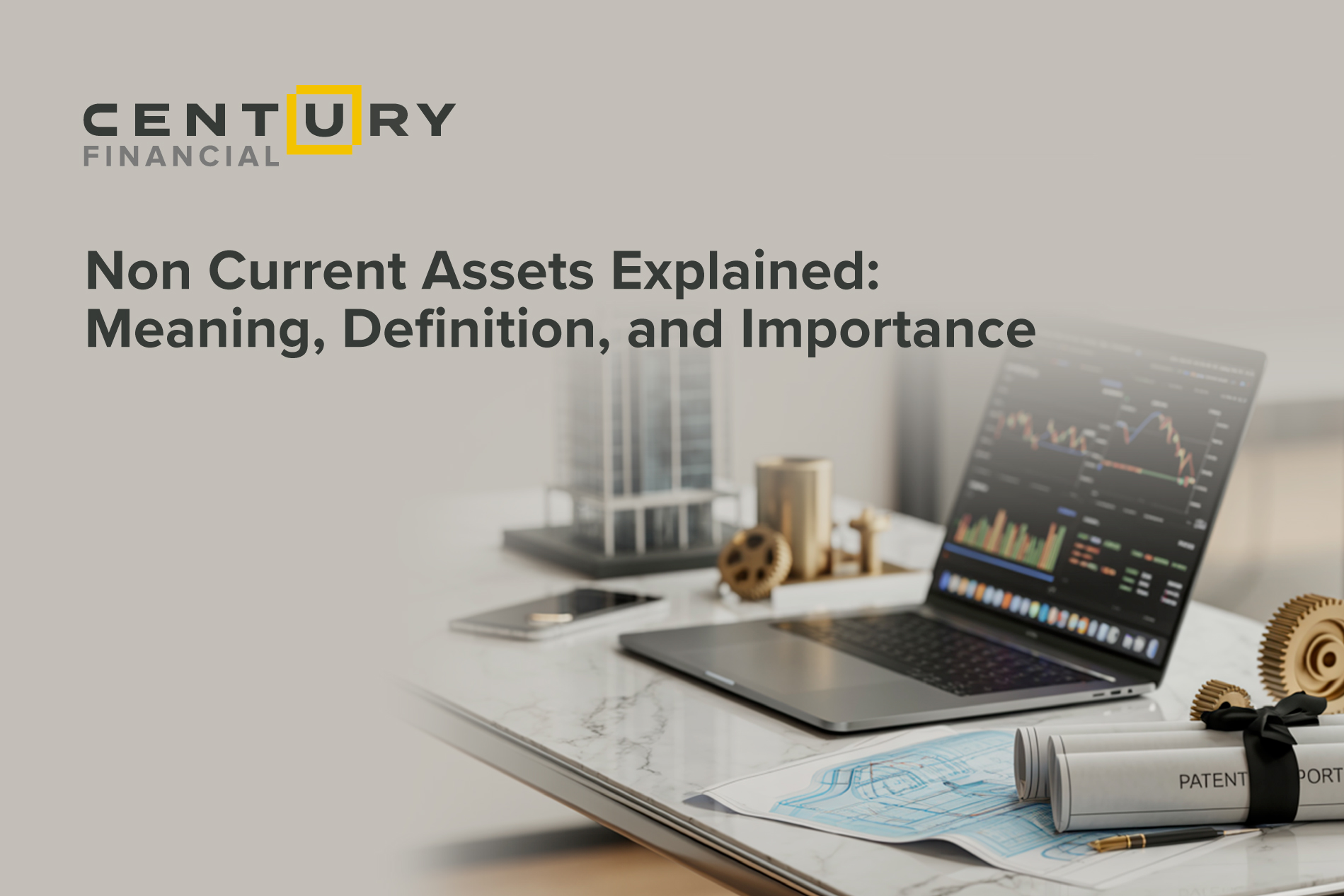

Non current assets are long-term resources owned by a business that are used to support operations and generate economic benefits over more than one accounting year. Unlike short-term assets, these assets are not meant to be sold or converted into cash in the near future and instead form the backbone of a company’s long-term financial strength.
Understanding the meaning and definition of non current assets is essential for investors, traders, and financial analysts who assess a company’s balance sheet before making decisions in the share market. Because non current assets such as property, equipment, long-term investments, and intangible assets help businesses expand, maintain competitiveness, and create sustainable revenue streams.
What Are Non Current Assets
Non current assets are long-term resources owned by a business that are not expected to be converted into cash or consumed within one accounting year. These assets play a crucial role in generating revenue over an extended period and support the company’s operational and investment activities. In simple terms, what are non current assets can be understood as assets that provide long-term economic benefits rather than short-term liquidity. Businesses rely on them to run operations, expand capacity, and maintain competitive advantage.
The non current assets meaning becomes especially important for investors, traders, and analysts who assess a company’s financial stability before participating in the share market or engaging in CFD trading.
Non Current Assets Definition and Meaning in Accounting
In accounting, these assets are acquired to support business operations, improve production capacity, or generate income over an extended period.
The meaning of non current assets in accounting goes beyond ownership. They represent a company’s long-term investment in growth and stability and are recorded on the balance sheet at their acquisition cost. Over time, their value may be adjusted through depreciation or amortization, depending on the nature of the asset. Understanding this concept helps investors and traders accurately evaluate a company’s financial position and long-term performance.
Non Current Assets Definition
These assets appear on the balance sheet under the non current section and are recorded after current assets. The non current assets definition in accounting refers to assets that:
Non Current Assets Meaning in Practical Terms
From a practical perspective, non current assets represent a company’s long-term investment in growth, infrastructure, and income generation. For CFD trading, F&O trading, analyzing stocks, etc., strong non current assets often indicate operational strength and sustainability.
In non current assets accounting, these assets are usually recorded at historical cost and adjusted for depreciation or amortization over time.
Examples of Non Current Assets
Non current assets include long-term resources that help a business operate and grow over many years. Common examples of non current assets are land, buildings, machinery, and equipment used in daily operations. They also include intangible assets such as patents, trademarks, and software.
Long-term financial holdings like non current investments in shares or bonds are part of this category. ‘Capital Work In Progress’ represents assets under construction, while deferred tax assets reflect future tax benefits. Together, these assets show a company’s long-term financial strength and investment focus.
| Asset Type | Description | Example |
|---|---|---|
| Property and equipment | Physical assets used in operations | Factory, machinery |
| Intangible assets | Non-physical assets with value | Brand name, software |
| Non current investments | Investments held for long term | Equity shares, bonds |
| Deferred tax assets | Tax benefits receivable in future | Loss carryforwards |
Non Current Assets in Balance Sheet and Accounting Treatment
Non current assets are initially recorded at their purchase cost, including expenses directly related to acquisition. Over time, their value is adjusted through depreciation or amortization, except for assets like land and certain investments.
This treatment ensures accurate reporting of asset value, profitability, and long-term business performance.
Non Current Assets in Balance Sheet
As mentioned before, non current assets in balance sheet are shown after current assets and represent the long-term capital structure of the company. Their proportion indicates how asset-intensive a business is.
Capital-heavy industries such as commodities, oil trading, and manufacturing generally show higher non current assets compared to service-based companies.
Non Current Assets Depreciation
Depreciation is a key concept in non current assets accounting. It refers to the systematic allocation of an asset’s cost over its useful life.
Common depreciation methods include:
Non Current Assets Turnover
Non current assets turnover measures how efficiently a company uses its long-term assets to generate revenue. A higher turnover ratio indicates better utilization of property, equipment, and long-term investments, which is a positive sign for operational efficiency. This ratio helps investors understand whether capital invested in non current assets is producing sufficient income.
Non Current Assets Turnover Ratio
Formula:
Operating Income ÷ Non Current Assets
Non Current vs Current Assets
| Feature | Current Assets | Non Current Assets |
|---|---|---|
| Time horizon | Short term | Long term |
| Liquidity | High | Low |
| Examples | Cash, inventory | Property, investments |
| Purpose | Working capital | Growth and stability |
Elevate your trading experience with
Century Trader App
Elevate your trading experience with
Century Trader App

Conclusion
Understanding what are non current assets is essential for anyone involved in trading, investing, or financial analysis. These assets reflect a company’s long-term vision, operational capacity, and growth strategy.
At Century Financial Services, we help traders go beyond surface-level analysis. Whether you are trading through our Trading Platform, using the Century Trader, or executing strategies on the MT5, TWS, CQG, our tools and market insights enable smarter trading across forex trading, commodities, CFD trading, and all your preferred trading strategies.
FAQs
Q1. What are non current investments?
A: Non current investments are long-term investments held by a company for strategic or income purposes rather than short-term trading.
Q2: Why are non current assets important for traders?
A: They indicate financial strength, scalability, and long-term growth potential, which is crucial when analyzing companies for share market trading.
Q3: Are non current assets always depreciated?
A: No. Assets like land and certain long-term investments are not depreciated as they do not lose value over time.
Q4. How do non current assets affect valuation?
A: They influence enterprise value, return ratios, and balance sheet strength, which are key metrics for traders and investors.
Q5. How are non current assets different from fixed assets?
A: Fixed assets are only tangible items like land and machinery, while non current assets also cover non-physical and financial resources.
This marketing and educational content has been created by Century Financial Consultancy LLC (“Century”) for general information only. It does not constitute investment, legal, tax, or other professional advice, nor does it constitute a recommendation, offer, or solicitation to buy or sell any financial instrument. The material does not take into account your investment objectives, financial situation, or particular needs.
The opinions expressed by the hosts, speakers, or guests are their own and may change without notice. Information is based on sources we consider to be reliable; however, Century does not guarantee its accuracy, completeness, or timeliness and accepts no liability for any loss arising from reliance on this content.
Trading and investing involve significant risk, and losses may exceed initial deposits. Past performance is not indicative of future results. CFDs and other leveraged products are complex instruments that may not be suitable for all investors. Please ensure you understand how these products work, the associated risks, and seek independent professional advice if necessary.
Century is licensed and regulated by the UAE Capital Market Authority (CMA) under License Nos. 20200000028 and 301044.
Please refer to the full risk disclosure mentioned on our website.




Regulated by CMA
Century Financial Consultancy LLC








Reach us:
-
Dubai
6th Floor, Emaar Square Building 4,
Downtown, Dubai, P.O. Box 65777,
Dubai, United Arab Emirates -
Abu Dhabi
27th Floor, Office 2701,
Shining Towers, Abu Dhabi, UAE -
Sharjah
29th Floor, Office 2905,
The Business Tower, Sharjah, UAE - +971 (4) 356 2800
- info@century.ae

Disclaimer: Trading in financial products carries substantial risk. Leveraged over-the-counter (OTC) derivatives, such as Contracts for Difference (CFDs) and spot forex, may result in losses exceeding initial deposits and may not be suitable for all investors. These complex instruments do not confer ownership of the underlying assets. Investors should carefully consider their investment objectives and risk appetite, and seek independent professional advice if necessary.
Century Financial Consultancy LLC (CFC) is licensed and regulated by the Capital Market Authority (CMA) of the UAE under license numbers 20200000028 and 301044 to carry out the activities of Financial Products dealer, Trading Broker in international markets, Trading Broker of OTC derivatives and currencies in the spot market, Introduction, Financial Consultations, and Promotion. CFC is incorporated under UAE law, registered with the Dubai Economic Department (No. 768189), with its office at 601, Level 6, Building No. 4, Emaar Square, Downtown Dubai, UAE, PO Box 65777.
The content on this website is provided solely for informational and educational purposes and does not constitute an offer, recommendation, or solicitation to buy or sell any securities or financial products.
Products and services offered by CFC are not intended for use in any jurisdiction where such use or distribution would breach local laws or regulatory requirements.
⚠️ Alert: Fraudulent Activity Notice
Century Financial Consultancy LLC (“Century”) has become aware of fraudulent individuals and entities impersonating our firm through unofficial websites, social media channels, and messaging applications such as Telegram, WhatsApp, and Discord.
Please be advised:
- Century does not manage investments on behalf of clients.
- Century does not solicit funds or guarantee investment returns.
- Century does not accept or make payments in cash, cryptocurrency, or digital assets.
- We do not conduct business via social media or messaging platforms.
Our only official website is www.century.ae, and all communication is conducted exclusively through verified channels.
We strongly urge the public to remain vigilant, verify the authenticity of any communication claiming to be from Century, and report any suspicious activity. Century disclaims any responsibility for losses arising from dealings with unauthorised or fraudulent parties.
