 Loading ...

Wednesday, January 28, 2026
Sinking Fund: Definition, Meaning, and How It Works in the Bonds Market
By Century Financial in 'Blog'
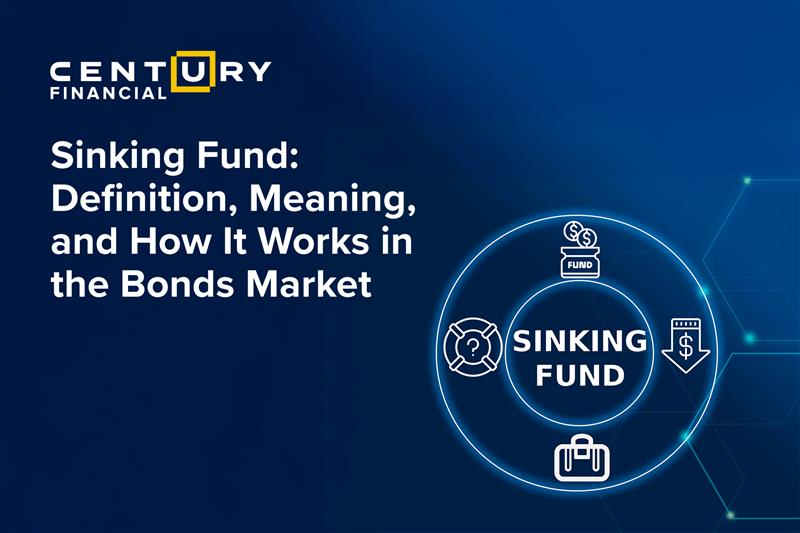

A sinking fund is a widely used financial mechanism in the bond market that reduces risk and protects investors. Whether you are a long-term bond investor or an active trader dealing in treasuries, CFDs, or fixed-income instruments, understanding how sinking funds work can help you make more informed trading decisions.
In this guide, we will break down the sinking fund definition, explain how bond sinking funds operate, explore their pros and cons, and show why they matter to traders and investors in today’s markets.
What Is a Sinking Fund?
A sinking fund is a special account of money that is a designated reserve by the issuer of a bond, which is usually a corporation or a government, that makes regular deposits into the sinking fund, which will be used to redeem a portion of the bonds.
Simply put, a sinking fund reduces the risk of default by ensuring funds are allocated to debt repayment. This mechanism provides investors with additional protection, particularly for long-term bonds where credit quality and market conditions may evolve.
Sinking Fund Definition in the Bonds Market
In the bond market, a sinking fund is an agreement in a bond indenture under which the issuer will establish a fund or redeem a specified number of bonds on a periodic schedule until maturity. By gradually amortizing the principal, the total amount of debt that must be repaid at maturity is reduced.
Sinking fund provisions are commonly found in:
- Corporate bonds
- Municipal bonds
- Treasury-linked instruments
- Asset-backed securities
Bonds that include this feature are often referred to as bond sinking fund instruments, and they are generally viewed as lower-risk options due to the added repayment discipline imposed on the issuer.
How Does a Bond Sinking Fund Work?
A bond sinking fund is established in accordance with the timeline specified in the bond prospectus or indenture. This timetable outlines how, when, and in what proportion the issuer should settle the outstanding debt before the bond's maturity date.
One common approach to meet the sinking fund requirement is to purchase outstanding bonds directly from the open market and retire them over time. In some cases, the issuer may call a portion of the bonds at a predetermined sinking fund price, reducing the total amount of debt in circulation.
Alternatively, the company or government may deposit cash into a trustee-managed sinking fund, which is then used to redeem bonds in accordance with the agreed schedule. Such activities are repeated until the bond matures or is fully retired.
Example of a Bond Sink in Action
Let’s say a company has just issued bonds worth AED 100 million with a 10-year maturity and a sinking fund provision under which 10 percent of the principal is repaid annually starting three years from issuance. In this structure, the issuer issues bonds systematically, retiring a specified number annually, resulting in lower total debt before maturity.
This progressive payment reduces the issuer's financial risk and enhances the balance sheet's stability over the long term. Trade-wise, this activity of sinking funds can affect bond prices, yield expectations, and liquidity in the secondary markets, as reduced outstanding bond supply can affect demand and pricing dynamics.
Why Investors and Traders Should Care About Sinking Funds
Due to bond valuations, yield expectations, and overall risk assessment, sinking funds have a direct impact on the fixed-income market, as these provisions govern the behavior of bonds throughout their lifecycle and their price in the secondary market by ensuring that debt is repaid at the scheduled time.
Some reasons why investors should be aware of sinking funds are:
- Lower default risk compared to non-sinking fund bonds
- Potential limits on price appreciation due to early redemption risk
- Improved issuer stability through predictable debt repayment
- Changes in bond liquidity and outstanding supply over time
For treasury, bond, and CFD traders, these factors influence market sentiment, yield spreads, and trading opportunities, making sinking fund analysis an essential component of informed decision-making.
Bond Sinking Fund vs Emergency Fund
A bond sinking fund and an emergency fund are fundamentally different, although both involve saving money for later withdrawal. A sinking fund is a legal obligation of a bond issuer to meet certain debt obligations over time. It is governed by the terms of the bond agreement and is intended to minimize credit risk among investors.
An emergency fund, on the other hand, is a personal, optional fund meant to cover unforeseen expenses or financial inconveniences. When taking on trading and investment risks, conflating these two terms can lead to misassessments, especially regarding the perceived safety, liquidity, and repayment structure of a fixed-income instrument.
Pros and Cons of Sinking Funds
Advantages of Sinking Funds
- Reduced credit risk for investors
- Improved issuer discipline and financial planning
- Greater confidence in long-term bonds
- Lower likelihood of default
These advantages often make sinking fund bonds attractive to conservative investors.
Disadvantages of Sinking Funds
- Call risk if bonds are redeemed early
- Limited upside if interest rates fall
- Reinvestment risk for investors
- Possible price suppression in secondary markets
Understanding these risks is crucial, especially when trading bonds or bond CFDs.
How Sinking Funds Impact Bond Prices and Yields
Sinking funds influence bond prices and yields because issuers are allowed to retire a portion of the bonds before maturity. As a result, investors face call and reinvestment risk, which can limit how much the bond’s price can rise. To compensate for this, bonds with sinking fund provisions may offer slightly higher yields than bonds without such features.
From a trading perspective, sinking fund activity can also affect supply in the secondary market. As the number of outstanding bonds gradually decreases, changes in availability can influence pricing and liquidity. For active traders, these shifts in supply and yield can create short-term opportunities, particularly during periods of changing interest rates or evolving credit conditions.
Trading Opportunities in the Bonds Market Using Sinking Fund Insights
Professional traders closely analyze sinking fund schedules to anticipate changes in bond supply, liquidity, and potential price movements. The gradual reduction in outstanding supply can influence demand dynamics and yield behavior in the secondary market.
Traders can more effectively time market entries and exits, evaluate yield compression or expansion, and match trading strategies with current interest rate trends and issuer credit conditions by comprehending bond sinking fund activity.
Sinking Funds vs Non-Sinking Fund Bonds: Which Is Better?
The choice between bonds with or without sinking funds depends mainly on individual trading objectives and investment strategies. Bonds with sinking fund provisions tend to suit risk-averse investors who prioritize capital protection and long-term stability.
In contrast, non-sinking fund bonds may appeal more to participants seeking higher price appreciation, as they typically carry less call risk and greater upside potential in falling interest rate environments. A well-diversified trading or investment approach often includes both types, allowing participants to adapt to changing market conditions and risk profiles.
Common Myths About Sinking Funds
A common misconception among traders is that sinking funds eliminate all forms of risk. While sinking fund provisions do help reduce default risk by ensuring planned debt repayment, they do not protect investors from other market-related risks
Interest rate risk, inflation risk, and reinvestment risk remain and can significantly affect bond prices and returns. As a result, informed traders and investors evaluate a bond's complete risk profile, including market conditions, yield dynamics, and issuer credit quality, before taking a position.
Conclusion
A sinking fund is more than a technical feature in bond agreements—it plays a critical role in risk management, pricing behavior, and overall stability in the bond market. By ensuring gradual debt repayment, sinking funds help reduce default risk and improve transparency for market participants.
For investors, sinking funds provide an additional layer of security, particularly for long-term fixed-income instruments. For traders, they provide valuable insights into bond pricing dynamics, yield movements, and supply changes in secondary markets. A clear understanding of how sinking funds operate enables more informed decision-making when trading treasuries, bonds, and fixed-income derivatives under varying market conditions.
Frequently Asked Questions About Sinking Funds
Q1. What is a sinking fund in simple terms?
A: A sinking fund is money set aside by a bond issuer to repay debt gradually over time, rather than paying the entire principal in one lump sum at maturity.
Q2: Are sinking fund bonds safer?
A: Sinking fund bonds are generally considered safer than non-sinking fund bonds because the issuer reduces outstanding debt over time. This reduces default risk and provides additional security for investors, particularly for long-term bonds.
Q3: Can sinking funds affect bond prices?
A: Yes, sinking fund provisions can affect bond prices. Early redemption and call risk may limit price appreciation, but yield levels are often adjusted to compensate investors for this risk.
Q4: Do government bonds have sinking funds?
A: Some government and municipal bonds include sinking fund provisions, depending on the issuance structure and terms. These features are more common in specific public-sector or project-linked bonds.
Q5: Can traders benefit from sinking fund analysis?
A: Absolutely. Traders analyze sinking fund schedules to anticipate changes in bond supply, liquidity, and yield behavior, helping them identify potential market movements and optimize trade timing.
Related Reads
This marketing and educational content has been created by Century Financial Consultancy LLC (“Century”) for general information only. It does not constitute investment, legal, tax, or other professional advice, nor does it constitute a recommendation, offer, or solicitation to buy or sell any financial instrument. The material does not take into account your investment objectives, financial situation, or particular needs.
The opinions expressed by the hosts, speakers, or guests are their own and may change without notice. Information is based on sources we consider to be reliable; however, Century does not guarantee its accuracy, completeness, or timeliness and accepts no liability for any loss arising from reliance on this content.
Trading and investing involve significant risk, and losses may exceed initial deposits. Past performance is not indicative of future results. CFDs and other leveraged products are complex instruments that may not be suitable for all investors. Please ensure you understand how these products work, the associated risks, and seek independent professional advice if necessary.
Century is licensed and regulated by the UAE Capital Market Authority (CMA) under License Nos. 20200000028 and 301044.
Please refer to the full risk disclosure mentioned on our website.





Regulated by CMA
Century Financial Consultancy LLC


.png)
.png)
.png)
.png)


Reach us:
-
Dubai
6th Floor, Emaar Square Building 4,
Downtown, Dubai, P.O. Box 65777,
Dubai, United Arab Emirates -
Abu Dhabi
27th Floor, Office 2701,
Shining Towers, Abu Dhabi, UAE -
Sharjah
29th Floor, Office 2905,
The Business Tower, Sharjah, UAE - +971 (4) 356 2800
- info@century.ae

Disclaimer: Trading in financial products carries substantial risk. Leveraged over-the-counter (OTC) derivatives, such as Contracts for Difference (CFDs) and spot forex, may result in losses exceeding initial deposits and may not be suitable for all investors. These complex instruments do not confer ownership of the underlying assets. Investors should carefully consider their investment objectives and risk appetite, and seek independent professional advice if necessary.
Century Financial Consultancy LLC (CFC) is licensed and regulated by the Capital Market Authority (CMA) of the UAE under license numbers 20200000028 and 301044 to carry out the activities of Financial Products dealer, Trading Broker in international markets, Trading Broker of OTC derivatives and currencies in the spot market, Introduction, Financial Consultations, and Promotion. CFC is incorporated under UAE law, registered with the Dubai Economic Department (No. 768189), with its office at 601, Level 6, Building No. 4, Emaar Square, Downtown Dubai, UAE, PO Box 65777.
The content on this website is provided solely for informational and educational purposes and does not constitute an offer, recommendation, or solicitation to buy or sell any securities or financial products.
Products and services offered by CFC are not intended for use in any jurisdiction where such use or distribution would breach local laws or regulatory requirements.
⚠️ Alert: Fraudulent Activity Notice
Century Financial Consultancy LLC (“Century”) has become aware of fraudulent individuals and entities impersonating our firm through unofficial websites, social media channels, and messaging applications such as Telegram, WhatsApp, and Discord.
Please be advised:
- Century does not manage investments on behalf of clients.
- Century does not solicit funds or guarantee investment returns.
- Century does not accept or make payments in cash, cryptocurrency, or digital assets.
- We do not conduct business via social media or messaging platforms.
Our only official website is www.century.ae, and all communication is conducted exclusively through verified channels.
We strongly urge the public to remain vigilant, verify the authenticity of any communication claiming to be from Century, and report any suspicious activity. Century disclaims any responsibility for losses arising from dealings with unauthorised or fraudulent parties.
