 Loading ...

Tuesday, December 30, 2025
Stock Split: Meaning, Types, Examples (Complete Guide for Beginners and Traders)
By Century Financial in 'Blog'
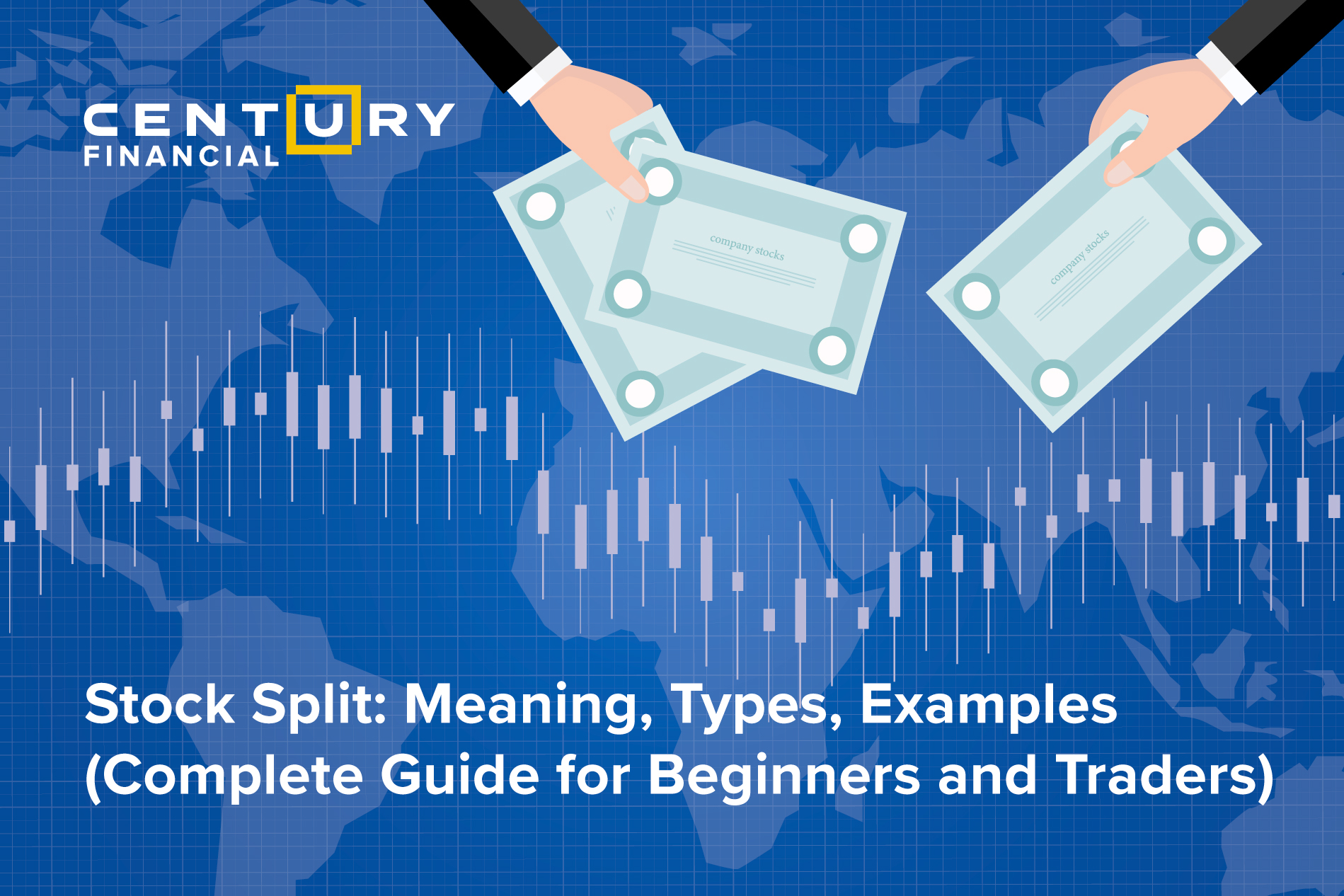

A stock split is a corporate action in which a company issues additional shares to existing shareholders while reducing the per-share price proportionately. Still, it does not change the company’s overall market capitalization. Since the total market value remains constant, understanding this helps traders see that stock splits mainly affect share price and liquidity without altering the company’s value.
Stock splits are common among growing companies whose share prices have risen significantly over time. Understanding how stock splits work, the different types, such as forward split and reverse split, and how they affect investors can help traders make informed decisions. In this guide, you’ll learn why companies split their shares, real-world examples, and how stock splits affect your portfolio and market sentiment.
What Is a Stock Split?
As mentioned, a stock split is a corporate action in which a company increases the number of shares outstanding without further liquidation. Existing shareholders will see an increased quantity in their holdings without any additional investment.
For example, in a 2-for-1 stock split, every shareholder receives one additional share for each share they already own, but the stock price is halved. The overall investment value remains unchanged.
This split shares meaning is crucial for traders seeking deeper market liquidity, easier entry points, and more trading opportunities.
Why Do Companies Do Stock Splits?
Companies typically announce a share split when their stock price becomes too high, making it less affordable for retail investors. A lower price improves liquidity and encourages greater trader participation.
Additionally, a split signals strong corporate confidence. Growing companies often use stock splits to reflect long-term performance and broaden their investor base.
This makes stock splits an essential indicator for active traders tracking corporate actions.
How a Stock Split Works
Here’s a simple breakdown of how a stock split operates:
Although the number of shares increases, the market capitalization remains unchanged. Stock splits only modify the number of shares and the per-share price, not the company’s value.
Common Types of Stock Splits
Companies can use different ratios depending on their goals. The most common types include:
2-for-1 Stock Split
If a stock trades at 200, after a 2-for-1 split, the price per share is 100, and each shareholder now owns twice as many shares. This maintains value while improving liquidity.
3-for-1 and 5-for-1 Splits
Companies with strong price growth often adopt larger split ratios to maintain stock price attractiveness to retail investors. These splits allow investors to acquire more shares at a lower price, thereby increasing trading volume.
Fractional Stock Splits
Some companies offer fractional shares after splits for users holding odd numbers of shares. This ensures every investor receives the correct proportion; even small traders benefit from such actions.
Reverse Stock Split: Meaning and Purpose
A reverse stock split (also called a reverse split) is the opposite of a normal stock split. Here, companies reduce the number of shares while increasing the share price proportionately.
Example: In a 1-for-10 reverse stock split, ten shares are combined into one new share. If the pre-split price was 5, the new price becomes 50.
Companies usually implement reverse splits for reasons such as:
Reverse splits do not always indicate poor performance. Sometimes, firms use a reverse stock split to restructure and strengthen their market position.
Stock Split vs Reverse Stock Split
Here are some notable differences between a stock split and a reverse stock split:
| Feature | Stock Split | Reverse Stock Split |
|---|---|---|
| Share Count | Increases | Decreases |
| Price Per Share | Decreases | Increases |
| Market Cap | Unchanged | Unchanged |
| Market Signal | Growth, confidence | Restructuring, compliance |
| Liquidity | Increases | Often decreases |
Both actions adjust the share price without affecting the company’s intrinsic value. Traders must focus on how liquidity and market sentiment shift after these actions.
Advantages of a Stock Split for Investors
Stock splits provide several benefits to retail and active traders:
Improved Affordability
A lower share price makes the stock accessible to more investors. New traders can purchase additional units without incurring substantial capital requirements.

Better Liquidity and Lower Bid-Ask Spreads
With more shares available, trading activity increases. This can reduce spreads and help traders open and close positions more efficiently.

Improved Market Sentiment
Companies usually perform splits when they expect continued growth. Splits can attract new investors and uplift confidence.

Enhanced Portfolio Flexibility
Owning more shares after a split allows traders to trim or diversify their portfolios more easily.

How Stock Splits Affect Trading Strategies
Right after a split, trading volume typically rises. Some traders attempt to capture volatility during this period to profit from market reactions.
For long-term investors, stock splits are usually a positive sign that the company is growing and seeks broader participation.
Options contracts are adjusted automatically during splits. Strike prices, contract sizes, and premium values change to maintain fairness. Understanding these adjustments is essential for derivatives traders.
Real-world Examples of Stock Splits
Many global companies use stock splits to attract investors:

Apple has split its shares multiple times, including a notable 4-for-1 split in 2020.

Tesla announced a 5-for-1 split in 2020 and another 3-for-1 split in 2022.

Amazon introduced a 20-for-1 stock split in 2022 to improve affordability for retail investors.
How to Identify Upcoming Stock Splits
Investors can track upcoming stock splits through:
On Century Trader, MT5, CQG, and TWS platforms, traders can easily monitor corporate actions across currencies, shares, commodities, indices, treasuries, and CFDs.
Conclusion
A stock split is an important corporate action that increases the number of outstanding shares while proportionally reducing the share price. Although it doesn’t directly change a company’s value, it improves liquidity, accessibility, and market sentiment.
Understanding stock splits, share splits, and reverse stock splits helps traders make informed decisions and capitalize on post-split price movements.
Elevate your trading experience with
Century Trader App
Elevate your trading experience with
Century Trader App

Whether you are a beginner or an advanced trader, having a reliable platform is essential for tracking market events.
FAQs
Q1. What is the meaning of split shares?
A: Split shares meaning refer to a corporate action where a company increases the number of its shares while proportionately reducing the share price. The total investment value remains unchanged.
Q2: Does a stock split affect my ownership?
A: No. A stock split doesn’t change your ownership percentage. You simply hold more shares at a lower per-share price.
Q3: Is a reverse stock split good or bad?
A: A reverse split is neither inherently good nor bad. It depends on the company’s rationale. Some do so to avoid delisting, while others restructure to achieve greater price stability.
Q4. Can I trade during a stock split?
A: Yes. Trading continues normally, although shares may reflect adjusted prices after the effective date.
Q5. Do stock splits always increase stock prices?
A: No. A stock split does not guarantee future price appreciation. It may improve liquidity and sentiment, but fundamentals decide long-term performance.
Related Reads
This marketing and educational content has been created by Century Financial Consultancy LLC (“Century”) for general information only. It does not constitute investment, legal, tax, or other professional advice, nor does it constitute a recommendation, offer, or solicitation to buy or sell any financial instrument. The material does not take into account your investment objectives, financial situation, or particular needs.
The opinions expressed by the hosts, speakers, or guests are their own and may change without notice. Information is based on sources we consider to be reliable; however, Century does not guarantee its accuracy, completeness, or timeliness and accepts no liability for any loss arising from reliance on this content.
Trading and investing involve significant risk, and losses may exceed initial deposits. Past performance is not indicative of future results. CFDs and other leveraged products are complex instruments that may not be suitable for all investors. Please ensure you understand how these products work, the associated risks, and seek independent professional advice if necessary.
Century is licensed and regulated by the UAE Capital Market Authority (CMA) under License Nos. 20200000028 and 301044.
Please refer to the full risk disclosure mentioned on our website.



Regulated by CMA
Century Financial Consultancy LLC


.png)
.png)
.png)
.png)


Reach us:
-
Dubai
6th Floor, Emaar Square Building 4,
Downtown, Dubai, P.O. Box 65777,
Dubai, United Arab Emirates -
Abu Dhabi
27th Floor, Office 2701,
Shining Towers, Abu Dhabi, UAE -
Sharjah
29th Floor, Office 2905,
The Business Tower, Sharjah, UAE - +971 (4) 356 2800
- info@century.ae

Disclaimer: Trading in financial products carries substantial risk. Leveraged over-the-counter (OTC) derivatives, such as Contracts for Difference (CFDs) and spot forex, may result in losses exceeding initial deposits and may not be suitable for all investors. These complex instruments do not confer ownership of the underlying assets. Investors should carefully consider their investment objectives and risk appetite, and seek independent professional advice if necessary.
Century Financial Consultancy LLC (CFC) is licensed and regulated by the Capital Market Authority (CMA) of the UAE under license numbers 20200000028 and 301044 to carry out the activities of Financial Products dealer, Trading Broker in international markets, Trading Broker of OTC derivatives and currencies in the spot market, Introduction, Financial Consultations, and Promotion. CFC is incorporated under UAE law, registered with the Dubai Economic Department (No. 768189), with its office at 601, Level 6, Building No. 4, Emaar Square, Downtown Dubai, UAE, PO Box 65777.
The content on this website is provided solely for informational and educational purposes and does not constitute an offer, recommendation, or solicitation to buy or sell any securities or financial products.
Products and services offered by CFC are not intended for use in any jurisdiction where such use or distribution would breach local laws or regulatory requirements.
⚠️ Alert: Fraudulent Activity Notice
Century Financial Consultancy LLC (“Century”) has become aware of fraudulent individuals and entities impersonating our firm through unofficial websites, social media channels, and messaging applications such as Telegram, WhatsApp, and Discord.
Please be advised:
- Century does not manage investments on behalf of clients.
- Century does not solicit funds or guarantee investment returns.
- Century does not accept or make payments in cash, cryptocurrency, or digital assets.
- We do not conduct business via social media or messaging platforms.
Our only official website is www.century.ae, and all communication is conducted exclusively through verified channels.
We strongly urge the public to remain vigilant, verify the authenticity of any communication claiming to be from Century, and report any suspicious activity. Century disclaims any responsibility for losses arising from dealings with unauthorised or fraudulent parties.
