 Loading ...

Monday, March 09, 2026
Tangible Asset: Definition, Meaning, Examples and Complete Guide
By Century Financial in 'Blog'

What Is a Tangible Asset? Definition and Meaning
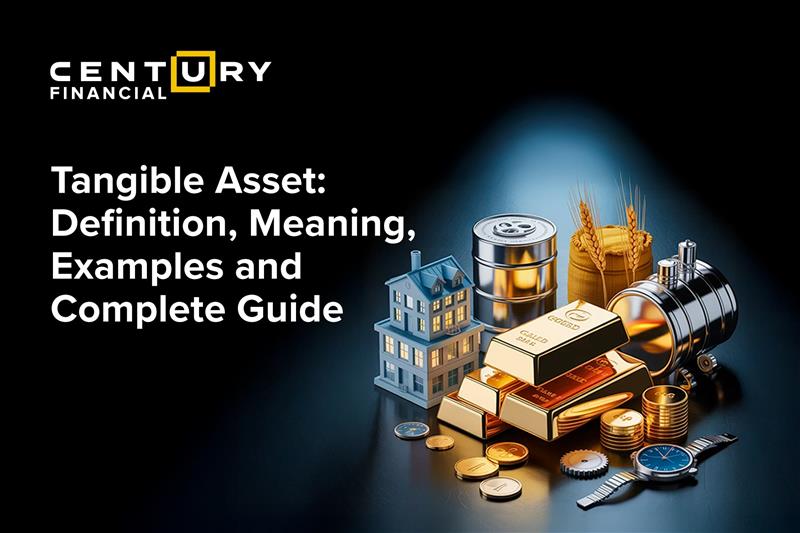
A tangible asset is a physical item with a measurable value that can be touched, seen, or felt. The meaning of tangible assets becomes clearer when compared to its opposite, which are intangible assets. Tangible assets are actual objects like land, machinery, gold, oil, and inventory, whereas intangible assets include goodwill, patents, and trademarks.
Tangible assets in finance are any resources or properties that hold economic value because of their physical substance. Individuals, companies, and governments widely use these assets as stores of value, production tools, or tradeable resources. Examples of tangible assets at a high level include property, commodities, vehicles, equipment, and physical share certificates.
Tangible Property Meaning and Tangible Items
Tangible items are everyday physical objects with value and differs from intangible property, such as copyrights or digital rights. In financial and trading contexts, tangible items often serve as underlying assets for derivatives like CFDs.
Examples of tangible property and items include
 Residential and commercial real estate
 Manufacturing plants and tools
 Precious metals like gold and silver
 Energy resources such as crude oil
 Agricultural goods like wheat or cotton
Types of Tangible Assets and Their Classification
Tangible assets are generally classified based on how they are used in economic activities and how long they provide value to individuals or businesses. They are categorized according to lifespan, liquidity, purpose, and whether they facilitate active trading or long-term business growth. When making trading and investment decisions, these classifications are crucial because asset type affects market behavior, risk exposure, and valuation.
Tangible Fixed Assets
Tangible fixed assets are long-term physical assets used in business operations. They are not intended for immediate resale and usually provide value over many years.
Common tangible fixed assets include:
Land and buildings Machinery and production equipment
 Vehicles used for business purposes
 Furniture and office infrastructure
These assets are depreciated over time, except land, which usually retains or appreciates its value.
Current Tangible Assets
Current tangible assets are physical assets expected to be used or converted into cash within a short period, usually within one year.
Examples include:
 Inventory or stock of goods
 Raw materials
 Finished products ready for sale
These assets play a crucial role in business liquidity and operational efficiency.
Tangible Resources and Tangible Goods
Tangible resources refer to physical materials or natural resources used to generate economic value. Tangible goods are physical products that can be bought, sold, or traded.
What are tangible goods in trading and investment contexts
 Metals used in gold trading
 Energy products used in oil trading
 Agricultural commodities
 Manufactured goods
These tangible goods often serve as underlying instruments in the commodities and CFD trading markets.
Tangible Assets Examples Across Financial Markets
Tangible assets examples vary across financial markets because physical assets underpin many different trading instruments and investment products. From company-owned property in the share market to globally traded commodities like gold and oil, tangible assets serve as the real-world foundation behind price movements and market valuation.
In financial markets, traders rarely exchange tangible assets in their physical form. Instead, these assets act as underlying instruments whose prices are influenced by supply, demand, production costs, and global economic conditions. Understanding how tangible assets function across markets helps traders better interpret price fluctuations and align their trading strategies with real economic activity.
Tangible Assets in Share Market
In the share market, companies with strong tangible asset bases often attract long-term investors. Their balance sheets reflect ownership of land, factories, equipment, and inventory. Investors often evaluate tangible assets to assess company stability and downside protection.
Tangible Assets in Commodities and Forex Trading
In commodities markets, tangible assets are the foundation of price discovery. Traders do not usually own the physical asset; they trade on its price movements. In forex trading, tangible assets indirectly influence currency strength. Countries rich in tangible resources often see their currencies affected by commodity price movements.
Tangible Assets in CFD Trading
CFD Trading allows traders to speculate on tangible assets without owning them physically. The underlying assets remain tangible, such as gold, oil, or shares, but trades are executed digitally. With CFDs, traders can capitalize on both rising and falling markets without having to own the asset.
Importance of Tangible Assets in Trading and Investment Decisions
In trading, tangible assets act as a bridge between the real economy and financial markets. Changes in production levels, storage capacity, transportation costs, and geopolitical factors directly affect the availability of physical assets such as gold, oil, and industrial commodities. These real-world factors are then reflected in market prices, creating opportunities for informed traders to anticipate trends and price movements.
Risk Management and Asset Stability
Tangible assets often retain intrinsic value, even during economic downturns. For example, gold trading is commonly used as a hedge against inflation or market volatility.
Key advantages of tangible assets
Tangible Assets vs Intangible Assets
| Aspect | Tangible Assets | Intangible Assets |
|---|---|---|
| Physical form | Yes | No |
| Ease of valuation | Relatively straightforward | Often subjective |
| Examples | Property, gold, machinery | Brand value, patents |
Role in Modern Digital Trading Platforms
Even in digital trading, tangible assets remain central, as platforms like MT5 and the Century Trader provide access to markets powered by tangible resources.
Traders can explore:
Conclusion
Tangible assets form the backbone of global financial markets. From tangible fixed assets that support company valuations to tangible resources like gold and oil that drive commodities trading, these assets offer transparency, intrinsic value, and diversification opportunities.
For modern traders, the ability to access tangible assets without physical ownership is a decisive advantage. With Century Financial, you can trade tangible assets across the share market, Forex trading, Commodities, and CFDs using advanced tools on a robust Trading Platform.
Whether you are interested in gold trading, oil trading, or diversified share basket strategies, Century Financial provides seamless access through the MT5 Platform and the Century Trader App. Our technology, market expertise, and competitive trading conditions help you turn real-world asset movements into informed trading decisions.
Frequently Asked Questions
Q1. What are tangible assets in simple words?
A: Tangible assets are physical things with value that you can touch, such as land, gold, machinery, or inventory.
Q2: What are tangible assets examples for traders?
A: Examples include gold, oil, real-estate, machinery, inventory, and basically items that provide value that can be seen and felt.
Q3: What is the difference between tangible property and tangible goods?
A: Tangible property usually refers to land and buildings, while tangible goods refer to physical products such as metals, energy resources, and manufactured items.
Q4. Are tangible assets safer than intangible assets?
A: Tangible assets are often considered more stable because they have physical value, but their prices can still fluctuate based on market conditions.
Q5. Can I trade tangible assets without owning them?
A: Yes, through derivative and CFD trading, traders can speculate on tangible assets without physical ownership using advanced trading platforms.
Related Reads
This marketing and educational content has been created by Century Financial Consultancy LLC (“Century”) for general information only. It does not constitute investment, legal, tax, or other professional advice, nor does it constitute a recommendation, offer, or solicitation to buy or sell any financial instrument. The material does not take into account your investment objectives, financial situation, or particular needs.
The opinions expressed by the hosts, speakers, or guests are their own and may change without notice. Information is based on sources we consider to be reliable; however, Century does not guarantee its accuracy, completeness, or timeliness and accepts no liability for any loss arising from reliance on this content.
Trading and investing involve significant risk, and losses may exceed initial deposits. Past performance is not indicative of future results. CFDs and other leveraged products are complex instruments that may not be suitable for all investors. Please ensure you understand how these products work, the associated risks, and seek independent professional advice if necessary.
Century is licensed and regulated by the UAE Capital Market Authority (CMA) under License Nos. 20200000028 and 301044.
Please refer to the full risk disclosure mentioned on our website.

Regulated by CMA
Century Financial Consultancy LLC


.png)
.png)
.png)
.png)
Reach us:
-
Dubai
6th Floor, Emaar Square Building 4,
Downtown, Dubai, P.O. Box 65777,
Dubai, United Arab Emirates -
Abu Dhabi
27th Floor, Office 2701,
Shining Towers, Abu Dhabi, UAE -
Sharjah
29th Floor, Office 2905,
The Business Tower, Sharjah, UAE - +971 (4) 356 2800
- info@century.ae

Disclaimer: Trading in financial products carries substantial risk. Leveraged over-the-counter (OTC) derivatives, such as Contracts for Difference (CFDs) and spot forex, may result in losses exceeding initial deposits and may not be suitable for all investors. These complex instruments do not confer ownership of the underlying assets. Investors should carefully consider their investment objectives and risk appetite, and seek independent professional advice if necessary.
Century Financial Consultancy LLC (CFC) is licensed and regulated by the Capital Market Authority (CMA) of the UAE under license numbers 20200000028 and 301044 to carry out the activities of Financial Products dealer, Trading Broker in international markets, Trading Broker of OTC derivatives and currencies in the spot market, Introduction, Financial Consultations, and Promotion. CFC is incorporated under UAE law, registered with the Dubai Economic Department (No. 768189), with its office at 601, Level 6, Building No. 4, Emaar Square, Downtown Dubai, UAE, PO Box 65777.
The content on this website is provided solely for informational and educational purposes and does not constitute an offer, recommendation, or solicitation to buy or sell any securities or financial products.
Products and services offered by CFC are not intended for use in any jurisdiction where such use or distribution would breach local laws or regulatory requirements.
⚠️ Alert: Fraudulent Activity Notice
Century Financial Consultancy LLC (“Century”) has become aware of fraudulent individuals and entities impersonating our firm through unofficial websites, social media channels, and messaging applications such as Telegram, WhatsApp, and Discord.
Please be advised:
- Century does not manage investments on behalf of clients.
- Century does not solicit funds or guarantee investment returns.
- Century does not accept or make payments in cash, cryptocurrency, or digital assets.
- We do not conduct business via social media or messaging platforms.
Our only official website is www.century.ae, and all communication is conducted exclusively through verified channels.
We strongly urge the public to remain vigilant, verify the authenticity of any communication claiming to be from Century, and report any suspicious activity. Century disclaims any responsibility for losses arising from dealings with unauthorised or fraudulent parties.
