 Loading ...

Monday, February 16, 2026
Call Option vs Put Option: A Complete Guide for Traders
By Century Financial in 'Blog'
.jpg)
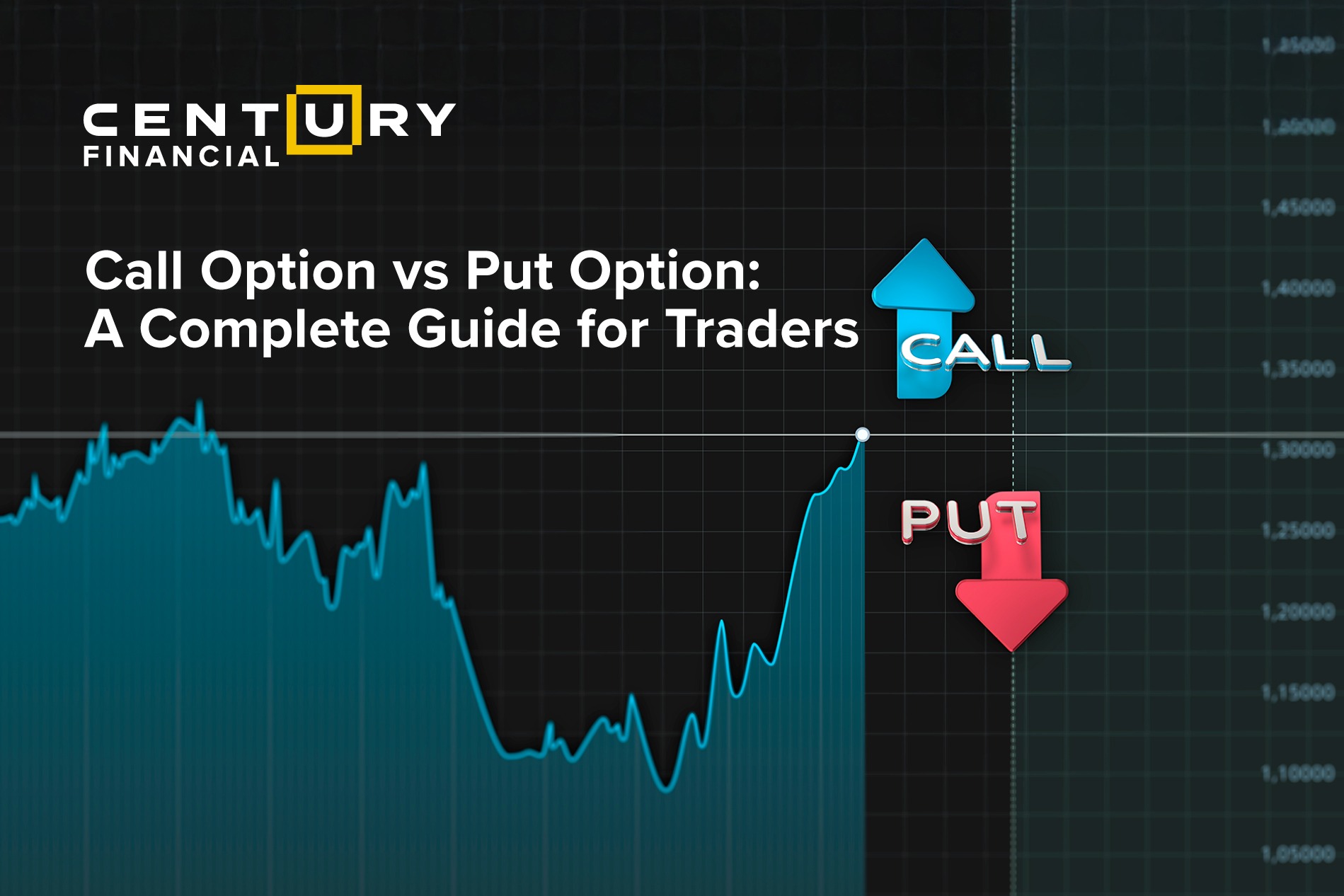
Options trading is one of the most versatile tools in the share market, allowing traders to profit from both rising and falling prices. Having a clear idea of the basics is integral to trading any market. With options, understanding the difference between a call option vs put option is fundamental.
This guide explains call option and put option concepts in depth, covers payoff structures, compares risks and rewards, and helps traders decide when to use calls or puts in real market conditions.
What Is Option Trading and How Does It Work?
Option trading involves contracts that give the buyer the right, but not the obligation, to buy or sell an underlying asset at a predetermined price on or before a predetermined expiry date. These contracts typically have equity, index, forex, oil, gold, and other commodities as their underlying assets.
Key concepts of option trading are:
Each option contract consists of the following key components:
What Is a Call Option?
A call option gives the buyer the right to purchase the underlying asset at a fixed price, known as the strike price, on or before the expiry date. Traders typically buy call options when they expect the asset's market price to increase within a specified time period.
How a Call Option Works
A call option works by allowing the buyer to benefit from rising prices. When a trader purchases a call option, they select a strike price and an expiry date and pay a premium to acquire the contract. This premium is the option's cost and represents the buyer’s maximum risk.
If the market price of the underlying asset moves above the strike price during the life of the option, the call option starts gaining value. As the difference between the market price and the strike price increases, the intrinsic value of the option also increases. The trader can either exercise the option to buy the asset at the lower strike price or sell the option in the market to realize the profit.
Example of a Call Option Trade
If the price rises to 115, the intrinsic value becomes 10.
Net profit = 10 - 3 = 7
If the price stays below 105, the call option expires worthless.
Call Option Payoff Structure
Call option payoff follows an upward-sloping curve:
What Is a Put Option?
A put option gives the buyer the right, but not the obligation, to sell an underlying asset at a predetermined price on or before the option’s expiry date. Traders generally use put options when they expect the cost of an asset to decline within a specific time frame.
How a Put Option Works
By purchasing a put option, the trader secures a selling price in advance, allowing them to benefit from falling market prices without shorting the underlying asset. If the market price drops below the strike price, the put option increases in value, reflecting the advantage of being able to sell the asset at a higher fixed price.
If the market price remains above the strike price until expiry, the put option expires worthless. In this case, the trader’s loss is limited strictly to the premium paid for the option. This predefined risk makes put options a popular choice for individuals and institutions trying to capitalize on bearish movements and investors looking to hedge existing positions against downside risk.
Example of a Put Option Trade
If the price drops to 85, intrinsic value becomes 10.
Net profit = 10 - 4 = 6
If the price remains above 95, the loss is limited to the premium.
Put Option Payoff Structure
The put option payoff follows a downward-sloping curve:
Difference Between Call Option and Put Option
Understanding the difference between a call option and a put option helps traders select the appropriate strategy based on market direction.
Call Option vs Put Option Comparison Table
| Basis | Call Option | Put Option |
|---|---|---|
| Market view | Bullish | Bearish |
| Right | Buy asset | Sell asset |
| Profit when | Price rises | Price falls |
| Maximum loss | Premium paid | Premium paid |
| Profit potential | Unlimited | Limited (price can fall to zero) |
| Common use | Growth strategy | Hedging and downside protection |
This comparison clarifies how puts and calls serve different objectives in option trading strategies.
Call and Put Options: When and Why Traders Use Them
Whether buying (going long) or selling (going short) call or put options, the strategy and use cases differ.
When to Use Call Options
When to Use Put Options
Common Call Put Option Strategies
Advanced traders combine calls and puts to build multi-leg strategies using professional tools on modern trading platforms.
Risks, Rewards, and Key Factors to Consider Before Trading Options
Risks in Call and Put Options
Key Factors Affecting Option Prices
Conclusion
Understanding call options vs put options is essential for any trader looking to navigate modern financial markets with confidence. When used strategically, calls and puts enhance portfolio flexibility, improve risk control, and unlock advanced trading opportunities.
At Century Financial, traders gain access to robust trading platform solutions, including the Century Trader, TWS, and MT5, designed to support informed decision-making regardless of which market you want to participate in. Be it the share market, forex trading, commodities, CFD trading, oil trading, or gold trading. With expert insights, advanced tools, and seamless execution, Century Financial empowers traders to implement option strategies with confidence and precision
FAQs on Call Option vs Put Option
Q1. What is the main difference between call option and put option?
A: The difference stems from the phase of the market when they can be used. A call option benefits from rising prices, while a put option benefits from falling prices.
Q2: Are call and put options suitable for beginners?
A: Yes, when used correctly. Beginners should begin by learning the fundamentals, familiarizing themselves with trading strategies, and back- and forward-testing strategies.
Q3: Can calls and puts be traded in commodities and forex?
A: As derivatives, option contracts have various assets as their underlying. Options are actively used in commodities, forex, oil, and gold trading across global markets.
Q4. Which is riskier: a call option or a put option?
A: Neither is riskier than the other. When buying options, both carry similar risk, as losses are limited to the premium. Risk increases significantly when selling options.
Q5. How do options fit into CFD trading?
A: Options complement CFD trading by offering hedging and directional strategies with defined risk.
Related Reads
This marketing and educational content has been created by Century Financial Consultancy LLC (“Century”) for general information only. It does not constitute investment, legal, tax, or other professional advice, nor does it constitute a recommendation, offer, or solicitation to buy or sell any financial instrument. The material does not take into account your investment objectives, financial situation, or particular needs.
The opinions expressed by the hosts, speakers, or guests are their own and may change without notice. Information is based on sources we consider to be reliable; however, Century does not guarantee its accuracy, completeness, or timeliness and accepts no liability for any loss arising from reliance on this content.
Trading and investing involve significant risk, and losses may exceed initial deposits. Past performance is not indicative of future results. CFDs and other leveraged products are complex instruments that may not be suitable for all investors. Please ensure you understand how these products work, the associated risks, and seek independent professional advice if necessary.
Century is licensed and regulated by the UAE Capital Market Authority (CMA) under License Nos. 20200000028 and 301044.
Please refer to the full risk disclosure mentioned on our website.


Regulated by CMA
Century Financial Consultancy LLC


.png)
.png)
.png)
.png)


Reach us:
-
Dubai
6th Floor, Emaar Square Building 4,
Downtown, Dubai, P.O. Box 65777,
Dubai, United Arab Emirates -
Abu Dhabi
27th Floor, Office 2701,
Shining Towers, Abu Dhabi, UAE -
Sharjah
29th Floor, Office 2905,
The Business Tower, Sharjah, UAE - +971 (4) 356 2800
- info@century.ae

Disclaimer: Trading in financial products carries substantial risk. Leveraged over-the-counter (OTC) derivatives, such as Contracts for Difference (CFDs) and spot forex, may result in losses exceeding initial deposits and may not be suitable for all investors. These complex instruments do not confer ownership of the underlying assets. Investors should carefully consider their investment objectives and risk appetite, and seek independent professional advice if necessary.
Century Financial Consultancy LLC (CFC) is licensed and regulated by the Capital Market Authority (CMA) of the UAE under license numbers 20200000028 and 301044 to carry out the activities of Financial Products dealer, Trading Broker in international markets, Trading Broker of OTC derivatives and currencies in the spot market, Introduction, Financial Consultations, and Promotion. CFC is incorporated under UAE law, registered with the Dubai Economic Department (No. 768189), with its office at 601, Level 6, Building No. 4, Emaar Square, Downtown Dubai, UAE, PO Box 65777.
The content on this website is provided solely for informational and educational purposes and does not constitute an offer, recommendation, or solicitation to buy or sell any securities or financial products.
Products and services offered by CFC are not intended for use in any jurisdiction where such use or distribution would breach local laws or regulatory requirements.
⚠️ Alert: Fraudulent Activity Notice
Century Financial Consultancy LLC (“Century”) has become aware of fraudulent individuals and entities impersonating our firm through unofficial websites, social media channels, and messaging applications such as Telegram, WhatsApp, and Discord.
Please be advised:
- Century does not manage investments on behalf of clients.
- Century does not solicit funds or guarantee investment returns.
- Century does not accept or make payments in cash, cryptocurrency, or digital assets.
- We do not conduct business via social media or messaging platforms.
Our only official website is www.century.ae, and all communication is conducted exclusively through verified channels.
We strongly urge the public to remain vigilant, verify the authenticity of any communication claiming to be from Century, and report any suspicious activity. Century disclaims any responsibility for losses arising from dealings with unauthorised or fraudulent parties.
