 Loading ...

Thursday, February 05, 2026
SpaceX Acquires xAI: What the $1.25 Trillion Deal Means for AI and Space
By Century Financial in 'Blog'
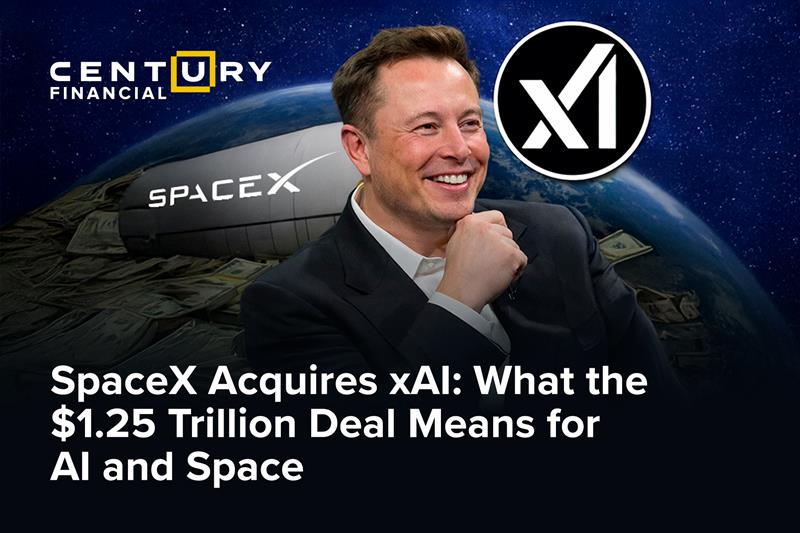
On February 2, 2026, SpaceX completed its acquisition of xAI, bringing together Elon Musk's rocket company and his AI startup. The merged company is now the world's most valuable private business, valued at about $1.25 trillion. This deal could lead to one of the largest IPOs ever.
Deal Structure and Valuations
The acquisition brings together SpaceX, valued at roughly $800 billion in its December 2025 secondary share sale, with xAI, valued at about $230 billion following its $20 billion funding round in January. Public records filed with the state of Nevada on February 2 list Space Exploration Technologies Corp. as the managing member of X.AI Holdings, formalizing the transaction.
The merged company plans to go public later in 2026, and reports suggest it could be valued at over $1.5 trillion. If so, this would be the largest IPO ever, far surpassing previous records.
Financial Rationale Behind the Merger
The timing of the deal shows the different financial paths of the two companies. In 2025, SpaceX made about $8 billion in profit on $15 to $16 billion in revenue, thanks to its launch services and Starlink satellite internet.
Meanwhile, xAI has been spending money quickly. The company told investors it used about $9.5 billion in the first nine months of 2025 to build the expensive infrastructure needed to compete with OpenAI, Google's Gemini, and Anthropic's Claude.
By joining SpaceX, xAI can now benefit from SpaceX's profits and cash flow. The merger also gives xAI investors a way to exit via the planned IPO, helping ease concerns about xAI's high spending in an uncertain AI market.
The Space-Based Data Center Vision
Musk says the deal is part of a plan to build data centers in space. Recently, SpaceX asked the Federal Communications Commission for permission to launch up to 1 million satellites for these 'orbital data centers.'
The main idea is to solve power problems for AI infrastructure on Earth. Data centers for AI need a lot of electricity and cooling, and costs are rising near current sites. In space, data centers could use almost constant solar energy and avoid cooling issues found on Earth.
However, this vision remains years away from practical implementation. The immediate need driving the merger appears to be financial rather than technological.
Market Context and What Investors Can Expect
This deal happens as competition in AI infrastructure heats up. Microsoft, OpenAI, Anthropic, and Meta have spent billions on data centers alone. These numbers show how much money it takes to compete in AI.
If you're following the upcoming IPO, here are some key factors that will affect the investment outlook:
The IPO could raise as much as $50 billion, making it the largest public offering ever.
The company will earn money from launch services, Starlink subscriptions, AI products, and social media ads.
The company has access to established space contracts and new opportunities in the AI market.
xAI's high spending is balanced by SpaceX's profitable main business.
It's unclear how public markets will value a company that covers space, satellite internet, and AI.
Musk calls the merger "the most ambitious, vertically-integrated innovation engine on (and off) Earth." It brings together rockets, satellite internet, AI, and social media under one company.
Conclusion
The SpaceX-xAI merger is a major move in Elon Musk's business empire. It helps xAI meet its urgent need for cash and sets up both companies for a possible record-breaking IPO. While the idea of space-based AI data centers is attracting attention, the main focus now is on financial stability and raising capital through public markets. We'll see how the merger works out and if it benefits future shareholders as the company gets closer to its expected market debut in late 2026.
FAQs
Q1. Why did SpaceX acquire xAI?
A: The SpaceX and xAI merger brings together space infrastructure and AI under one company. It also gives xAI investors a way to exit through SpaceX's planned IPO.
Q2: When will the SpaceX-xAI IPO happen?
A: The merged company plans to go public in mid to late 2026. Reports say the IPO could raise up to $50 billion and value the company at over $1.5 trillion, making it the biggest public offering in history.
Q3: What are space-based data centers and are they realistic?
A: Space-based data centers are facilities in orbit that would handle AI computations using almost constant solar power. Musk thinks this could be cost-effective in 2 to 3 years, but the idea is still mostly theoretical.
Q4. How does this deal affect Tesla shareholders?
A: Tesla invested $2 billion in xAI in January 2026 and sold $430 million worth of Megapack batteries to xAI in 2025. Now that xAI is part of SpaceX, Tesla shareholders own preferred stock in a company that is under SpaceX.
Q5. What is the combined company's revenue model?
A: The merged company makes money from SpaceX's launch services and government contracts, Starlink internet subscriptions, xAI's AI products and services, and X's advertising and subscription revenue.
This marketing and educational content has been created by Century Financial Consultancy LLC (“Century”) for general information only. It does not constitute investment, legal, tax, or other professional advice, nor does it constitute a recommendation, offer, or solicitation to buy or sell any financial instrument. The material does not take into account your investment objectives, financial situation, or particular needs.
The opinions expressed by the hosts, speakers, or guests are their own and may change without notice. Information is based on sources we consider to be reliable; however, Century does not guarantee its accuracy, completeness, or timeliness and accepts no liability for any loss arising from reliance on this content.
Trading and investing involve significant risk, and losses may exceed initial deposits. Past performance is not indicative of future results. CFDs and other leveraged products are complex instruments that may not be suitable for all investors. Please ensure you understand how these products work, the associated risks, and seek independent professional advice if necessary.
Century is licensed and regulated by the UAE Capital Market Authority (CMA) under License Nos. 20200000028 and 301044.
Please refer to the full risk disclosure mentioned on our website.






Regulated by CMA
Century Financial Consultancy LLC








Reach us:
-
Dubai
6th Floor, Emaar Square Building 4,
Downtown, Dubai, P.O. Box 65777,
Dubai, United Arab Emirates -
Abu Dhabi
27th Floor, Office 2701,
Shining Towers, Abu Dhabi, UAE -
Sharjah
29th Floor, Office 2905,
The Business Tower, Sharjah, UAE - +971 (4) 356 2800
- info@century.ae

Disclaimer: Trading in financial products carries substantial risk. Leveraged over-the-counter (OTC) derivatives, such as Contracts for Difference (CFDs) and spot forex, may result in losses exceeding initial deposits and may not be suitable for all investors. These complex instruments do not confer ownership of the underlying assets. Investors should carefully consider their investment objectives and risk appetite, and seek independent professional advice if necessary.
Century Financial Consultancy LLC (CFC) is licensed and regulated by the Capital Market Authority (CMA) of the UAE under license numbers 20200000028 and 301044 to carry out the activities of Financial Products dealer, Trading Broker in international markets, Trading Broker of OTC derivatives and currencies in the spot market, Introduction, Financial Consultations, and Promotion. CFC is incorporated under UAE law, registered with the Dubai Economic Department (No. 768189), with its office at 601, Level 6, Building No. 4, Emaar Square, Downtown Dubai, UAE, PO Box 65777.
The content on this website is provided solely for informational and educational purposes and does not constitute an offer, recommendation, or solicitation to buy or sell any securities or financial products.
Products and services offered by CFC are not intended for use in any jurisdiction where such use or distribution would breach local laws or regulatory requirements.
⚠️ Alert: Fraudulent Activity Notice
Century Financial Consultancy LLC (“Century”) has become aware of fraudulent individuals and entities impersonating our firm through unofficial websites, social media channels, and messaging applications such as Telegram, WhatsApp, and Discord.
Please be advised:
- Century does not manage investments on behalf of clients.
- Century does not solicit funds or guarantee investment returns.
- Century does not accept or make payments in cash, cryptocurrency, or digital assets.
- We do not conduct business via social media or messaging platforms.
Our only official website is www.century.ae, and all communication is conducted exclusively through verified channels.
We strongly urge the public to remain vigilant, verify the authenticity of any communication claiming to be from Century, and report any suspicious activity. Century disclaims any responsibility for losses arising from dealings with unauthorised or fraudulent parties.
