 Loading ...

.jpg)
The Fed is beyond being just a bank. It is the authority responsible for managing the money supply, maintaining financial stability, controlling inflation, and influencing employment levels. Because the US dollar is the world’s primary reserve currency, decisions made by the Fed impact investors, traders, and economies worldwide.
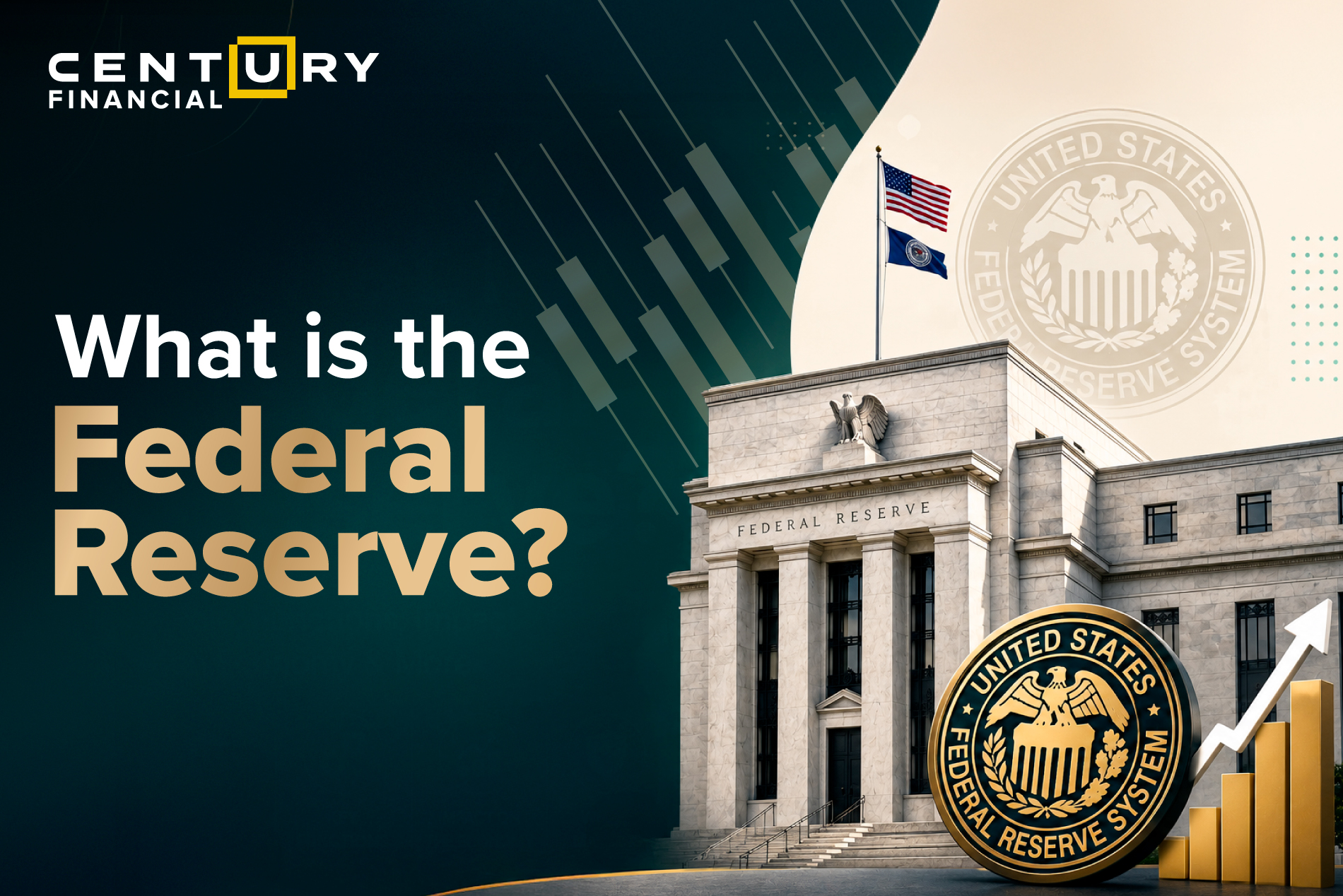
Anyone participating in the global financial markets needs to understand what the Federal Reserve is. The Federal Reserve, commonly called the Fed, is the central banking system of the United States. It plays a critical role in shaping economic conditions not only in the US but across global markets, including forex, commodities, equities, and CFDs.
Federal Reserve Meaning and Overview
The Federal Reserve System was established in 1913 by the Federal Reserve Act, following repeated financial panics that exposed weaknesses in the US banking system. Its purpose was to create a safer, more flexible, and more stable monetary and financial system.
At its core, the Federal Reserve's role is to regulate money and credit conditions to support economic growth while keeping inflation under control.
What Is the Federal Reserve Bank?
The Federal Reserve Bank refers to one of the 12 regional banks operating under the Federal Reserve System. These banks serve as the operational arms of the Fed, implementing monetary policy and supervising commercial banks.
Key characteristics of the Federal Reserve:
Structure of the Federal Reserve System
The Federal Reserve Bank system is designed to balance centralized decision-making with regional representation. This structure allows the Fed to respond effectively to economic conditions across different parts of the US.
Main Components of the Federal Reserve System
| Component | Role |
|---|---|
| Board of Governors | Sets monetary policy direction and supervises banks |
| 12 Federal Reserve Banks | Implement policy and provide financial services |
| Federal Open Market Committee (FOMC) | Decides federal reserve interest rates |
| Member Banks | Commercial banks that hold reserves with the Fed |
Federal Reserve Purpose and Core Functions
A dual mandate given by Congress defines the Federal Reserve's purpose: to promote maximum employment and maintain price stability across the US economy. These two goals guide every major policy decision taken by the Federal Reserve and shape how it responds to economic growth, inflation, recessions, and financial crises.
Beyond the dual mandate, the Federal Reserve also works to ensure moderate long-term interest rates and a resilient financial system. By managing liquidity and credit conditions, the Fed aims to create a structure in which businesses can expand, consumers can borrow responsibly, and financial markets can function efficiently without excessive volatility. In addition, the Fed works to maintain moderate long-term interest rates and financial system stability.
Fed Functions Explained
The primary Fed functions include:
Federal Reserve Interest Rates and Monetary Policy
Federal Reserve interest rates are one of the most powerful tools in global finance. The Fed does not directly set all interest rates but controls the federal funds rate, which influences borrowing costs across the economy.
How the Federal Reserve Works Through Interest Rates
When the Fed adjusts interest rates:
Impact of Fed Rate Changes on Markets
| Market | Effect of Rate Hikes | Effect of Rate Cuts |
|---|---|---|
| Forex trading | Stronger US dollar | Weaker US dollar |
| Gold trading | Prices often fall | Prices often rise |
| Oil trading | Demand pressure | Demand support |
| Share market | Valuation pressure | Valuation support |
Elevate your trading experience with
Century Trader App
Elevate your trading experience with
Century Trader App

How the Federal Reserve Impacts Global Trading
Even though the Fed is based in the US and functions for the country, its decisions influence global markets. International investors, central banks, and traders respond immediately to Fed signals because the US dollar sits at the center of the global financial system.
When the Federal Reserve changes interest rates or signals a shift in monetary policy, capital flows quickly across borders. Higher US interest rates tend to attract global investment into dollar-denominated assets, strengthening the US dollar and putting pressure on other currencies. Lower rates often push investors toward higher-yielding or riskier assets in emerging and developed markets.
Conclusion
Understanding what the Federal Reserve is is not just academic knowledge; it is a practical advantage for traders and investors. Fed decisions influence global liquidity, interest rates, and risk sentiment, shaping opportunities across forex, indices, commodities, shares, and CFDs.
With advanced tools like the Century Trader and MT5, you can track, analyze, and execute trades during Fed policy decisions without missing a beat. Whether you are building a diversified share basket or actively trading global markets, Century Financial Services provides the technology, expertise, and market access needed to stay ahead of Federal Reserve-driven market movements.
Start trading smarter with Century Financial Services and transform economic insights into actionable strategies!
FAQs
Q1. What is the Federal Reserve in simple terms?
A: The Federal Reserve is the central bank of the United States that controls the money supply, manages interest rates, and works to keep the economy stable.
Q2: Why is the Federal Reserve important for traders?
A: Fed decisions influence market volatility, currency movements, commodity prices, and stock valuations, making them essential for trading strategies.
Q3: How often does the Fed change interest rates?
A: The Federal Open Market Committee meets eight times a year, but rate changes depend on economic conditions.
Q4. Does the Federal Reserve control inflation?
A: Yes, controlling inflation is one of the Fed’s main responsibilities, carried out through interest rate adjustments and liquidity management.
Q5. How does the Federal Reserve affect forex trading?
A: Interest rate changes impact the US dollar, which directly affects currency pairs traded in global forex markets
This marketing and educational content has been created by Century Financial Consultancy LLC (“Century”) for general information only. It does not constitute investment, legal, tax, or other professional advice, nor does it constitute a recommendation, offer, or solicitation to buy or sell any financial instrument. The material does not take into account your investment objectives, financial situation, or particular needs.
The opinions expressed by the hosts, speakers, or guests are their own and may change without notice. Information is based on sources we consider to be reliable; however, Century does not guarantee its accuracy, completeness, or timeliness and accepts no liability for any loss arising from reliance on this content.
Trading and investing involve significant risk, and losses may exceed initial deposits. Past performance is not indicative of future results. CFDs and other leveraged products are complex instruments that may not be suitable for all investors. Please ensure you understand how these products work, the associated risks, and seek independent professional advice if necessary.
Century is licensed and regulated by the UAE Capital Market Authority (CMA) under License Nos. 20200000028 and 301044.
Please refer to the full risk disclosure mentioned on our website.






Regulated by CMA
Century Financial Consultancy LLC








Reach us:
-
Dubai
6th Floor, Emaar Square Building 4,
Downtown, Dubai, P.O. Box 65777,
Dubai, United Arab Emirates -
Abu Dhabi
27th Floor, Office 2701,
Shining Towers, Abu Dhabi, UAE -
Sharjah
29th Floor, Office 2905,
The Business Tower, Sharjah, UAE - +971 (4) 356 2800
- info@century.ae

Disclaimer: Trading in financial products carries substantial risk. Leveraged over-the-counter (OTC) derivatives, such as Contracts for Difference (CFDs) and spot forex, may result in losses exceeding initial deposits and may not be suitable for all investors. These complex instruments do not confer ownership of the underlying assets. Investors should carefully consider their investment objectives and risk appetite, and seek independent professional advice if necessary.
Century Financial Consultancy LLC (CFC) is licensed and regulated by the Capital Market Authority (CMA) of the UAE under license numbers 20200000028 and 301044 to carry out the activities of Financial Products dealer, Trading Broker in international markets, Trading Broker of OTC derivatives and currencies in the spot market, Introduction, Financial Consultations, and Promotion. CFC is incorporated under UAE law, registered with the Dubai Economic Department (No. 768189), with its office at 601, Level 6, Building No. 4, Emaar Square, Downtown Dubai, UAE, PO Box 65777.
The content on this website is provided solely for informational and educational purposes and does not constitute an offer, recommendation, or solicitation to buy or sell any securities or financial products.
Products and services offered by CFC are not intended for use in any jurisdiction where such use or distribution would breach local laws or regulatory requirements.
⚠️ Alert: Fraudulent Activity Notice
Century Financial Consultancy LLC (“Century”) has become aware of fraudulent individuals and entities impersonating our firm through unofficial websites, social media channels, and messaging applications such as Telegram, WhatsApp, and Discord.
Please be advised:
- Century does not manage investments on behalf of clients.
- Century does not solicit funds or guarantee investment returns.
- Century does not accept or make payments in cash, cryptocurrency, or digital assets.
- We do not conduct business via social media or messaging platforms.
Our only official website is www.century.ae, and all communication is conducted exclusively through verified channels.
We strongly urge the public to remain vigilant, verify the authenticity of any communication claiming to be from Century, and report any suspicious activity. Century disclaims any responsibility for losses arising from dealings with unauthorised or fraudulent parties.
