 Loading ...

Monday, October 12, 2026
Investing in Installments: How Dollar-Cost Averaging Works
By Century Financial in 'Blog'

Introduction
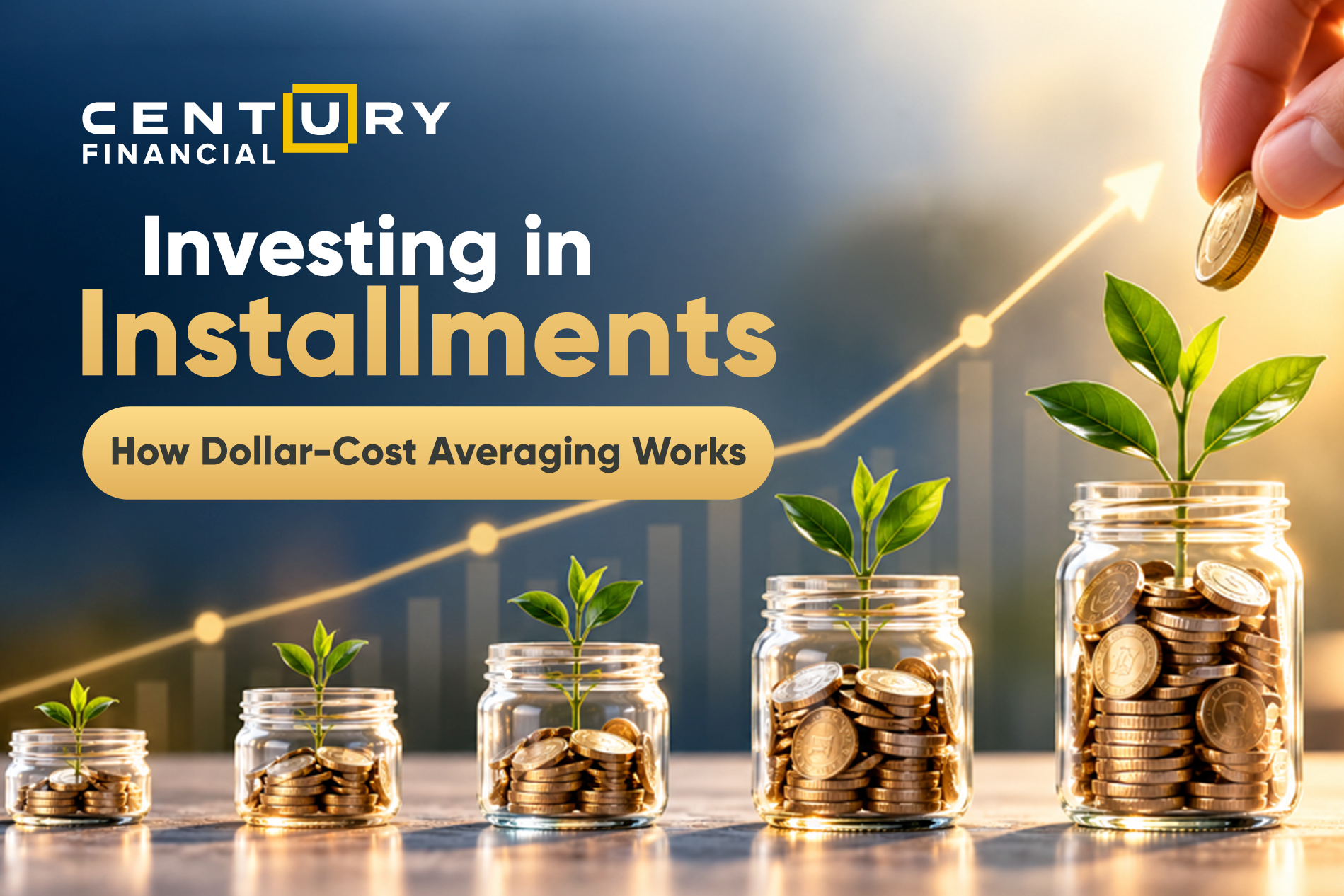
Very few investors, including professionals, consistently buy at the lowest price and sell at the highest. There is usually skepticism around timing markets for long-term investments, as it might ultimately lead to loss of opportunities. Dollar-cost averaging handles this by using a fixed, repeated schedule instead of trying to time the market.
This piece explains how dollar-cost averaging works, how it compares to lump-sum investing, where it is often misunderstood, and what it does and doesn't address.
What Is Dollar-Cost Averaging?
Dollar-cost averaging (DCA) refers to investing a fixed amount at regular intervals, regardless of the asset's price. The schedule, not the investor, determines when to buy. Whether weekly, monthly, or at another interval, you invest the same amount each time.
Because the amount invested stays constant while prices change, you buy more units when prices are low and fewer when prices are high. Over time, this smooths your average price paid without requiring you to forecast market direction.
How Does Dollar-Cost Averaging Work in Practice?
The mechanics are straightforward. A fixed sum buys a variable number of units each period as the price changes, even when the amount invested stays the same.
Here's a four-month example using a fixed $500 investment:
| Month | Price per Unit | Amount Invested | Units Bought |
|---|---|---|---|
| 1 | $50 | $500 | 10.00 |
| 2 | $40 | $500 | 12.50 |
| 3 | $60 | $500 | 8.33 |
| 4 | $50 | $500 | 10.00 |
The total invested over four months is $2,000, resulting in 40.83 units purchased. The average cost per unit is $48.97, which is lower than the simple average price of $50 over the same period.
Why Is the Average Cost Lower Than the Average Price?
This difference happens because the investment amount is fixed, but the number of units bought changes. There is an inverse relation between price and units bought. When the price drops, the same amount buys more units; when the price rises, it buys fewer.
This results in an average cost that is lower than the average price, without needing to forecast market movements.
Dollar-Cost Averaging vs Lump-Sum Investing
| Factor | Dollar-Cost Averaging | Lump-Sum Investing |
|---|---|---|
| Timing risk | Spread across multiple entry points | Concentrated at a single entry point |
| Market exposure | Builds up gradually | Full exposure from day one |
| Emotional pressure | Lower, since no single decision carries the full weight | Higher, since one entry point determines the starting basis |
| Capital requirement | Works with smaller, recurring amounts | Requires the full sum upfront |
Example 1
A salaried person invests AED 2,000 from each monthly paycheck into a diversified ETF. The schedule fits their income pattern and removes the pressure of investing a large amount at once, giving you more controlled market exposure.
Example 2 (Lump-Sum Timing Issue)
A student received a gift of AED 24,000. Investing it all on a single day exposes the entire amount to the market at that entry point. Fearing the market might decline, they divide the money into six monthly installments, spreading the exposure across six entry points averaging the price of the units bought.
What Dollar-Cost Averaging Does and Doesn't Do
What it does:
What it doesn't do:
Where Dollar-Cost Averaging Gets Misunderstood
Is Dollar-Cost Averaging the Same as Averaging Down?
No, the two work on entirely different logic. One follows a fixed calendar; the other follows the price itself.
How Do Transaction Costs Affect Small, Frequent Purchases?
Every purchase carries some cost, even a small one. Splitting one sum into many smaller buys multiplies how often that cost applies.
DCA Works Across All Instruments
Dollar-cost averaging isn't limited to stocks. It extends to ETFs, indices, commodities, and more, wherever regular purchases are practical.
Building a Regular Investing Routine with Century
With Century’s award-winning and intuitive platforms, you can set up the same routine manually by planning a fixed amount and interval, then placing trades consistently through Century Trader, MT5, TWS, or CQG.
Century's platforms let you compare performance once you set up a routine. Both short-term and long-term results are visible in one place, making it easier to see how staggered entries perform relative to your overall open positions. Share Baskets can also structure recurring purchases by theme or sector, rather than focusing on a single instrument.
Elevate your trading experience with
Century Trader App
Elevate your trading experience with
Century Trader App

Conclusion
Dollar-cost averaging fixes the amount invested and uses a schedule to determine how many units are bought each period. This approach smooths the average price paid over time, but the trade-offs compared to lump-sum investing depend on how markets move during the investment period.
For those building a regular contribution habit from a salary, bonus, or other recurring source, you can set up the routine at any interval. Century's platforms, like Century Trader, MT5, TWS, and CQG, let you decide your own schedule, with both short-term and long-term performance visible together.

Frequently Asked Questions
Q1: What is dollar-cost averaging in simple terms?
A: It's investing a fixed amount of money at regular intervals, regardless of price, so you buy more units when prices are low and fewer when prices are high.
Q2: How often are dollar-cost averaging purchases typically made?
A: Weekly or monthly intervals are the most common, usually timed to match a recurring income source like a salary. However, investors can set the interval to whatever schedule suits them.
Q3: Can dollar-cost averaging be used with ETFs?
A: Yes, ETFs are one of the most common instruments for dollar-cost averaging, since they offer diversified exposure in a single, repeatable purchase.
Q4: Can dollar-cost averaging be applied to CFDs or leveraged products?
A: It can be, but the cost structure differs; overnight financing charges on positions held over time add a layer of cost that doesn't apply to a straightforward stock or ETF purchase. Margin calls during market instability can also cause forced liquidation.
Q5: Does dollar-cost averaging guarantee a profit?
A: No. It reduces the risk of poor timing by spreading entry points out, but it doesn't protect against a sustained decline in an asset's value or guarantee any particular outcome.
This marketing and educational content has been created by Century Financial Consultancy LLC (“Century”) for general information only. It does not constitute investment, legal, tax, or other professional advice, nor does it constitute a recommendation, offer, or solicitation to buy or sell any financial instrument. The material does not take into account your investment objectives, financial situation, or particular needs.
The opinions expressed by the hosts, speakers, or guests are their own and may change without notice. Information is based on sources we consider to be reliable; however, Century does not guarantee its accuracy, completeness, or timeliness and accepts no liability for any loss arising from reliance on this content.
Trading and investing involve significant risk, and losses may exceed initial deposits. Past performance is not indicative of future results. CFDs and other leveraged products are complex instruments that may not be suitable for all investors. Please ensure you understand how these products work, the associated risks, and seek independent professional advice if necessary.
Century is licensed and regulated by the UAE Capital Market Authority (CMA) under License Nos. 20200000028 and 301044.
Please refer to the full risk disclosure mentioned on our website.



Regulated by CMA
Century Financial Consultancy LLC








Reach us:
-
Dubai
6th Floor, Emaar Square Building 4,
Downtown, Dubai, P.O. Box 65777,
Dubai, United Arab Emirates -
Abu Dhabi
27th Floor, Office 2701,
Shining Towers, Abu Dhabi, UAE -
Sharjah
29th Floor, Office 2905,
The Business Tower, Sharjah, UAE - +971 (4) 356 2800
- info@century.ae

Disclaimer: Trading in financial products carries substantial risk. Leveraged over-the-counter (OTC) derivatives, such as Contracts for Difference (CFDs) and spot forex, may result in losses exceeding initial deposits and may not be suitable for all investors. These complex instruments do not confer ownership of the underlying assets. Investors should carefully consider their investment objectives and risk appetite, and seek independent professional advice if necessary.
Century Financial Consultancy LLC (CFC) is licensed and regulated by the Capital Market Authority (CMA) of the UAE under license numbers 20200000028 and 301044 to carry out the activities of Financial Products dealer, Trading Broker in international markets, Trading Broker of OTC derivatives and currencies in the spot market, Introduction, Financial Consultations, and Promotion. CFC is incorporated under UAE law, registered with the Dubai Economic Department (No. 768189), with its office at 601, Level 6, Building No. 4, Emaar Square, Downtown Dubai, UAE, PO Box 65777.
The content on this website is provided solely for informational and educational purposes and does not constitute an offer, recommendation, or solicitation to buy or sell any securities or financial products.
Products and services offered by CFC are not intended for use in any jurisdiction where such use or distribution would breach local laws or regulatory requirements.
⚠️ Alert: Fraudulent Activity Notice
Century Financial Consultancy LLC (“Century”) has become aware of fraudulent individuals and entities impersonating our firm through unofficial websites, social media channels, and messaging applications such as Telegram, WhatsApp, and Discord.
Please be advised:
- Century does not manage investments on behalf of clients.
- Century does not solicit funds or guarantee investment returns.
- Century does not accept or make payments in cash, cryptocurrency, or digital assets.
- We do not conduct business via social media or messaging platforms.
Our only official website is www.century.ae, and all communication is conducted exclusively through verified channels.
We strongly urge the public to remain vigilant, verify the authenticity of any communication claiming to be from Century, and report any suspicious activity. Century disclaims any responsibility for losses arising from dealings with unauthorised or fraudulent parties.
