 Loading ...

Tuesday, June 09, 2026
Short Covering in the Stock Market: Meaning, Strategy, and Real Examples
By Century Financial in 'Blog'
.jpg)
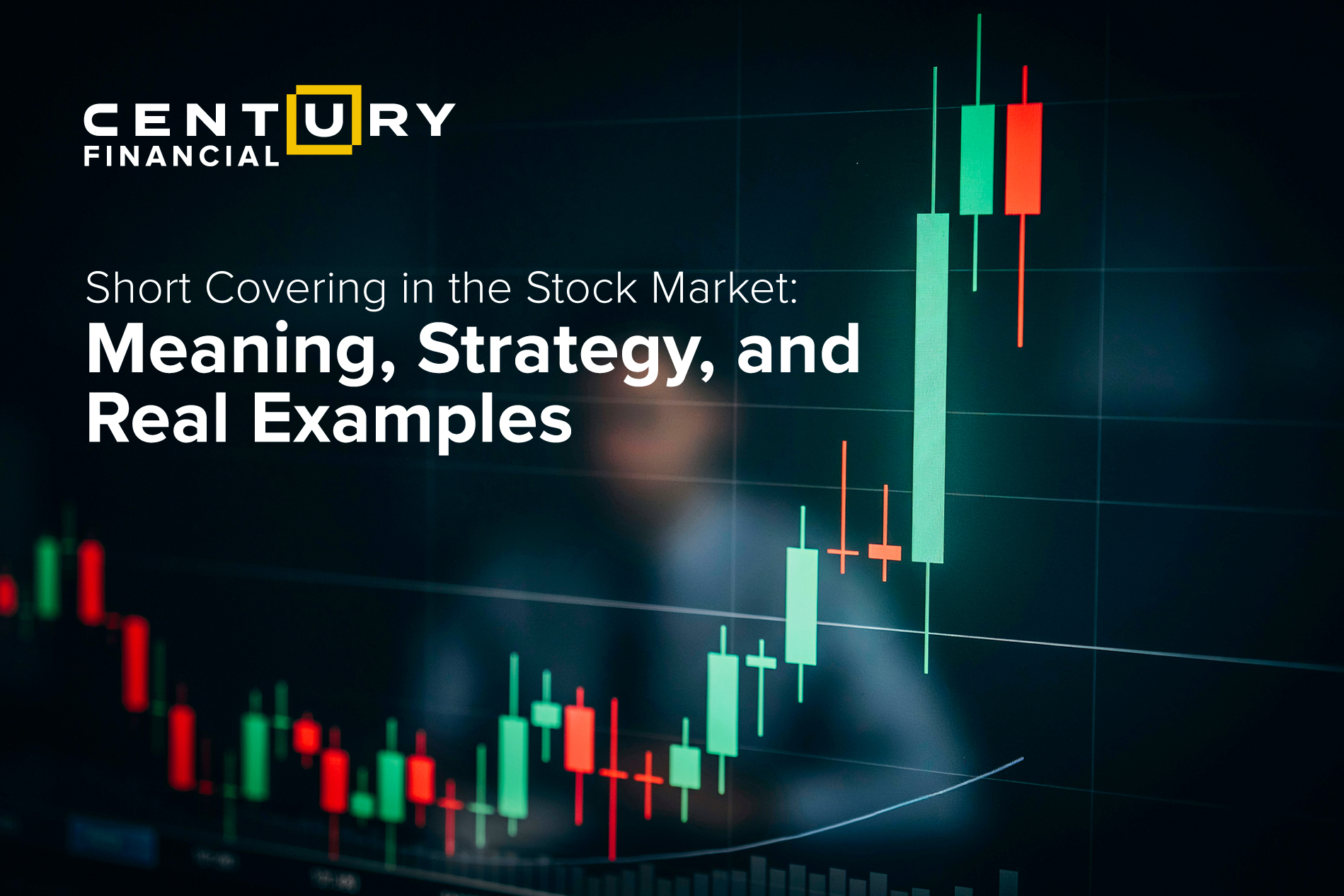
Short covering occurs when traders who have earlier engaged in short selling buy back shares to close their positions. It is a critical concept in trading that directly impacts stock prices, market trends, and volatility. While short selling benefits from falling prices, short covering marks the exit point of that trade and often acts as a trigger for sudden price reversals.
Whether you are tracking short covering in stocks for intraday opportunities or analyzing it as part of a broader market trend, this concept plays a vital role in identifying momentum shifts. In the share market, short covering can be triggered by profit-taking, rising losses, technical breakouts, or unexpected news. Understanding this phenomenon, how it differs from short selling, and how traders use the short-covering strategy is essential for anyone trading stocks, CFDs, commodities, or forex.
Understanding Short Selling and Short Covering in the Share Market
Short selling and short covering are closely linked concepts. To understand short covering, it is important to first understand how short selling works. Short selling is a trading strategy where a trader sells an asset they do not own, expecting its price to fall. The trader borrows it from a broker, sells it in the market, and plans to buy it back later. The profit or loss depends on the difference between the selling price and the repurchase price.
Short covering occurs when a trader buys back the borrowed asset to close a short position. This can be done either to book profits or to limit losses when the stock price starts rising unexpectedly. In simple terms, short selling opens a position, and short covering closes it.
What Is Short Covering In Stocks and Why It Matters
What is short covering in stocks becomes especially important during volatile market phases. When a stock starts moving up sharply, short sellers may rush to cover their positions to avoid further losses. This sudden demand often accelerates the upward price movement.
Short covering matters because it can:

Trigger sharp intraday or short-term rallies

Change market sentiment quickly

Create opportunities and risks for both buyers and sellers

Influence overall share market momentum
How Short Covering Works: Step-by-Step Explanation
When prices move against short sellers, their need to exit positions creates additional buying pressure. By breaking down the mechanics of short covering step by step, you can better identify early signals of trend reversals, increased volatility, and potential short-term rallies in the share market.
Step-by-Step Process of Short Covering
Short Covering Example with Market Impact
Assume a trader shorts a stock at 500, expecting it to fall. Instead, positive news pushes the price to 560. To avoid further losses, the trader buys the stock at 560 and exits the position. If many traders do the same, the stock experiences heavy buying pressure, pushing prices even higher.
If this buying pressure intensifies, it can trigger a short squeeze. A short squeeze is an extreme form of short covering where losses force traders to exit at any available price.
Difference Between Short Covering and Short Squeeze
| Aspect | Short Covering | Short Squeeze |
|---|---|---|
| Nature | Normal exit of short positions | Forced mass exit of short sellers |
| Trigger | Profit booking or risk control | Sudden sharp price rise |
| Impact | Moderate price increase | Explosive upward movement |
| Frequency | Common | Relatively rare |
Short Covering Strategy: How Traders Use It Effectively
A well-planned short covering strategy helps traders manage risk and optimize returns, especially in volatile conditions. It focuses on identifying early reversal signals, monitoring volume and price behavior, and exiting short positions before losses escalate.
When used correctly, short covering strategies can protect capital and even turn adverse market moves into controlled trading decisions.
When to Use a Short Covering Strategy
Short covering is commonly observed before major events such as earnings announcements, policy decisions, or global economic updates. Traders typically rely on short covering strategies when:
Technical Indicators that Signal Short Covering
The following indicators often hint at potential short covering activity:

Rising volumes with price increases

Breakout above resistance levels

Bullish candlestick patterns

Momentum oscillators moving upward
Risk Management During Short Covering
Short covering carries risks due to the unlimited upside potential in prices. Using advanced tools can help traders manage short positions efficiently. Effective risk management includes:
Short Covering Across Different Markets and Instruments
Short covering is not limited to equities and can be observed across a wide range of financial markets and trading instruments. As price trends reverse or volatility increases, traders in different asset classes are often forced to exit short positions, leading to sudden spikes in buying activity. Understanding how short covering behaves across markets helps traders adapt strategies and manage risk more effectively in changing market conditions.
Short Covering in Commodities and Forex Markets
In the following markets, short covering often results in faster price spikes due to leveraged positions.
Short Covering in CFD Trading
CFD Trading allows traders to take both long and short positions with leverage. Short covering in CFDs can be swift due to margin requirements, making risk management critical.
Benefits, Limitations, and Market Psychology Behind Short Covering
Understanding the psychology behind short covering helps anticipate market moves rather than react to them.
Fear of rising losses often forces short sellers to exit positions quickly, creating sharp but sometimes temporary price rallies. By recognizing both the advantages and limitations of short covering, traders can make more disciplined decisions and avoid emotional trading during high-volatility phases.
Benefits of Short Covering Awareness
Limitations and Risks
Role of market sentiment in short covering
Fear could be a dominant emotion behind short covering. When prices rise rapidly, traders rush to exit positions, often ignoring fundamentals. This herd behavior is a key driver of short-term market rallies. Since the price increase is not technically or fundamentally sound, entering during these times could lead to short-term losses.
Elevate your trading experience with
Century Trader App
Elevate your trading experience with
Century Trader App

Conclusion
Short covering is a powerful force that shapes short-term price movements across stocks, forex, and derivatives. For traders looking to navigate volatile markets with confidence, access to reliable tools, insights, and execution platforms is essential.
Century Financial offers robust trading platforms, including the advanced Century Trader, and global market access through the MT5, CQG, and TWS platforms, enabling traders to participate efficiently in the markets, be it commodities, forex trading, or shares.
FAQs
Q1. What is short covering in stocks?
A: Short covering in stocks refers to buying back shares that were previously sold short in order to close an open position and return borrowed shares.
Q2: Is short covering bullish or bearish?
A: Short covering is generally bullish in the short term because it increases buying demand, pushing stock prices higher.
Q3: How is short covering different from buying?
A: Short covering is done to exit a short position, while buying usually reflects a fresh bullish view on the stock.
Q4. Can retail traders benefit from short covering?
A: Yes, retail traders can benefit by identifying stocks where heavy short covering may trigger rapid upward moves.
Q5. Does short covering affect long-term trends?
A: Short covering mainly impacts short-term price movements. Long-term trends still depend on fundamentals and broader economic factors.
This marketing and educational content has been created by Century Financial Consultancy LLC (“Century”) for general information only. It does not constitute investment, legal, tax, or other professional advice, nor does it constitute a recommendation, offer, or solicitation to buy or sell any financial instrument. The material does not take into account your investment objectives, financial situation, or particular needs.
The opinions expressed by the hosts, speakers, or guests are their own and may change without notice. Information is based on sources we consider to be reliable; however, Century does not guarantee its accuracy, completeness, or timeliness and accepts no liability for any loss arising from reliance on this content.
Trading and investing involve significant risk, and losses may exceed initial deposits. Past performance is not indicative of future results. CFDs and other leveraged products are complex instruments that may not be suitable for all investors. Please ensure you understand how these products work, the associated risks, and seek independent professional advice if necessary.
Century is licensed and regulated by the UAE Capital Market Authority (CMA) under License Nos. 20200000028 and 301044.
Please refer to the full risk disclosure mentioned on our website.




Regulated by CMA
Century Financial Consultancy LLC








Reach us:
-
Dubai
6th Floor, Emaar Square Building 4,
Downtown, Dubai, P.O. Box 65777,
Dubai, United Arab Emirates -
Abu Dhabi
27th Floor, Office 2701,
Shining Towers, Abu Dhabi, UAE -
Sharjah
29th Floor, Office 2905,
The Business Tower, Sharjah, UAE - +971 (4) 356 2800
- info@century.ae

Disclaimer: Trading in financial products carries substantial risk. Leveraged over-the-counter (OTC) derivatives, such as Contracts for Difference (CFDs) and spot forex, may result in losses exceeding initial deposits and may not be suitable for all investors. These complex instruments do not confer ownership of the underlying assets. Investors should carefully consider their investment objectives and risk appetite, and seek independent professional advice if necessary.
Century Financial Consultancy LLC (CFC) is licensed and regulated by the Capital Market Authority (CMA) of the UAE under license numbers 20200000028 and 301044 to carry out the activities of Financial Products dealer, Trading Broker in international markets, Trading Broker of OTC derivatives and currencies in the spot market, Introduction, Financial Consultations, and Promotion. CFC is incorporated under UAE law, registered with the Dubai Economic Department (No. 768189), with its office at 601, Level 6, Building No. 4, Emaar Square, Downtown Dubai, UAE, PO Box 65777.
The content on this website is provided solely for informational and educational purposes and does not constitute an offer, recommendation, or solicitation to buy or sell any securities or financial products.
Products and services offered by CFC are not intended for use in any jurisdiction where such use or distribution would breach local laws or regulatory requirements.
⚠️ Alert: Fraudulent Activity Notice
Century Financial Consultancy LLC (“Century”) has become aware of fraudulent individuals and entities impersonating our firm through unofficial websites, social media channels, and messaging applications such as Telegram, WhatsApp, and Discord.
Please be advised:
- Century does not manage investments on behalf of clients.
- Century does not solicit funds or guarantee investment returns.
- Century does not accept or make payments in cash, cryptocurrency, or digital assets.
- We do not conduct business via social media or messaging platforms.
Our only official website is www.century.ae, and all communication is conducted exclusively through verified channels.
We strongly urge the public to remain vigilant, verify the authenticity of any communication claiming to be from Century, and report any suspicious activity. Century disclaims any responsibility for losses arising from dealings with unauthorised or fraudulent parties.
