 Loading ...

Wednesday, August 12, 2026
Oil caught between falling demand and a tightening Hormuz squeeze
By Vijay Valecha in 'Century in News'
Vijay Valecha, Wed, Aug 12, 2026 Khaleej Times
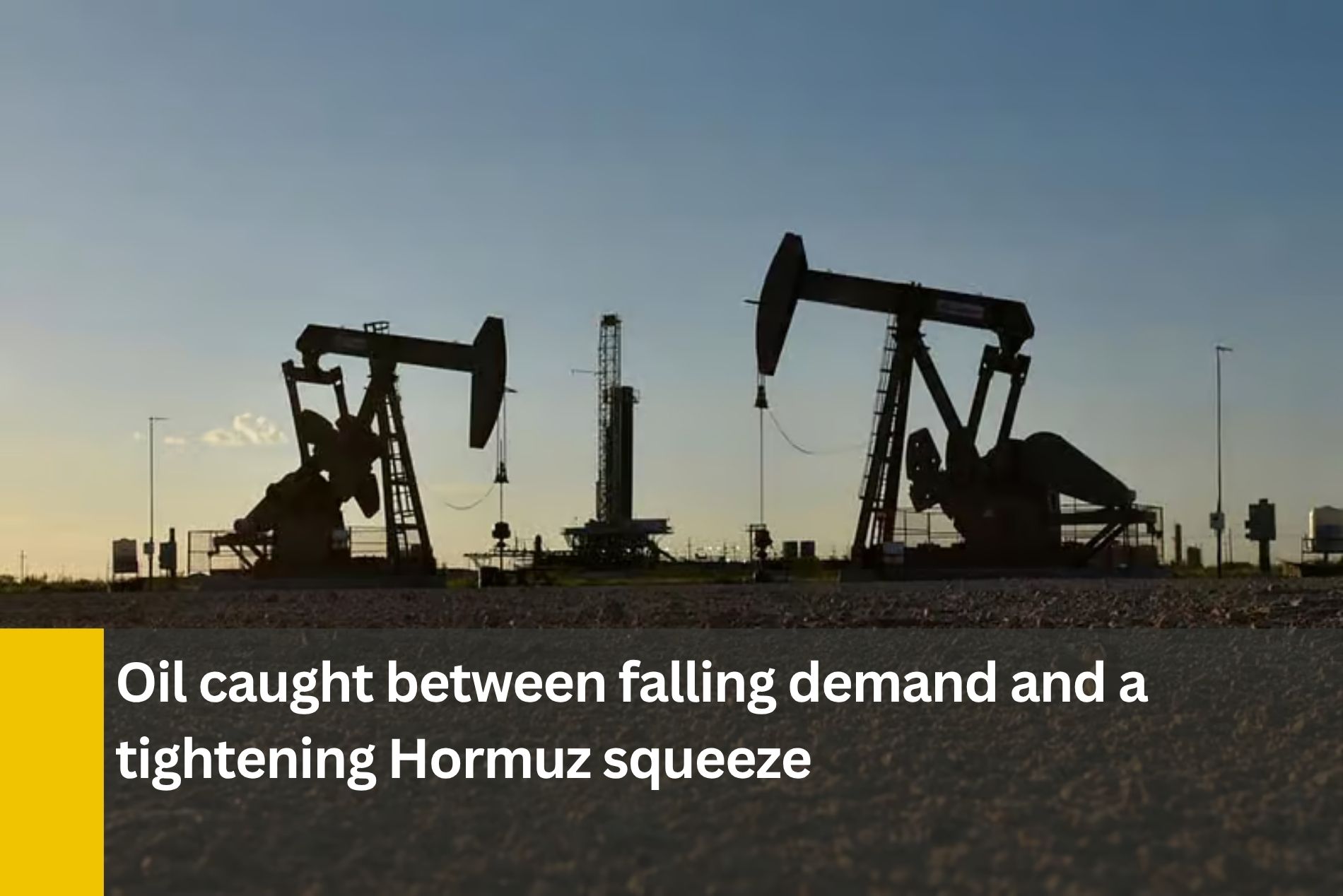
Brent slips below $89 as Opec and IEA cut 2026 demand forecasts, but analysts warn thinning inventories and stalled Iran talks mean supply risk, not demand, may decide where prices head nextOil markets are being pulled in two directions at once, and Wednesday’s trading captured that tension in miniature. A wave of downgraded demand forecasts pushed prices lower even as the underlying supply story — a Strait of Hormuz still effectively disrupted, inventories at multi-year lows, and diplomacy between Washington and Tehran going nowhere — argues for prices to stay elevated.
The question now facing traders is less about today’s headline than about which force wins out into year-end: a softening consumption outlook, or a physical market that analysts describe as dangerously thin on buffers.
That tug-of-war showed up directly in the numbers. Oil prices fell in volatile trading on Wednesday, having earlier traded $1 higher.
Brent futures were down 49 cents, or 0.55 per cent, at $88.42 a barrel by 1315 GMT, while US West Texas Intermediate (WTI) crude fell 25 cents, or 0.3 per cent, to $82.95, according to Reuters data.
The Organisation of Petroleum Exporting Countries lowered its world oil demand growth forecast for 2026 to 580,000 barrels per day in its monthly report, while the International Energy Agency went further, slashing its 2026 projections and now expecting a 1.6 million bpd contraction in demand this year — even as it forecasts a 4.3 million bpd drop in supply and an overall 2026 deficit of around 1.27 million bpd.
The split between weakening demand and a widening supply deficit is precisely why the market is struggling to find direction, and why forecasters are increasingly focused on how long the Hormuz disruption — rather than demand alone — will end up setting the price.
Geopolitical premium still dominatesDespite the softer demand outlook, analysts say the market remains hostage to headlines out of the Gulf. “This week, oil edged higher as markets continued to price in significant geopolitical risk surrounding the Middle East,” said Vijay Valecha, Chief Investment Officer at Century Financial. He noted that although “Iran and Oman appear to be closing in on an agreement to partially resume shipping through the Strait of Hormuz, investors remain cautious due to conflicting reports from Washington and Tehran,” pointing to a recent US military strike on a vessel attempting to breach the Iranian port blockade and continuing security threats in the Gulf of Oman and Yemen.
Valecha added that the IEA’s estimated global supply deficit “widened to 1.8 mb/d in the third quarter, more than double the figure of around 800 kb/d from a month ago,” with observed global inventories plunging 69 million barrels in July alone — taking total stocks below 7.9 billion barrels for the first time since April 2025. “Until there is a confirmed deal, oil is likely to remain volatile, with Brent expected to remain supported by both the geopolitical overhang and the ongoing inventory drawdown,” he said.
Oxford Economics: $85 oil the new baselineThe most closely watched number in the market, however, may be Oxford Economics’ revised baseline. In its August World Economic Prospects Monthly, released on Wednesday, the consultancy said it now expects Brent to “average $85 per barrel over the remainder of this year before gradually falling back to about $65 by the end of 2027,” as a long-term reduction in Hormuz shipping becomes “the most likely scenario.”
Crucially, Oxford Economics does not expect a swift resolution. “Mutual deep distrust and an unwillingness by either party to make large concessions mean a lasting deal is unlikely to be reached and maintained anytime soon,” the firm wrote, adding that traffic through the Strait is expected to “fluctuate as tensions ebb and flow” until at least 2028, remaining “well below pre-conflict norms.”
Even so, Oxford Economics argues the global economy can absorb the shock: rising non-Middle East supply, inventory drawdowns and demand destruction should partially offset higher prices, meaning “the hit to world GDP from the revision to our oil price forecast is relatively small.”
Taken together, the competing signals — softer demand forecasts, thinning inventories, record distillate tightness and an $85 oil baseline through year-end — leave traders bracing for continued volatility until Hormuz talks produce a durable outcome.
Source
__399202320.jpg)
__1310535975.jpg)

Regulated by CMA
Century Financial Consultancy LLC


.png)


.png)
.png)

Reach us:
-
Dubai
6th Floor, Emaar Square Building 4,
Downtown, Dubai, P.O. Box 65777,
Dubai, United Arab Emirates -
Abu Dhabi
27th Floor, Office 2701,
Shining Towers, Abu Dhabi, UAE -
Sharjah
29th Floor, Office 2905,
The Business Tower, Sharjah, UAE - +971 (4) 356 2800
- info@century.ae

Disclaimer: Trading in financial products carries substantial risk. Leveraged over-the-counter (OTC) derivatives, such as Contracts for Difference (CFDs) and spot forex, may result in losses exceeding initial deposits and may not be suitable for all investors. These complex instruments do not confer ownership of the underlying assets. Investors should carefully consider their investment objectives and risk appetite, and seek independent professional advice if necessary.
Century Financial Consultancy LLC (CFC) is licensed and regulated by the Capital Market Authority (CMA) of the UAE under license numbers 20200000028 and 301044 to carry out the activities of Financial Products dealer, Trading Broker in international markets, Trading Broker of OTC derivatives and currencies in the spot market, Introduction, Financial Consultations, and Promotion. CFC is incorporated under UAE law, registered with the Dubai Economic Department (No. 768189), with its office at 601, Level 6, Building No. 4, Emaar Square, Downtown Dubai, UAE, PO Box 65777.
The content on this website is provided solely for informational and educational purposes and does not constitute an offer, recommendation, or solicitation to buy or sell any securities or financial products.
Products and services offered by CFC are not intended for use in any jurisdiction where such use or distribution would breach local laws or regulatory requirements.
⚠️ Alert: Fraudulent Activity Notice
Century Financial Consultancy LLC (“Century”) has become aware of fraudulent individuals and entities impersonating our firm through unofficial websites, social media channels, and messaging applications such as Telegram, WhatsApp, and Discord.
Please be advised:
- Century does not manage investments on behalf of clients.
- Century does not solicit funds or guarantee investment returns.
- Century does not accept or make payments in cash, cryptocurrency, or digital assets.
- We do not conduct business via social media or messaging platforms.
Our only official website is www.century.ae, and all communication is conducted exclusively through verified channels.
We strongly urge the public to remain vigilant, verify the authenticity of any communication claiming to be from Century, and report any suspicious activity. Century disclaims any responsibility for losses arising from dealings with unauthorised or fraudulent parties.
