 Loading ...

Wednesday, August 12, 2026
UAE sees the smallest foreign outflow of any Gulf equity market in July
By Vijay Valecha in 'Century in News'
Vijay Valecha, Wed, Aug 12, 2026 Enterprise AM
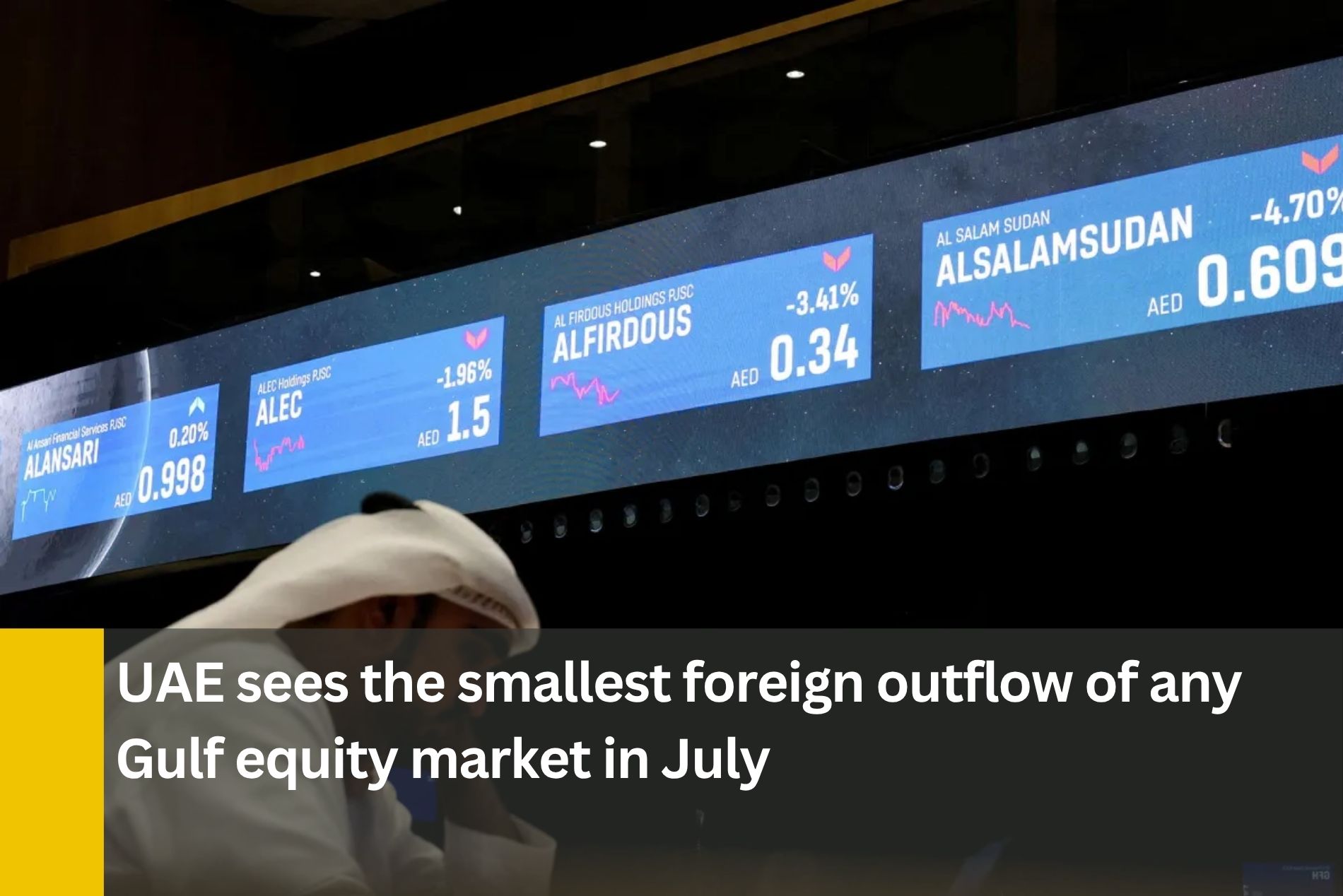
Abu Dhabi recorded US 148 mn net foreign inflow in July, leading Gulf bourses.
Foreign investors pulled money out of every major Gulf equity market in July — but the UAE lost the least by far. As renewed US-Iran escalation triggered USD 415 mn in net foreign outflows from GCC equity markets — reversing June’s net inflows of USD 144 mn — the UAE lost just USD 26 mn, according to investor relations consultancy Iridium. Every other major Gulf market bled more: Saudi Arabia saw USD 129 mn in outflows, breaking a run of inflows in 11 of the previous 12 months; Kuwait led the region with USD 153 mn out the door; and Qatar shed USD 72 mn.
What the numbers tell us: “The UAE’s foreign flow position in July is a strong signal that international investors are treating it as a relatively steady market during periods of regional stress,” Century Financial Chief Investment Officer Vijay Valecha says.
But the UAE’s small headline number hides a split. Abu Dhabi pulled in USD 148 mn of foreign money — the only Gulf bourse to draw a net inflow in July — while Dubai saw USD 174 mn head out.
BACKGROUND- That flips the pattern seen in 2Q, when Saudi Arabia was the only GCC market to draw net foreign inflows — totaling USD 1.6 bn — while both UAE exchanges bled money, with Dubai losing USD 641.5 mn and Abu Dhabi shedding USD 187.3 mn, per Kamco Invest’s 2Q GCC trading report. Four months on, Saudi is the market breaking a run of inflows, and Abu Dhabi is the one foreign investors are choosing.
Three things explain the divergence#1- The economy held up better than expected: The S&P Global UAE PMI never dipped below the 50 growth mark throughout the escalation, falling to a low of 52.1 in April before rebounding to 52.7 in July. Energy exports proved equally resilient: crude output hit a multi-year high of more than 3.8 mn bbl / d in June, with roughly 3.7 mn bbl / d moving through the Strait of Hormuz despite shipping disruptions. “Business conditions on the ground did not deteriorate in the way the headlines might have suggested,” Valecha says.
#2- In Abu Dhabi, market access kept widening: Foreign investors accounted for 77% of new registrations on the Abu Dhabi Securities Exchange in 1H 2026 and 48% of trading value — a sign, Valecha argues, that global capital is building long-term positions rather than trading in and out.
#3- Sector mix is doing the rest of the work: Abu Dhabi’s index gives foreign investors exposure to energy, utilities, large-cap financials, and government-linked infrastructure, while Dubai’s is tied to property, tourism, consumer activity, and banking. “After the recent geopolitical conflict, the sectors expected to attract foreign inflows are concentrated within Abu Dhabi,” Valecha says — and July’s split backs him up, with Abu Dhabi pulling in USD 148 mn of inflows against Dubai’s USD 174 mn of outflows.
The outlookIf tensions stay where they are, Valecha's base case holds — flows stay positive but modest, propped up by the same fundamentals that got the UAE through July. “The outlook for foreign flows into the UAE remains positive over the next three to six months,” Valecha says.
“As long as the domestic economy remains in expansion and market access continues to widen, the UAE could be a leading Gulf market for flows to recover as tensions ease,” he says.
If the conflict escalates further — more attacks on Gulf neighbors or continued disruption around the Strait of Hormuz — Valecha expects a broader Gulf risk discount rather than a UAE-specific selloff. That would mean higher required returns on UAE assets, pressure on Dubai and Abu Dhabi’s logistics and financial hubs, and a broader emerging market pullback that catches the UAE regardless of its own numbers. Even then, he doesn’t see it tipping into capital flight: “relative underperformance and higher volatility,” in his words, not a reversal of the July pattern.
If tensions ease, Valecha points to one specific trigger for a fast turnaround: a reopened Strait of Hormuz alongside a lasting US-Iran ceasefire. That would cut both oil-price volatility and the risk premium priced into the region — and “a rapid reversal of the market correction can occur,” he says, pointing to Dubai in particular as the more tactically de-risked of the two exchanges and therefore the one with more room to snap back.
Source
__399202320.jpg)
__1310535975.jpg)

Regulated by CMA
Century Financial Consultancy LLC


.png)


.png)
.png)

Reach us:
-
Dubai
6th Floor, Emaar Square Building 4,
Downtown, Dubai, P.O. Box 65777,
Dubai, United Arab Emirates -
Abu Dhabi
27th Floor, Office 2701,
Shining Towers, Abu Dhabi, UAE -
Sharjah
29th Floor, Office 2905,
The Business Tower, Sharjah, UAE - +971 (4) 356 2800
- info@century.ae

Disclaimer: Trading in financial products carries substantial risk. Leveraged over-the-counter (OTC) derivatives, such as Contracts for Difference (CFDs) and spot forex, may result in losses exceeding initial deposits and may not be suitable for all investors. These complex instruments do not confer ownership of the underlying assets. Investors should carefully consider their investment objectives and risk appetite, and seek independent professional advice if necessary.
Century Financial Consultancy LLC (CFC) is licensed and regulated by the Capital Market Authority (CMA) of the UAE under license numbers 20200000028 and 301044 to carry out the activities of Financial Products dealer, Trading Broker in international markets, Trading Broker of OTC derivatives and currencies in the spot market, Introduction, Financial Consultations, and Promotion. CFC is incorporated under UAE law, registered with the Dubai Economic Department (No. 768189), with its office at 601, Level 6, Building No. 4, Emaar Square, Downtown Dubai, UAE, PO Box 65777.
The content on this website is provided solely for informational and educational purposes and does not constitute an offer, recommendation, or solicitation to buy or sell any securities or financial products.
Products and services offered by CFC are not intended for use in any jurisdiction where such use or distribution would breach local laws or regulatory requirements.
⚠️ Alert: Fraudulent Activity Notice
Century Financial Consultancy LLC (“Century”) has become aware of fraudulent individuals and entities impersonating our firm through unofficial websites, social media channels, and messaging applications such as Telegram, WhatsApp, and Discord.
Please be advised:
- Century does not manage investments on behalf of clients.
- Century does not solicit funds or guarantee investment returns.
- Century does not accept or make payments in cash, cryptocurrency, or digital assets.
- We do not conduct business via social media or messaging platforms.
Our only official website is www.century.ae, and all communication is conducted exclusively through verified channels.
We strongly urge the public to remain vigilant, verify the authenticity of any communication claiming to be from Century, and report any suspicious activity. Century disclaims any responsibility for losses arising from dealings with unauthorised or fraudulent parties.
