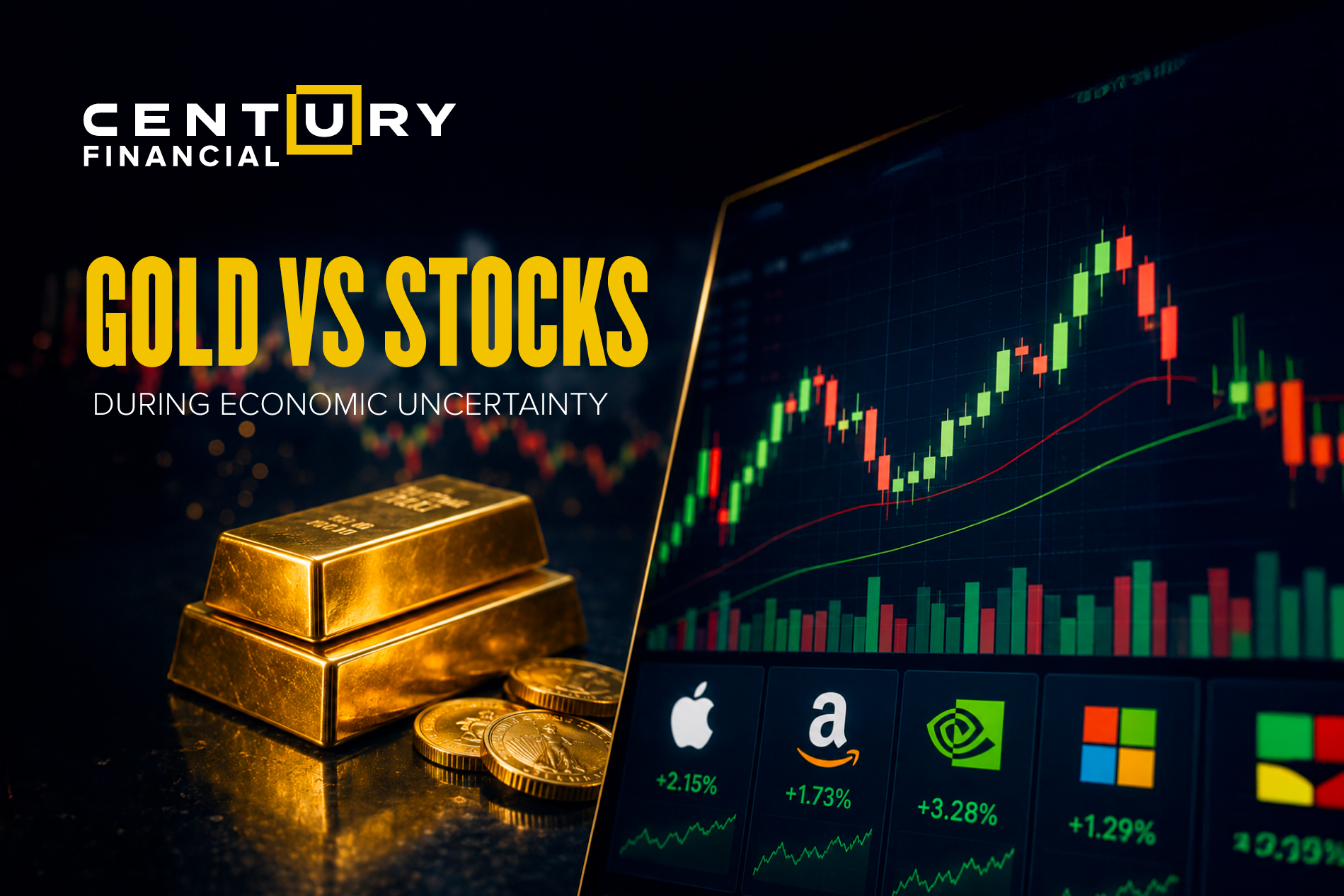
When markets panic, money flows in two directions: some into gold for safety, some into stocks betting on recovery. Understanding which asset works in which situation helps you position correctly when uncertainty hits.
The choice between gold and stocks is not binary—each serves different purposes under different conditions. Understanding when each thrives during uncertainty improves your ability to allocate capital and manage risk efficiently.
Gold vs Stocks: The Basics
What Is Gold Trading?
Gold functions as a store of value and hedge against currency devaluation and inflation. Trading in gold means buying XAU/USD, which represents the spot price of gold. There are no dividends or interest; traders profit from price appreciation.
Gold is highly liquid, with tight spreads on major platforms. Gold trading platforms also offer real-time quotes and execution during 24-hour global markets.
What Is Stock Trading?
Stock trading involves buying and selling shares of publicly listed companies. Traders profit from price appreciation or dividend income. Factors such as company earnings and growth prospects impact a company's stock performance in the markets.
Stock trading platforms provide access to exchanges such as the NYSE, NASDAQ, DFM, and ADX. Leverage availability depends on the broker and account type.
Why Gold Is Considered a Safe-Haven Asset
Gold maintains value during crises. In market cycles where stocks plummet, gold often rises. This opposite relationship makes gold valuable as a form of portfolio insurance. Gold's safe-haven status stems from factors such as:
No credit risk
Gold has intrinsic value and is not dependent on an issuer's ability to repay.
Universally accepted
Gold is recognised and traded across global markets.
Historical store of value
Gold has preserved value over centuries and across market cycles.
Negative correlation during crises
Gold may rise when stocks fall during periods of severe uncertainty.
Gold vs Stocks During Economic Uncertainty: Key Differences
| Factor |
Gold |
Stocks |
| During Crises |
Typically rises as a safe-haven asset |
Typically falls during risk-off periods |
| Income Generation |
None |
Dividends may be available |
| Recovery Potential |
Limited |
High and linked to company earnings |
| Correlation to Economy |
Often negative during weakness |
Generally positive during growth |
| Time Horizon |
Short-term protection or insurance |
Long-term growth |
| Performance During Growth |
May underperform |
May outperform |
Gold vs Stocks During Major Economic Events

Recessions
Gold typically outperforms stocks during recessions. Because of earnings declines and rising unemployment, stock prices may compress sharply. Gold prices often rise when investors seek safety. During recovery, stocks may grow faster than gold.

High Inflation Periods
Both can perform during inflation in different ways. Gold may rise as investors hedge inflation risk. Stocks with pricing power may also perform well. High inflation combined with aggressive rate hikes creates a conflict, and the result depends on which factor dominates.

Interest Rate Cycles
Rising rates may pressure both gold and stocks initially as bonds become more attractive. Falling rates can support both, although stocks may benefit more as lower rates reduce the discount applied to future earnings.

Geopolitical Crises
Wars, sanctions, and political crises can trigger gold rallies as investors seek safety. Stocks may fall because of uncertainty about the economic impact. However, the effect can fade quickly when actual economic damage remains limited.
When Gold May Outperform Stocks
As a safe-haven asset, gold's main strength is protection. Gold may outperform when:
- Recession fears increase and earnings pressure weighs on stocks
- Geopolitical crises create greater safe-haven demand
- Inflation accelerates without equally aggressive rate hikes
- Central banks cut interest rates sharply
- Stress emerges within the financial system
When Stocks May Outperform Gold
Stocks' key strengths are recovery potential and income generation. Stocks may outperform when:
- Economic growth accelerates and corporate earnings expand
- Interest rates fall and lower discount rates support valuations
- Inflation remains stable and an inflation hedge is less necessary
- Global disputes ease and the uncertainty premium fades
- Corporate earnings exceed market expectations
How to Trade Gold and Stocks Online
Choosing a Gold Trading Platform
Gold trades 24 hours, so platforms should support extended market access. Demo accounts and multilingual support can also be valuable. Gold platforms should offer real-time quotes, competitive spreads, and reliable execution.
Choosing a Stock Trading Platform
Stock platforms should provide access to the exchanges you intend to trade, such as the NYSE or NASDAQ. They should display real-time quotes during exchange hours and support limit, market, and stop orders. Commission structures also matter for frequent traders.
Conclusion
Gold and stocks serve different purposes during economic uncertainty. Understanding how each performs during recessions, inflation, interest-rate cycles, and geopolitical events can help traders allocate capital more effectively.
Gold may outperform during crises and inflation spikes, while stocks may outperform during recovery and economic growth. An approach that includes both can combine protection from gold with the growth potential of stocks. Century Financial provides access to trade both assets through platforms offering live data and reliable execution.
Frequently Asked Questions
+
Is gold safer than stocks during economic uncertainty?
Gold typically performs better during crises, recessions, and global uncertainty. However, it has more limited growth potential. The appropriate choice depends on your objectives, risk tolerance, and portfolio structure.
+
Does gold always rise when stocks fall?
No. Gold often rises during stock-market declines driven by recession fears or geopolitical crises, but it may fall alongside stocks when rising interest rates are the main cause of the decline.
+
Which asset performs better during inflation?
Both can perform during inflation through different mechanisms. Gold may rise as investors hedge inflation risk, while stocks with pricing power can pass higher costs to customers. Gold often performs strongly during high-inflation periods.
+
Is gold trading better than stock trading during a recession?
Gold may outperform during recessions because investors seek safety while company earnings weaken. However, stocks can recover strongly when the recession ends, so diversification may be more appropriate than choosing only one asset.
+
What is the best gold and stock trading platform?
A suitable platform should offer reliable execution, real-time quotes, charting, and both desktop and mobile access. Century Trader and MT5 provide access to gold and stocks with live market data and trading tools.
 Loading ...