 Loading ...

Wednesday, September 09, 2026
Quantitative Trading Demystified: From Data to Execution
تم إعداد هذا المنشور من قبل سنشري للاستشارات

Introduction
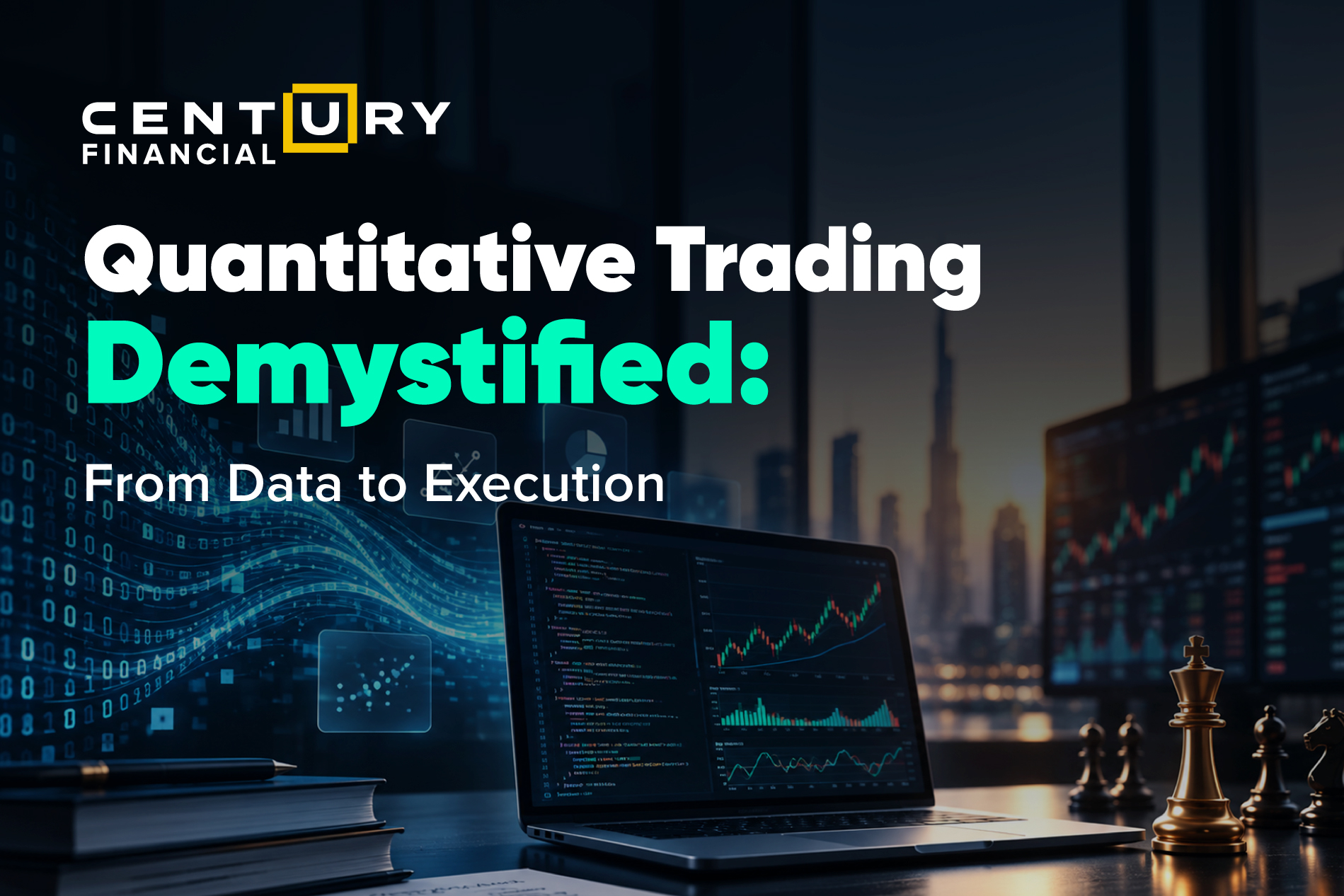
A quiet shift has been happening in how trading decisions get made. Fewer of them start with a hunch about where a market is headed, and more start with a data pull, a spreadsheet, or a model someone spent weeks testing. That shift has a name: quantitative trading, the practice of using mathematics, statistics, and historical data to identify and test trading ideas before any money is actually at risk.
This piece walks through what that looks like in practice, how the process runs from raw data to a live trade, the strategies most commonly built this way, and where quantitative trading overlaps with, and differs from, algorithmic and manual trading.
What Is Quantitative Trading?
Quantitative Trading Meaning
At its simplest, quantitative trading means testing an idea with numbers before acting on it. Someone builds a model, feeds it data, and lets the output, not a feeling, define when to enter or exit a position.
What Is Quantitative Analysis in Trading?
Quantitative analysis applies statistical methods, including regression and correlation analysis, to market data to measure relationships and patterns. It's the analytical foundation a quantitative trading model is built on.
How Quantitative Trading Differs From Traditional Trading
Traditional, or discretionary, trading depends on a trader reading news, charts, and context in real time and deciding from there. Quantitative trading turns that same reasoning into a model that can be tested against years of data long before it touches a live market.
How Does Quantitative Trading Work?
The process usually runs through five connected stages: collecting data, analysing it for patterns, building a model, backtesting that model, and finally executing and monitoring trades. Each stage shapes what the next one can do, and a weak link early on tends to show up later as a bad signal.
Key Components of Quantitative Trading
Five elements tend to show up in any working quantitative approach, and each one leans on the others holding steady. Pull any one of these out and the rest tend to wobble. A model built on incomplete data produces confident, wrong signals, and backtesting without proper risk management can make a reckless strategy look disciplined on paper. The components are:
Quantitative Trading Strategies
Most quantitative strategies fall into a handful of established families, each resting on a different assumption about how prices behave.
| Strategy | Core idea | Signal used | Key risk |
|---|---|---|---|
| Mean reversion | Prices that stray far from an average tend to drift back toward it | Deviation from a historical average, volatility | A market that keeps trending instead of reverting |
| Momentum trading | Instruments already moving in a direction tend to keep moving | Recent price and volume trends | Sharp, sudden reversals |
| Statistical arbitrage | Related instruments show temporary pricing gaps that tend to close | Correlation data across baskets of securities | Correlations breaking down |
| Pairs trading | Two historically correlated instruments are traded against each other when they diverge | The price spread between the pair | A permanent break in that correlation |
| Trend-following | Staying aligned with a prevailing direction across markets | Moving averages, trend indicators | Choppy, range-bound conditions |
Quantitative Trading vs Algorithmic and Manual Trading
Quantitative, algorithmic, and manual trading might seem similar or confusing. Additionally, since a quantitative strategy commonly gets executed through algorithms once the model is built, quantitative vs algorithmic trading blur together in everyday use. They describe different parts of a trade: the analysis behind it, the execution of it, or the human judgment driving it.
What Is Algorithmic Trading?
Algorithmic trading means using pre-programmed rules to execute trades automatically based on variables like price, timing, or volume. It's fundamentally about execution, and it doesn't require a statistical model behind it at all.
How Manual Trading Works
Manual, or discretionary, trading relies on a person reading charts, news, and market context in real time, then placing orders based on that judgment rather than a fixed rule set.
Key Differences Across the Three Approaches
| Approach | Core basis | Decision-making | Execution |
|---|---|---|---|
| Quantitative trading | Statistical and mathematical models | Model-driven, grounded in tested data | May use algorithms, but doesn't require them |
| Algorithmic trading | Pre-programmed rule sets | Rule-based, not necessarily model-derived | Automated by design |
| Manual (discretionary) trading | Trader judgment and market experience | Human interpretation in real time | Orders placed manually |
Benefits of Quantitative Trading
The core appeal of a quantitative approach comes down to structure: decisions that can be tested and repeated rather than shaped by how a trader feels on a given day. Note that none of the following points make a quantitative strategy inherently more profitable than a discretionary one.
Risks in Quantitative Trading
Quantitative trading carries its own set of risks, and most trace back to the model itself rather than the market alone.
The Process in Practice
Everything covered so far, from data to models to backtests, still needs a platform to actually run on. Most traders end up leaning on more than one tool depending on the stage: one for testing an idea against history, another for watching it once it's live, sometimes a third for reaching asset classes the first two don't cover.
Century Financial's platform lineup spans a good part of that range. MT5 and CQG both support the kind of historical data access and charting a backtest depends on, while TWS and IBKR extend that into broader global market access for strategies that cross regions. The Century Trader App keeps monitoring and execution in one place once a model goes live.
Elevate your trading experience with
Century Trader App
Elevate your trading experience with
Century Trader App

Conclusion
Quantitative trading turns market decisions into models built on data, statistics, and historical testing, standing apart from discretionary trading and its dependence on real-time judgment calls. Whichever approach a trader leans toward, the common thread is testing an idea before scaling it and staying on top of it once it's live.
Century Financial's platforms, including MT5, CQG, TWS, IBKR and the Century Trader App, support that kind of process, from data access through to backtesting and execution, alongside tools like Share Baskets for structuring exposure across multiple assets at once. For anyone curious about bringing a more structured, data-led process into their own trading, it might be worth seeing how those tools fit into that workflow.
Frequently Asked Questions
Q1: What is quantitative trading in simple terms?
A: Holding positions for minutes, hours, or days. Scalpers hold seconds/minutes. Day traders close by market close. Swing traders hold days/a week. All operate within short-term frameworks hunting daily price moves.
Q2: How does quantitative trading work?
A: It typically moves through five stages: collecting market data, identifying patterns, building a model, backtesting it against historical data, then executing and monitoring live trades.
Q3: What are the main quantitative trading strategies?
A: Common strategies include mean reversion, momentum trading, statistical arbitrage, pairs trading, and trend-following, each built on a different assumption about price behavior.
Q4: Is quantitative trading profitable?
A: Is quantitative trading profitable?
Q5: What is the difference between quantitative and algorithmic trading?
A: Quantitative trading focuses on the statistical model behind a decision, while algorithmic trading focuses on automated execution. A strategy can use both together.
لا تقدم شركة سنشري للإستشارات والتحليل المالي ش.ذ.م.م (الشركة) محتوى هذه المدونة، بما في ذلك أي أبحاث أو تحليلات أو آراء أو توقعات أو أي معلومات أخرى (يُشار إليها مجتمعةً باسم "المعلومات")، إلا لأغراض التسويق والتثقيف وإتاحة المعلومات العامة. ولا يُفسَّر ذلك على أنه نصيحة استثمارية أو توصية أو دعوة لشراء أو بيع أي أدوات مالية.
كما يجوز نشر هذه المعلومات عبر قنوات مختلفة، بما في ذلك موقع الشركة الإلكتروني، ومنصات الغير، والنشرات الإخبارية، والمواد التسويقية، ورسائل البريد الإلكتروني، ووسائل التواصل الاجتماعي، وتطبيقات المراسلة، والندوات الإلكترونية، وغيرها من وسائل التواصل. وبينما تسعى الشركة لضمان دقة المحتوى، فإنها لا تضمن اكتماله أو موثوقيته أو تحديثه في الوقت المناسب. وعليه، فأي قرارات تُتخذ بناءً على هذه المعلومات تكون على مسؤوليتك الشخصية. ولا تتحمل الشركة أي مسؤولية عن أي خسارة أو ضرر ناتج عن استخدامها.
ينطوي تداول المنتجات المالية على مخاطر كبيرة، بما لا يتناسب مع جميع المستثمرين. فيُرجى التأكد من وعيك التام بالمخاطر، وطلب الاستشارة المهنية المتخصصة إذا لزم الأمر.
يُرجى الاطلاع على بيان كشف المخاطر الشامل المتوفر على موقعنا الإلكتروني.


تنظمها هيئة الأوراق المالية والسلع
سنشري للاستشارات المالي ش.ذ.م.م


تصل إلينا:
-
دبي
الطابق رقم 6, مبنى رقم 4, ساحة إعمار دبي
وسط مدينة دبي، ص.ب: 65777،
دبي، الإمارات العربية المتحدة -
Abu Dhabi
27th Floor, Office 2701,
Shining Towers, Abu Dhabi, UAE -
Sharjah
29th Floor, Office 2905,
The Business Tower, Sharjah, UAE - +971 (4) 356 2800
- info@century.ae

Century Financial is the presenting sponsor of

ينطوي التداول في المنتجات المالية على مخاطر كبيرة. فالاعتماد على المشتقات المالية المتاحة للتداول خارح البورصة، مثل عقود الفروقات وتداول العملات الأجنبية (الفوركس) الفوري، قد يتسبب في خسائر تتجاوز قيمة الإيداعات الأولية، مما يجعلها غير ملائمة لجميع المستثمرين. فهذه الأدوات المالية المعقدة لا تمنح ملكية مباشرة للأصول الأساسية. لذا، ينبغي للمستثمرين الاحتراز عند تحديد أهدافهم الاستثمارية ومراعاة مستوى المخاطرة المتوقَع، واللجوء إلى الاستشارة المهنية المتخصصة عند الضرورة.
سنشري للإستشارات والتحليل المالي ش.ذ.م.م (الشركة)، شركة مرخّصة ومنظمة من هيئة الأوراق المالية والسلع في دولة الإمارات العربية المتحدة، بموجب الترخيص رقم (20200000028) و(301044) لتولي أعمال الوساطة في الأسواق الدولية، وتداول المشتقات المالية والعملات المتاحة للتداول خارج البورصة في سوق التداول الفوري، بالإضافة إلى تقديم الخدمات الاستشارية والترويجية. تأسست الشركة بموجب قوانين دولة الإمارات العربية المتحدة، وهي مسجلة لدى دائرة التنمية الاقتصادية بدبي (رقم: 768189)، حيث يقع مكتبها المسجّل في 601، الطابق السادس، المبنى رقم 4، ميدان إعمار، وسط مدينة دبي، دولة الإمارات العربية المتحدة، ص.ب. 65777.
لا يُعرَض محتوى هذا الموقع الإلكتروني إلا لأغراض تعريفية تثقيفية بحتة، فلا يمثل عرضًا ولا توصيةً ولا دعوةً لشراء أو بيع أي أوراق مالية أو منتجات مالية.
لا تنوي الشركة استخدام أو توزيع منتجاتها وخدماتها في أي ولاية قضائية حيث يُشكِّل هذا الاستخدام أو التوزيع انتهاكًا للقوانين المحلية أو اللوائح التنظيمية.
