 Loading ...

Thursday, February 05, 2026
A Complete Guide to Corporate Bond ETFs for Smart Investors
By Century Financial in 'Blog'
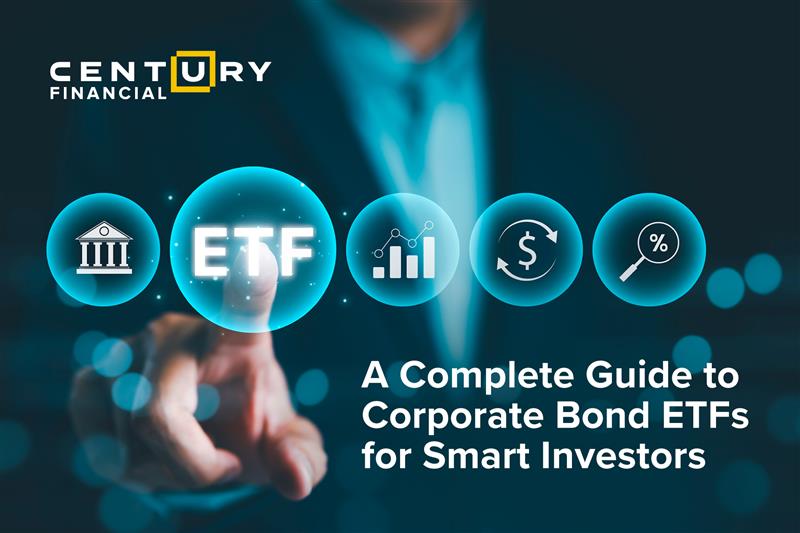

What Are Corporate Bond ETFs?
Corporate bond ETFs fall into a category of instruments that make the markets such an attractive place of investment. Within the same ecosystem, infamous for volatility and unpredictability, stable investment avenues based on debt give market participants a way to stabilize their portfolios.
Let's look at the words one by one: "Corporate" shows who the issuer of this instrument is, "bond" is an umbrella term for a long-term debt instrument, and finally, "ETF" stands for Exchange Traded Fund. Put them together, and this avenue mobilizes capital and places it in a basket of bonds issued by companies.
Factors that define and differentiate debentures (another word for corporate bonds) are many, including, but not limited to, interest rates, ratings, yield, and the type of bond itself. So, read along if you are interested!
How Corporate Bond ETFs Work in the Market
Corporate bond ETFs provide exposure to a diversified pool of corporate debt. Instead of buying individual bonds after dedicating hours of consideration to maturity dates and yields, the ETF structure bundles dozens—sometimes even hundreds—of them into a single tradable unit. By investing in corporate bond ETFs, you are opting for the liquidity of stocks with the stability of fixed-income instruments.
These ETFs often play an essential role across multiple trading approaches, including hedging, portfolio balancing, and even income-focused strategies. For instance, traders sometimes use corporate bond ETFs within their option trading strategies. Here, ETFs provide stability, while options let them capitalize on short-term volatility.
Benefits of Investing in Corporate Bond ETFs
Corporate bond ETFs are attractive to many investors because they offer a reliable way to earn income while making it easy to trade, much like stocks. Exposure to a variety of bonds are made easy with these funds without the hassle of purchasing them one by one, which can be quite complicated.
Diversification Across Corporate Credit
One of the strongest advantages of corporate bond ETFs is the built-in diversification they offer.
Broad issuer exposure that spreads risk across multiple companies instead of a single borrower.
Sector and maturity mix that balances performance across economic cycles and changing conditions.
Stable portfolio anchor that can complement positions in CFDs or currencies during volatile periods.
Lower Costs Compared to Active Bond Funds
The effectiveness of an investment avenue can be tampered by its costs, but ETFs can prove beneficial in this regard too.
Index-tracking efficiency helps these ETFs keep fees lower than actively managed bond funds.
Reduced turnover costs allow more of the bond income to remain with the investor.
Long-term cost advantage that compounds meaningfully for income-focused portfolios.
Access to Investment-Grade & High-Yield Bonds
Flexibility is one of the core reasons bond ETFs have grown in popularity.
Dual-market availability lets investors choose between safer investment-grade or higher-yielding bonds.
Customizable risk levels through ETFs targeting specific rating buckets or blended exposures.
Simplified access to markets that would otherwise require large capital and specialized bond dealers.
Ease of Trading Corporate Bond ETFs Like Shares
Another reason investors go for the best corporate bond ETFs is the convenience of trading they offer.
Exchange-traded flexibility allows investors to buy and sell throughout the day at live market prices.
Stock-like liquidity makes corporate bond ETFs far more accessible than individual bonds.
Accessibility of information drives investors to conduct their due diligence.
Risks Associated with Corporate Bond ETFs
Debt instruments are often considered steadier than many market-linked assets, but “low risk” never means “no risk.” Within the world of debt, corporate bonds carry added layers of uncertainty because you’re lending to companies, not governments. This is why ratings matter, as they give investors a quick snapshot of a company’s ability to repay, but even highly rated issuers can face unexpected stress.
Credit Risk & Default Probability
Corporate bond ETFs hold multiple issuers, and any deterioration in a company’s financial health can affect the ETF’s value which can lead to:
Lower repayment strength
Downgrade pressure
Higher default odds
Weak issuer earnings
Interest Rate Sensitivity
An inverse relationship exists between bond prices and interest rates, which means rising rates can quickly reduce ETF values. Other factors include:
Price-rate inversion
Duration-related drops
Yield curve shifts
Policy change impact
Liquidity Risks During Volatile Markets
During stressed markets and changing trading patterns, bond liquidity can become thin, leading to wider ETF spreads than usual. This leads to:
Wider bid-ask
Fast price swings
Limited market depth
Stress-driven selling
Tracking Error vs Underlying Bond Index
Because ETFs trade like stocks while bonds settle differently, returns may not perfectly match the index they track, leading to issues like:
Index mismatch
Cost-driven deviation
Turnover impact
Timing differences
Best Corporate Bond ETFs to Watch in 2026
Here are some corporate bond ETFs you could consider while building your debt portfolio:
This fund includes a wide range of U.S. investment-grade corporate bonds, giving you access to high-quality credit from companies with different maturity dates.
This ETF invests in investment-grade corporate bonds with intermediate maturities, aiming to balance income potential and moderate interest-rate sensitivity.
This fund gives you access to short-term, investment-grade corporate bonds, which can help lower interest-rate risk compared to longer-term options. Keep in mind, trading may be less active than with larger funds.
This ETF provides a mix of intermediate-term U.S. investment-grade corporate bonds, with low fees and a wide range of issuers. It is a popular choice among investors seeking diversified exposure in the corporate bond space.
This fund focuses on short-term, investment-grade corporate bonds. It is often chosen by investors who want less risk from interest rate changes and more stable income.
Corporate Bond ETFs vs Corporate Bond Funds
Corporate bond ETFs and corporate bond funds often look similar at first glance, but the way they trade, price, and charge fees can feel very different once you compare them side by side. Here’s a simple table that breaks down the key distinctions investors care about.
| Factors | Corporate Bond ETFs | Corporate Bond Funds |
|---|---|---|
| Trading Method | Can be traded intraday like shares | Bought or sold at end-of-day NAV |
| Pricing Transparency | Live market prices visible throughout the day | Single daily price based on portfolio valuation |
| Flexibility | Easy to enter/exit quickly | Less suitable for active trading moves |
| Minimum Investment | Usually low, similar to stocks | Can be higher depending on the fund |
| Use Cases | Trading, hedging, short-term adjustments | Long-term, professionally managed exposure |
Diversifying with Corporate Bond ETFs
Corporate bond ETFs play different roles for different kinds of investors, whether you’re someone who scans charts by the hour or someone who checks their portfolio once a month. The same ETF can act as a safety net for a trader and a steady income source for a long-term investor.
Corporate bond ETFs can serve as a steady anchor in a volatile market. When traders are exploring different strategies, trading in derivatives, or managing riskier equity holdings, these ETFs can provide the stability that's often needed to navigate the ups and downs of trading.
Quick risk buffer
Reliable liquidity base
Counterweight to volatility
Smooth hedging tool
For long-term investors, corporate bond ETFs offer consistent income and a diverse range of issuers without the hassle of purchasing individual bonds. For those who are comfortable taking on a bit more risk, high-yield ETFs present an opportunity to pursue higher returns while keeping a diversified approach.
Consistent income potential
Broad credit exposure
Lower long-run costs
Access to high-yield baskets
How to Trade Corporate Bond ETFs with Century Financial
Century Financial gives traders access to corporate bond ETFs through platforms designed for different trading styles, while empowering their trades with local market updates and insights.
Platforms such as MT5, CQG, and TWS provide flexible ways to track, analyze, and trade bond-based instruments. With transparent pricing and multi-asset access, traders can easily integrate corporate bond ETFs into their broader market approach without overcomplicating the process.
Factors to Consider Before Investing in Corporate Bond ETFs
Before committing to any corporate bond ETFs, it helps to understand how different features can influence returns and risk.
YTM and YTC indicate the income you can expect if the underlying bonds are held to maturity or called early. These figures help compare the return potential across different ETFs in a straightforward way.
Duration shows how sensitive the ETF is to interest rate changes, while convexity explains how that sensitivity evolves as rates move. Together, they help investors judge how sharply the ETF might react during periods of rapid rate adjustments.
An ETF’s credit mix highlights how much exposure it has to investment-grade issuers versus riskier, high-yield companies. Unlike treasuries, this ETP depends on the financial health of individual firms, making the rating spread an essential consideration.
Fees and liquidity can affect long-term performance. Lower expense ratios and easier trade execution make it simpler to compare the best corporate bond ETF options when building a diversified portfolio that may also include commodities or indices.
Conclusion
Corporate bond ETFs are really an intriguing option for investors. They combine the reliable returns we often seek from fixed-income investments with the convenience of trading shares. At Century Financial, this style of investing is supported by years of market experience, access to global platforms, and an education hub built to help traders understand what they’re buying.
Interested in experiencing this world of investment? Start by opening an account and exploring the platforms at your own pace.
FAQs
Q1. What is a Corporate Bond ETF?
A: A corporate bond ETF is a collection of company-issued bonds packaged into a single security that trades on an exchange. It gives you instant exposure to multiple issuers without having to buy bonds individually.
Q2: Are corporate bond ETFs safer than equity ETFs?
A: They tend to be less volatile because they're backed by corporate debt rather than shares, but the credit quality of the bonds within the ETF dictates the ETF's quality.
Q3: What is the difference between a corporate bond fund and a corporate bond ETF?
A: A corporate bond fund is usually actively managed, with prices calculated daily, while corporate bond ETFs are listed on an exchange, with market forces determining prices. Entering, exiting, charges, and management styles all differ between them.
Q4. Which factors determine the returns of corporate bond ETFs?
A: Returns depend on interest rates, credit ratings, yield-to-maturity, ETF costs, and broader market demand for corporate debt. Duration plays a major role in an ETF's sensitivity to rate changes.
Q5. How can I trade corporate bond ETFs on platforms like MT5, TWS, and CQG?
A: You can open an account with Century Financial, and you’ll be able to opt for these platforms and Century Trader to participate in the global financial markets.
Related Reads
This marketing and educational content has been created by Century Financial Consultancy LLC (“Century”) for general information only. It does not constitute investment, legal, tax, or other professional advice, nor does it constitute a recommendation, offer, or solicitation to buy or sell any financial instrument. The material does not take into account your investment objectives, financial situation, or particular needs.
The opinions expressed by the hosts, speakers, or guests are their own and may change without notice. Information is based on sources we consider to be reliable; however, Century does not guarantee its accuracy, completeness, or timeliness and accepts no liability for any loss arising from reliance on this content.
Trading and investing involve significant risk, and losses may exceed initial deposits. Past performance is not indicative of future results. CFDs and other leveraged products are complex instruments that may not be suitable for all investors. Please ensure you understand how these products work, the associated risks, and seek independent professional advice if necessary.
Century is licensed and regulated by the UAE Capital Market Authority (CMA) under License Nos. 20200000028 and 301044.
Please refer to the full risk disclosure mentioned on our website.


Regulated by CMA
Century Financial Consultancy LLC


.png)
.png)
.png)
.png)


Reach us:
-
Dubai
6th Floor, Emaar Square Building 4,
Downtown, Dubai, P.O. Box 65777,
Dubai, United Arab Emirates -
Abu Dhabi
27th Floor, Office 2701,
Shining Towers, Abu Dhabi, UAE -
Sharjah
29th Floor, Office 2905,
The Business Tower, Sharjah, UAE - +971 (4) 356 2800
- info@century.ae

Disclaimer: Trading in financial products carries substantial risk. Leveraged over-the-counter (OTC) derivatives, such as Contracts for Difference (CFDs) and spot forex, may result in losses exceeding initial deposits and may not be suitable for all investors. These complex instruments do not confer ownership of the underlying assets. Investors should carefully consider their investment objectives and risk appetite, and seek independent professional advice if necessary.
Century Financial Consultancy LLC (CFC) is licensed and regulated by the Capital Market Authority (CMA) of the UAE under license numbers 20200000028 and 301044 to carry out the activities of Financial Products dealer, Trading Broker in international markets, Trading Broker of OTC derivatives and currencies in the spot market, Introduction, Financial Consultations, and Promotion. CFC is incorporated under UAE law, registered with the Dubai Economic Department (No. 768189), with its office at 601, Level 6, Building No. 4, Emaar Square, Downtown Dubai, UAE, PO Box 65777.
The content on this website is provided solely for informational and educational purposes and does not constitute an offer, recommendation, or solicitation to buy or sell any securities or financial products.
Products and services offered by CFC are not intended for use in any jurisdiction where such use or distribution would breach local laws or regulatory requirements.
⚠️ Alert: Fraudulent Activity Notice
Century Financial Consultancy LLC (“Century”) has become aware of fraudulent individuals and entities impersonating our firm through unofficial websites, social media channels, and messaging applications such as Telegram, WhatsApp, and Discord.
Please be advised:
- Century does not manage investments on behalf of clients.
- Century does not solicit funds or guarantee investment returns.
- Century does not accept or make payments in cash, cryptocurrency, or digital assets.
- We do not conduct business via social media or messaging platforms.
Our only official website is www.century.ae, and all communication is conducted exclusively through verified channels.
We strongly urge the public to remain vigilant, verify the authenticity of any communication claiming to be from Century, and report any suspicious activity. Century disclaims any responsibility for losses arising from dealings with unauthorised or fraudulent parties.
