 Loading ...

Tuesday, January 13, 2026
Exponential Moving Average (EMA): Complete Guide for Traders
By Century Financial in 'Blog'
.jpg)
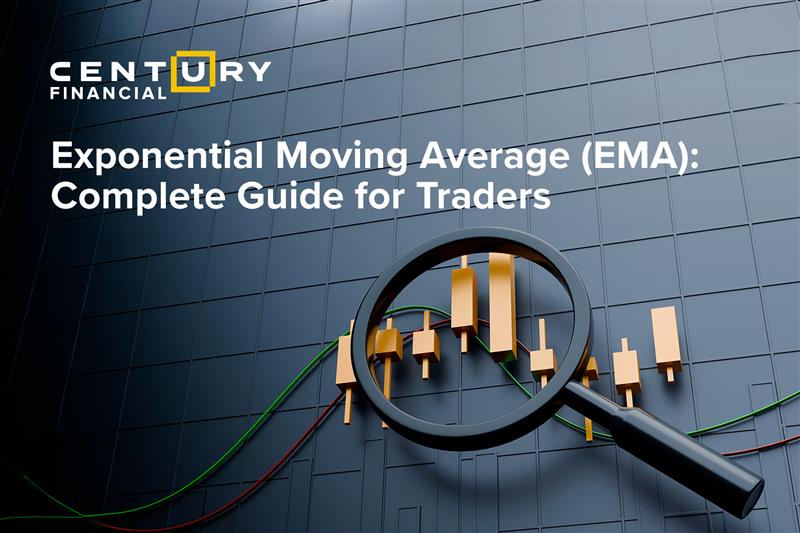
The Exponential Moving Average (EMA) is one of the most widely used technical indicators in trading. Whether you trade stocks, forex, commodities, indices, or CFDs, understanding how EMA works can significantly improve trade timing, trend identification, and risk management.
Unlike the Simple Moving Average (SMA), which gives equal weight to all past prices, the EMA places greater emphasis on recent price data. This makes it more responsive to market movements and particularly useful in fast-changing or volatile market conditions. Because of this responsiveness, traders often rely on EMA to identify early trend changes, dynamic support and resistance levels, and momentum shifts.
In addition to trend-following strategies, the EMA plays an essential role in supply and demand trading. Traders use EMA to confirm price reactions around key zones, validate trend direction, and avoid counter-trend trades. When price aligns with EMA direction near strong supply or demand areas, it often increases the probability of a successful trade setup.
What Is EMA in Trading?
The Exponential Moving Average (EMA) computes the average price of an asset over a defined time frame, with greater weight assigned to the most recent price data. Traders can respond more quickly to price movements with the EMA because of this mechanism. EMA is continuously updated as new price data is released to traders, helping them gauge market direction.
Trading above the EMA is a strong indicator of bullish momentum, whereas trading below the EMA is sometimes a strong indicator of bearish momentum. The EMA slope also provides a clue to trend strength, and steeper angles indicate greater momentum.
Some key characteristics of the EMA indicator include:
Faster reaction to price changes compared to traditional moving averages
Better trend clarity during active and trending markets
Strong compatibility with momentum-based and supply demand trading strategies
Most traders use commonly used EMA periods such as 9, 20, 50, 100, and 200, selecting them based on their trading timeframe and strategy.
EMA in Stock Market Trading
EMA is an incredible tool to trade in the stock market. It helps short-term traders determine whether a stock is on its way up or not. Different EMA settings are used by market participants, depending on their trading horizons. 20- and 50-day are preferred by swing traders, and long-term investors go for 100 or 200 EMA.
EMA in stock market trading works best when combined with other technical indicators, such as volume analysis, price structure, and high-timeframe trend confirmation. Such a combination will eliminate false signals and improve the accuracy of trading decisions.
Formula for Exponential Moving Average (EMA)
The EMA calculation applies a multiplier to recent prices, which increases the indicator’s responsiveness.
EMA Formula:
EMA = (Closing Price × Multiplier) + [Previous EMA × (1 - Multiplier)]
Multiplier Formula:
Multiplier = 2 ÷ (No. of Observations + 1)
For example, for a 50-day MA, the number of observations will be 50
How EMA Is Calculated in Trading Platforms
Modern trading platforms calculate EMAs in real time using price data. Traders only need to select the EMA period and apply it to the chart.
Shorter EMA periods react quickly but may give more false signals. Longer EMA periods move slowly but provide stronger trend confirmation. Choosing the right EMA depends on your trading timeframe and strategy.
EMA Trading Strategies That Traders Actually Use
EMA works best when price consistently respects the EMA, indicating institutional participation rather than random or speculative movement.
Popular EMA trading approaches include:
Trend-following trades using EMA slope
Pullback entries toward dynamic EMA support or resistance
Momentum confirmation during breakouts
EMA Crossing and EMA Crossover Strategy
EMA crossing is one of the most widely used signal methods in technical analysis for identifying potential trend changes. It occurs when a shorter-period EMA moves above or below a longer-period EMA, signaling a possible shift in market momentum.
Traders use EMA crossovers to spot early trend direction, confirm breakouts, and filter trades in trending markets. However, crossover signals are most effective when supported by price action, market structure, or higher-timeframe confirmation to reduce false signals.
An EMA crossover occurs when
A short-term EMA crosses above a long-term EMA (bullish signal)
A short-term EMA crosses below a long-term EMA (bearish signal)
Common EMA crossover combinations
9 EMA and 21 EMA for intraday trading
20 EMA and 50 EMA for swing trading
50 EMA and 200 EMA for long-term trend shifts
Combining EMA with Supply and Demand in Trading
Market indicators are the strongest when used alongside other indicators. EMA acts as a dynamic trend guide, while supply demand zones provide precise entry areas.
Best practices:
Trade demand zones only when the price is above the EMA
Trade supply zones only when the price is below the EMA
Avoid zones that conflict with the EMA direction
This combination improves accuracy and reduces emotional decision-making.
EMA vs SMA: Key Differences Traders Should Know
The main difference between EMA and SMA lies in sensitivity. Note that most professional traders prefer EMA in active trading environments.
| EMA | SMA |
|---|---|
| Responds faster to recent prices | Slower and smoother |
| Better for short-term trading | Better for long-term trend analysis |
| More accurate during volatile markets | Less sensitive to noise |
What Is a Good EMA Setting?
There is no perfect EMA setting, because, as with everything in markets, EMAs are dynamic. Also, EMA performance varies with an individual's trading style, market time, and market conditions.
Standard EMA settings include:
Scalping: 9 EMA, 20 EMA
Intraday trading: 20 EMA, 50 EMA
Swing trading: 50 EMA, 100 EMA
Long-term trend analysis: 200 EMA
Choosing the right EMA setting requires aligning it with the trading objective and market behavior. Testing EMA settings on historical price data helps traders understand how the indicator performs across different market phases before applying it in live trading.
Limitations of EMA in Trading
Despite its advantages, EMA has limitations. Understanding both sides is crucial to having a balanced outlook.
EMA may fail when:
Markets are range-bound
News-driven volatility spikes
Price whipsaws around the EMA
This is why it is advisable to use EMA in conjunction with structural, volume, or supply and demand analysis.
Conclusion
The Exponential Moving Average (EMA) is a popularly used indicator for interpreting market trends and momentum. It is also applicable to intraday, swing, or long-term trading strategies due to its ability to quickly react to recent price changes.
Although EMA is effective at determining trend direction, crossovers, and support and resistance, it is most effective when used alongside price structure, volume, supply and demand analysis, and a trusted platform like Century Trader.
When applied correctly, through a trustworthy broker like Century Financial that helps you have a smooth trading experience, with proper confirmations and risk management, EMA is a valuable tool for enhancing trade timing and consistency.
Elevate your trading experience with
Century Trader App
Elevate your trading experience with
Century Trader App

FAQs
Q1. What does EMA mean in trading?
A: EMA stands for Exponential Moving Average. It gives more attention to recent prices, making it more responsive than simple moving averages.
Q2: Is EMA suitable for beginners?
A: Yes. EMA is simple to understand and widely used, but beginners should avoid using it alone without confirmation.
Q3: Which EMA is best for stock trading?
A: The 20 EMA and 50 EMA are commonly used in stock trading, depending on whether the trader is short-term or swing-focused.
Q4. Can EMA be used with supply and demand trading?
A: Yes. EMA helps filter trades, so traders focus only on supply and demand zones aligned with the trend.
Q5. Is EMA better than SMA?
A: EMA is better suited to short-term, volatile markets, while SMA is better suited to long-term smoothing.
Related Reads
This marketing and educational content has been created by Century Financial Consultancy LLC (“Century”) for general information only. It does not constitute investment, legal, tax, or other professional advice, nor does it constitute a recommendation, offer, or solicitation to buy or sell any financial instrument. The material does not take into account your investment objectives, financial situation, or particular needs.
The opinions expressed by the hosts, speakers, or guests are their own and may change without notice. Information is based on sources we consider to be reliable; however, Century does not guarantee its accuracy, completeness, or timeliness and accepts no liability for any loss arising from reliance on this content.
Trading and investing involve significant risk, and losses may exceed initial deposits. Past performance is not indicative of future results. CFDs and other leveraged products are complex instruments that may not be suitable for all investors. Please ensure you understand how these products work, the associated risks, and seek independent professional advice if necessary.
Century is licensed and regulated by the UAE Capital Market Authority (CMA) under License Nos. 20200000028 and 301044.
Please refer to the full risk disclosure mentioned on our website.

Regulated by CMA
Century Financial Consultancy LLC


.png)
.png)
.png)
.png)


Reach us:
-
Dubai
6th Floor, Emaar Square Building 4,
Downtown, Dubai, P.O. Box 65777,
Dubai, United Arab Emirates -
Abu Dhabi
27th Floor, Office 2701,
Shining Towers, Abu Dhabi, UAE -
Sharjah
29th Floor, Office 2905,
The Business Tower, Sharjah, UAE - +971 (4) 356 2800
- info@century.ae

Disclaimer: Trading in financial products carries substantial risk. Leveraged over-the-counter (OTC) derivatives, such as Contracts for Difference (CFDs) and spot forex, may result in losses exceeding initial deposits and may not be suitable for all investors. These complex instruments do not confer ownership of the underlying assets. Investors should carefully consider their investment objectives and risk appetite, and seek independent professional advice if necessary.
Century Financial Consultancy LLC (CFC) is licensed and regulated by the Capital Market Authority (CMA) of the UAE under license numbers 20200000028 and 301044 to carry out the activities of Financial Products dealer, Trading Broker in international markets, Trading Broker of OTC derivatives and currencies in the spot market, Introduction, Financial Consultations, and Promotion. CFC is incorporated under UAE law, registered with the Dubai Economic Department (No. 768189), with its office at 601, Level 6, Building No. 4, Emaar Square, Downtown Dubai, UAE, PO Box 65777.
The content on this website is provided solely for informational and educational purposes and does not constitute an offer, recommendation, or solicitation to buy or sell any securities or financial products.
Products and services offered by CFC are not intended for use in any jurisdiction where such use or distribution would breach local laws or regulatory requirements.
⚠️ Alert: Fraudulent Activity Notice
Century Financial Consultancy LLC (“Century”) has become aware of fraudulent individuals and entities impersonating our firm through unofficial websites, social media channels, and messaging applications such as Telegram, WhatsApp, and Discord.
Please be advised:
- Century does not manage investments on behalf of clients.
- Century does not solicit funds or guarantee investment returns.
- Century does not accept or make payments in cash, cryptocurrency, or digital assets.
- We do not conduct business via social media or messaging platforms.
Our only official website is www.century.ae, and all communication is conducted exclusively through verified channels.
We strongly urge the public to remain vigilant, verify the authenticity of any communication claiming to be from Century, and report any suspicious activity. Century disclaims any responsibility for losses arising from dealings with unauthorised or fraudulent parties.
