 Loading ...

Monday, April 27, 2026
Position Sizing in Volatile Markets: What the Frameworks Say
By Century Financial in 'Blog'
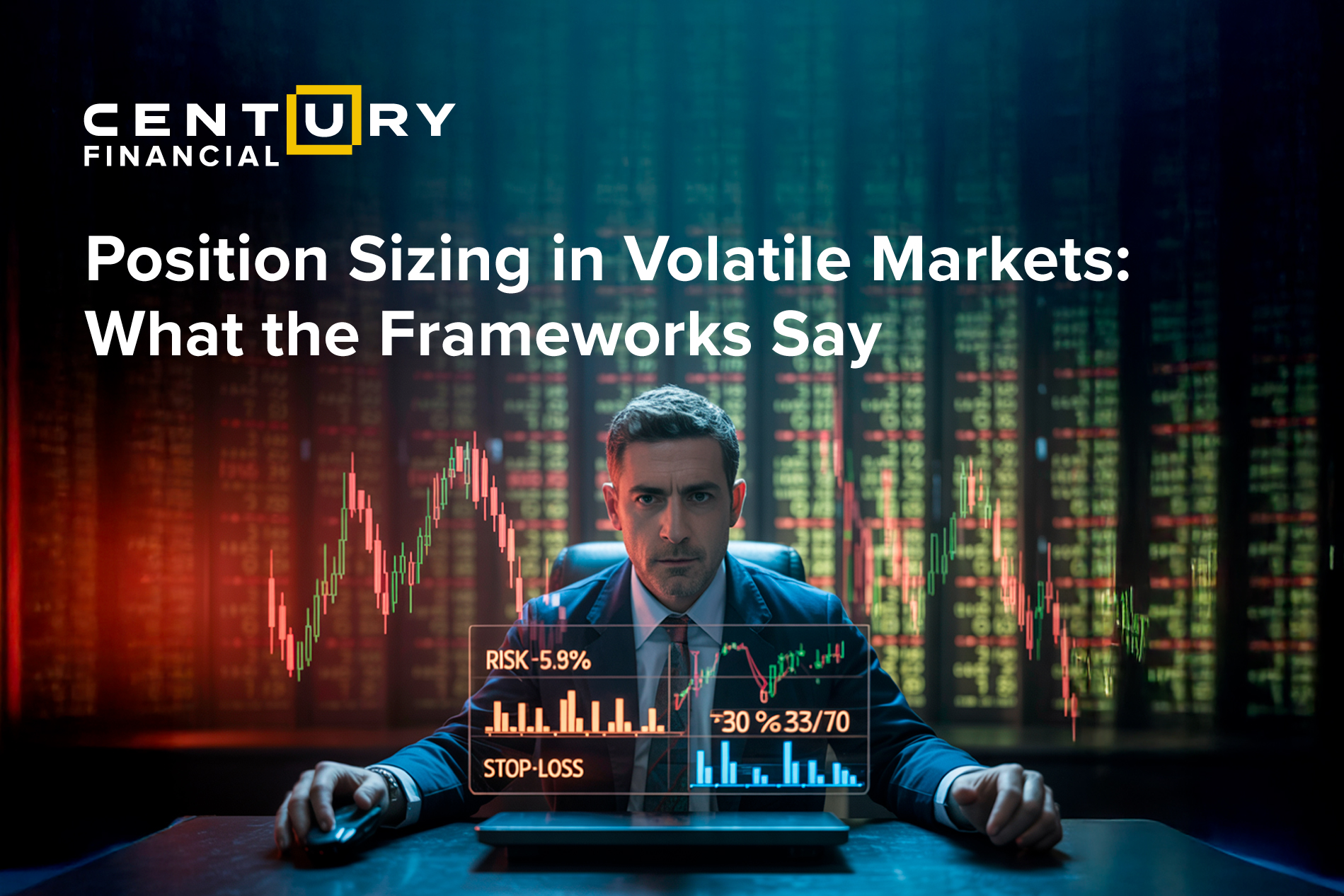

Markets can absorb a lot of uncertainty. But when geopolitical flashpoints reignite (a ceasefire collapses, a conflict escalates), the volatility that follows tends to be sharper and less predictable than the routine kind. Spreads widen, prices gap, and risk exposure that looked manageable one day can look very different the next.
This is where position sizing gets tested. Not as a concept, but as a practice. The frameworks traders use to manage capital allocation during normal conditions, like the 3-5-7 rule, were largely built with moments like this in mind, and understanding what they actually say is more useful than reacting to the noise.
What Position Sizing Actually Involves
At normal volatility levels, price swings are relatively contained. During geopolitical events, that range can expand quickly, meaning a stop-loss calibrated for quieter conditions may get triggered by intraday noise rather than an actual directional move.
Position sizing refers to how much of a portfolio’s capital is allocated to a single trade. It’s a mechanical decision, but the inputs that feed it shift significantly when market conditions change. The core question a sizing framework tries to answer is, given the potential downside on this trade, how large can this position be before the loss threatens the broader portfolio? That question looks very different when volatility is elevated.
Three Frameworks Traders Reference
There’s no universal method. What exists is a set of frameworks, each developed through trading practice, each treating the volatility problem differently.
Fixed Fractional Sizing
Fixed fractional sizing allocates a consistent percentage of total capital to each trade, commonly between 1 and 3%. As capital changes, the absolute position size changes proportionally, which naturally limits exposure as losses accumulate. Some traders also reduce the fixed percentage itself during volatile periods, reflecting the wider risk each trade carries.
- A more rigid approach to position sizing
- The fixed percentage can be adjusted manually to reflect current market conditions
- Doesn’t account for correlation between open positions
ATR-Based Sizing
ATR-based sizing uses the Average True Range (ATR) indicator—a measure of average price movement over a set period, including overnight gaps—to determine where a stop should logically sit. From there, the maximum position size that keeps potential loss within a defined threshold is calculated. As volatility rises and ATR expands, position sizes under this model contract mechanically.
- Stop-loss placement is derived from actual market movement ranges
- Position sizes reduce automatically when volatility increases
- Relies on historical price ranges as a proxy for near-term volatility
The Kelly Criterion
Originally a formula from information theory, the Kelly Criterion calculates a theoretically optimal allocation based on the probability of a winning trade and the win/loss ratio. Most traders use a fractional version — half-Kelly or quarter-Kelly — because full Kelly sizing can be aggressive and amplify drawdowns when probability estimates turn out to be wrong.
- Fractional Kelly reduces the model’s more aggressive output while retaining its core logic
- During high-uncertainty periods, arriving at reliable probability estimates gets harder
- Works best as a cross-check against other sizing methods rather than a standalone approach
Putting Frameworks Into Practice
Understanding how a framework works is one part of it. Applying it in real time requires the right tools alongside the right method. The Century Trader App integrates key elements of this process in one place.
Here’s what that typically looks like in practice:
Elevate your trading experience with
Century Trader App
Elevate your trading experience with
Century Trader App

What the Frameworks Don’t Resolve
No sizing model removes risk from trading. What they offer is a structured basis for capital allocation decisions, one that operates independently of the emotional pressure that builds when markets move sharply and fast.
Volatility events don’t make frameworks obsolete. If anything, it's when having one in place matters most, because the conditions that make disciplined sizing harder are the same ones that make undisciplined sizing more costly.
Conclusion
Position sizing frameworks have been refined across decades of market conditions — including the kind of sharp, geopolitics-driven volatility that periodically tests even well-structured approaches. Each model addresses capital allocation differently, and each comes with its own assumptions about what markets will and won’t do.
With over 35 years of serving UAE-based traders and investors, Century Financial provides access to a multi-asset trading environment — shares, indices, currencies, commodities, ETFs, and treasuries — on platforms including MT5, the Century Trader App, CQG, TWS, and IBKR. As a broker licensed by the CMA, Century combines platform capability with a long-standing focus on trader education and transparent operations. Open an account or start a demo today!
FAQs
Q1. What is position sizing in trading?
A: Position sizing is the process of determining how much capital to allocate to a specific trade. It’s typically expressed as a percentage of total portfolio capital, or as a unit size calculated relative to the trader’s maximum acceptable loss per trade.
Q2: How does volatility affect position sizing decisions?
A: Higher volatility generally produces wider price swings, which affects where stop-losses can practically be placed and how much risk a given position carries. Several frameworks adjust position sizes downward as volatility increases, keeping risk exposure within more consistent bounds.
Q3: What is ATR and how does it factor into sizing?
A: The Average True Range is a technical indicator measuring average price movement over a specified period, including overnight gaps. In sizing calculations, it’s used to determine a logical stop-loss distance from entry.
Q4. Is one framework better suited to high-volatility markets?
A: Different frameworks suit different trading styles, time horizons, and risk tolerances, but each model carries its own assumptions, and none eliminates the need for ongoing judgment.
This marketing and educational content has been created by Century Financial Consultancy LLC (“Century”) for general information only. It does not constitute investment, legal, tax, or other professional advice, nor does it constitute a recommendation, offer, or solicitation to buy or sell any financial instrument. The material does not take into account your investment objectives, financial situation, or particular needs.
The opinions expressed by the hosts, speakers, or guests are their own and may change without notice. Information is based on sources we consider to be reliable; however, Century does not guarantee its accuracy, completeness, or timeliness and accepts no liability for any loss arising from reliance on this content.
Trading and investing involve significant risk, and losses may exceed initial deposits. Past performance is not indicative of future results. CFDs and other leveraged products are complex instruments that may not be suitable for all investors. Please ensure you understand how these products work, the associated risks, and seek independent professional advice if necessary.
Century is licensed and regulated by the UAE Capital Market Authority (CMA) under License Nos. 20200000028 and 301044.
Please refer to the full risk disclosure mentioned on our website.




Regulated by CMA
Century Financial Consultancy LLC








Reach us:
-
Dubai
6th Floor, Emaar Square Building 4,
Downtown, Dubai, P.O. Box 65777,
Dubai, United Arab Emirates -
Abu Dhabi
27th Floor, Office 2701,
Shining Towers, Abu Dhabi, UAE -
Sharjah
29th Floor, Office 2905,
The Business Tower, Sharjah, UAE - +971 (4) 356 2800
- info@century.ae

Disclaimer: Trading in financial products carries substantial risk. Leveraged over-the-counter (OTC) derivatives, such as Contracts for Difference (CFDs) and spot forex, may result in losses exceeding initial deposits and may not be suitable for all investors. These complex instruments do not confer ownership of the underlying assets. Investors should carefully consider their investment objectives and risk appetite, and seek independent professional advice if necessary.
Century Financial Consultancy LLC (CFC) is licensed and regulated by the Capital Market Authority (CMA) of the UAE under license numbers 20200000028 and 301044 to carry out the activities of Financial Products dealer, Trading Broker in international markets, Trading Broker of OTC derivatives and currencies in the spot market, Introduction, Financial Consultations, and Promotion. CFC is incorporated under UAE law, registered with the Dubai Economic Department (No. 768189), with its office at 601, Level 6, Building No. 4, Emaar Square, Downtown Dubai, UAE, PO Box 65777.
The content on this website is provided solely for informational and educational purposes and does not constitute an offer, recommendation, or solicitation to buy or sell any securities or financial products.
Products and services offered by CFC are not intended for use in any jurisdiction where such use or distribution would breach local laws or regulatory requirements.
⚠️ Alert: Fraudulent Activity Notice
Century Financial Consultancy LLC (“Century”) has become aware of fraudulent individuals and entities impersonating our firm through unofficial websites, social media channels, and messaging applications such as Telegram, WhatsApp, and Discord.
Please be advised:
- Century does not manage investments on behalf of clients.
- Century does not solicit funds or guarantee investment returns.
- Century does not accept or make payments in cash, cryptocurrency, or digital assets.
- We do not conduct business via social media or messaging platforms.
Our only official website is www.century.ae, and all communication is conducted exclusively through verified channels.
We strongly urge the public to remain vigilant, verify the authenticity of any communication claiming to be from Century, and report any suspicious activity. Century disclaims any responsibility for losses arising from dealings with unauthorised or fraudulent parties.
