 Loading ...

Friday, June 12, 2026
Types of Dividend Policy: A Complete Guide for Investors and Traders
By Century Financial in 'Blog'

.jpg)
Long-term investment can generate revenue in two ways, one is profit through capital appreciation which can be enjoyed once the shares are sold. Another way is through dividend payouts. For investors in the share market, understanding how companies decide to distribute profits is just as important as analyzing price movements. Dividend income plays a major role in long-term wealth creation and portfolio stability.This is where dividend policy becomes critical.
Here, we will try to understand dividend policy meaning, explore dividend decisions made by companies, break down the major types of dividend policy, and connect dividend strategy with real-world trading and investing outcomes. Whether you trade equities, CFDs, or manage long-term investments, this guide will help you interpret dividend distribution policy with clarity.
Dividend Policy Meaning and Why It Matters
Dividend policy refers to the framework a company follows to decide how much of its earnings will be distributed to shareholders and how much will be retained for reinvestment. These decisions directly affect stock valuation, investor confidence, and future growth potential.
Dividend decisions are influenced by several factors such as profitability, cash flow stability, expansion plans, market conditions, and shareholder expectations. A consistent dividend strategy often signals financial strength, while irregular dividends may indicate reinvestment priorities or earnings volatility.
Key reasons dividend policy matters to investors:
How Companies Make Dividend Decisions
Dividend decisions are structured financial choices guided by internal performance and external market expectations. Management teams aim to strike a balance between rewarding shareholders and maintaining enough capital for growth.
Major factors influencing dividend decisions are of two categories:
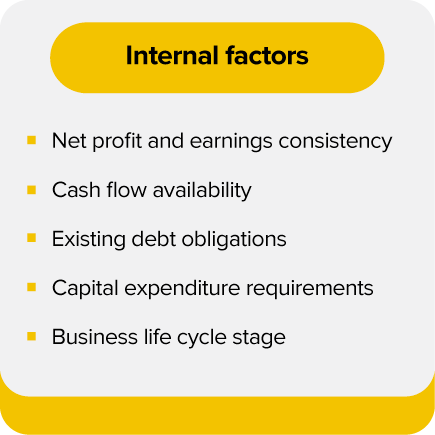
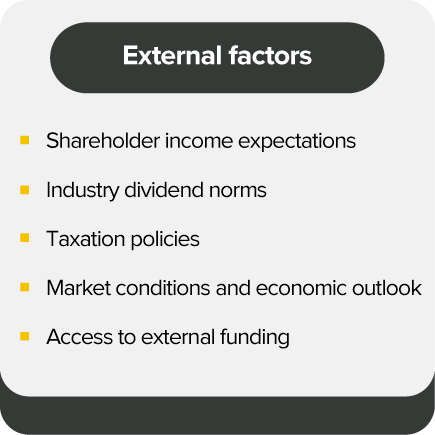
Types of Dividend Policy Explained in Detail
Understanding the types of dividend policy can help predict payout behavior and align investments with income or growth goals.
Residual Dividend Policy
Residual dividend policy focuses on funding profitable investment opportunities first. Dividends are paid only after all acceptable capital projects are financed. This policy is commonly adopted by growth-oriented firms and is closely watched by active traders analyzing reinvestment efficiency.
How it works

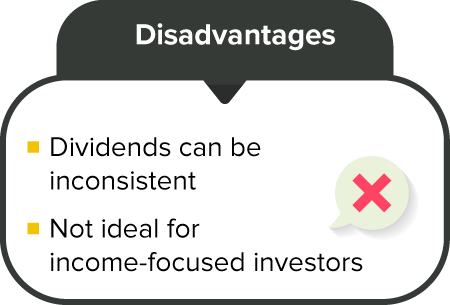
Stable Dividend Policy
Many long-term investors prefer companies following this approach when building diversified portfolios or share basket strategies. A stable dividend policy aims to provide shareholders with predictable, consistent dividend payouts regardless of short-term earnings fluctuations
Key characteristics

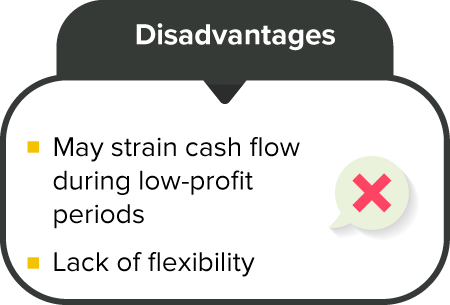
Constant Payout Ratio Dividend Policy
Under this approach, a fixed percentage of earnings is paid as dividends. Dividend amounts fluctuate directly with company profits. This policy is often analyzed by traders who track earnings cycles and changes in dividend yields.
Key features
.png)
.png)
Zero Dividend Policy
Zero dividend policy involves retaining all profits for reinvestment, with no dividend payments to shareholders. While no direct income is provided, investors may benefit from capital appreciation.
Why companies choose this
Hybrid Dividend Policy
Hybrid dividend policy combines elements of stable dividends with additional payouts during high-profit periods. This dividend strategy is increasingly popular among companies aiming to satisfy both conservative and growth-oriented investors.
Benefits
Elevate your trading experience with
Century Trader App
Elevate your trading experience with
Century Trader App

Dividend Policy and Its Impact on Trading and Investing
Even for traders engaged in forex or gold, dividend announcements can create temporary volatility. It is especially important for stock CFD and equity index traders. Investors using an intuitive and smooth trading platform benefit from understanding dividend timing, ex-dividend dates, and payout structures through timely updates and quick order execution.
Dividend policies also play a role in
Portfolio income planning
Long-term wealth accumulation
Sector rotation analysis
Using tools like the Century Trader allows investors to track dividend-paying stocks, analyze historical payouts, and manage multi-asset portfolios efficiently.
Conclusion
Whether you seek regular income, long-term capital growth, or tactical trading opportunities, dividend analysis should be an integral part of your investment approach. At Century Financial, investors gain access to global markets, advanced trading tools, and expert insights across shares, commodities, and more.
With platforms like the MT5, CQG, TWS, and Century Trader, you can analyze dividend-paying stocks, build diversified portfolios, and execute informed strategies with confidence.
FAQs on Dividend Policy
Q1. What is the main objective of dividend policy?
A: The primary objective of dividend policy is to balance shareholder returns with the company’s long-term growth and financial stability.
Q2: Which dividend policy is best for long-term investors?
A: Stable dividend policy and hybrid dividend policy are generally preferred by long-term investors seeking consistent income and moderate growth.
Q3: How does dividend policy affect share price?
A: Dividend policy influences investor confidence, valuation multiples, and stock price stability. Consistent dividends often reduce price volatility.
Q4. Do dividend policies matter in CFD Trading?
A: Yes, in the case of stock CFDs, dividend adjustments can affect the underlying’s price, making dividend awareness essential for CFD traders.
Q5. Can companies change their dividend policy?
A: Yes, companies can revise dividend policies based on profitability, market conditions, and strategic priorities.
This marketing and educational content has been created by Century Financial Consultancy LLC (“Century”) for general information only. It does not constitute investment, legal, tax, or other professional advice, nor does it constitute a recommendation, offer, or solicitation to buy or sell any financial instrument. The material does not take into account your investment objectives, financial situation, or particular needs.
The opinions expressed by the hosts, speakers, or guests are their own and may change without notice. Information is based on sources we consider to be reliable; however, Century does not guarantee its accuracy, completeness, or timeliness and accepts no liability for any loss arising from reliance on this content.
Trading and investing involve significant risk, and losses may exceed initial deposits. Past performance is not indicative of future results. CFDs and other leveraged products are complex instruments that may not be suitable for all investors. Please ensure you understand how these products work, the associated risks, and seek independent professional advice if necessary.
Century is licensed and regulated by the UAE Capital Market Authority (CMA) under License Nos. 20200000028 and 301044.
Please refer to the full risk disclosure mentioned on our website.






Regulated by CMA
Century Financial Consultancy LLC








Reach us:
-
Dubai
6th Floor, Emaar Square Building 4,
Downtown, Dubai, P.O. Box 65777,
Dubai, United Arab Emirates -
Abu Dhabi
27th Floor, Office 2701,
Shining Towers, Abu Dhabi, UAE -
Sharjah
29th Floor, Office 2905,
The Business Tower, Sharjah, UAE - +971 (4) 356 2800
- info@century.ae

Disclaimer: Trading in financial products carries substantial risk. Leveraged over-the-counter (OTC) derivatives, such as Contracts for Difference (CFDs) and spot forex, may result in losses exceeding initial deposits and may not be suitable for all investors. These complex instruments do not confer ownership of the underlying assets. Investors should carefully consider their investment objectives and risk appetite, and seek independent professional advice if necessary.
Century Financial Consultancy LLC (CFC) is licensed and regulated by the Capital Market Authority (CMA) of the UAE under license numbers 20200000028 and 301044 to carry out the activities of Financial Products dealer, Trading Broker in international markets, Trading Broker of OTC derivatives and currencies in the spot market, Introduction, Financial Consultations, and Promotion. CFC is incorporated under UAE law, registered with the Dubai Economic Department (No. 768189), with its office at 601, Level 6, Building No. 4, Emaar Square, Downtown Dubai, UAE, PO Box 65777.
The content on this website is provided solely for informational and educational purposes and does not constitute an offer, recommendation, or solicitation to buy or sell any securities or financial products.
Products and services offered by CFC are not intended for use in any jurisdiction where such use or distribution would breach local laws or regulatory requirements.
⚠️ Alert: Fraudulent Activity Notice
Century Financial Consultancy LLC (“Century”) has become aware of fraudulent individuals and entities impersonating our firm through unofficial websites, social media channels, and messaging applications such as Telegram, WhatsApp, and Discord.
Please be advised:
- Century does not manage investments on behalf of clients.
- Century does not solicit funds or guarantee investment returns.
- Century does not accept or make payments in cash, cryptocurrency, or digital assets.
- We do not conduct business via social media or messaging platforms.
Our only official website is www.century.ae, and all communication is conducted exclusively through verified channels.
We strongly urge the public to remain vigilant, verify the authenticity of any communication claiming to be from Century, and report any suspicious activity. Century disclaims any responsibility for losses arising from dealings with unauthorised or fraudulent parties.
