 Loading ...

Tuesday, August 11, 2026
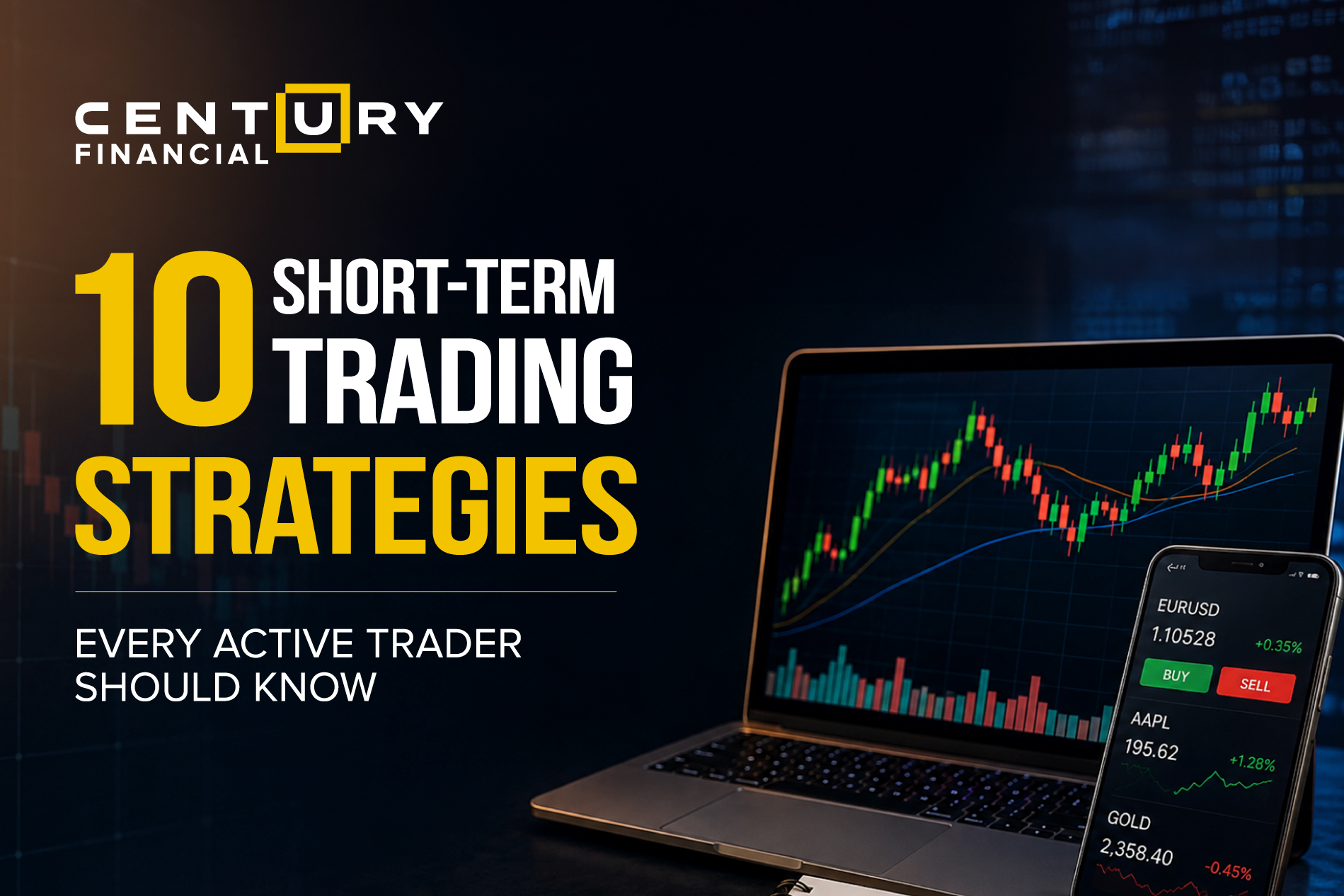
10 Short-Term Trading Strategies Every Active Trader Should Know
By Century Financial in 'Blog'

What Is Short-Term Trading?
Short-term trading means holding positions for minutes, hours, or days—rarely longer than a week. Here, traders are not betting on a company's long-term prospects or a currency's decade-long trend but on the immediate price movement.
There are types of short-term traders too. Scalpers hold for seconds or minutes. Day traders close positions before market close. Swing traders hold for days or, at most, for a week. Success in short-term trading strategies requires speed, precision, and emotional discipline. One emotional decision could destroy months of profits.
Benefits and Risks of Short-Term Trading
| Benefits | Risks |
|---|---|
| Potential profits from daily price movements | High costs due to commissions, spreads, slippage on many trades |
| No overnight gap risk with scalping or day trading strategies | Heightened emotional stress because of constant monitoring and quick decision-making needs |
| Ability to profit during flat or down markets | Increased possibility of execution errors during volatility |
10 Best Short-Term Trading Strategies That Work
#1: Momentum Trading
When a stock or currency pair starts moving up, momentum traders buy, riding the wave until momentum fades, then exit.
Momentum trading works best during strong trending days but fails during choppy, sideways markets where momentum whipsaws constantly.
#2: Breakout Trading
Breakout traders wait for price to break through established resistance or support levels. When the breakout happens, they follow immediately.
Breakouts often reverse. Sometimes the bigger the breakout, the higher the risk of reversal. Breakout trading has high reward potential as well as a high false signal risk.
#3: Pullback Trading
Even in bull markets, price rises, then pulls back (minor decline within the uptrend). Pullback traders buy the dip, betting the uptrend resumes.
This strategy might work in strong trends. There are higher chances of losses when "pullback" turns into a reversal and the trend ends.
#4: Scalping
Scalpers trade the smallest moves. A 5-pip profit is a win, and a 10-pip profit is a great day. Scalpers hold their position for seconds or minutes maximum.
This strategy fits those with direct market access, tight spreads, and a level-headed approach. As the costs of many such small trades pile up over time, it can be difficult for retail traders.
#5: Moving Average Crossover Trading
Moving average crossover systems use two moving averages (typically 50-period and 200-period). Traders buy when the shorter MA crosses above the slower MA and vice versa.
This strategy is a mechanical, rules-based approach, as whipsaws are frequent in choppy markets. MA crossover trading works better in markets with more distinct trends.
#6: Trend Following Trading
Trend followers identify the direction (up or down) and trade with it. Though defined opportunities are often lower in frequency than other strategies, they could have a higher average profit per trade. Works well during strong, extended trends.
#7: Range Trading
Range traders buy support and sell resistance in choppy markets where price oscillates within a range. Range trading is a great strategy in consolidating markets, albeit with thorough analysis, but could fail catastrophically when the range breaks and momentum follows. Traders must be willing to exit quickly when the range breaks.
#8: News Trading
News traders position ahead of or immediately after economic announcements. Economic reports releases, Fed decisions, earnings surprises—these create volatility traders exploit. High volatility often creates wide spreads and slippage. Risk/reward could be favorable, but execution risk is high with news-based trading.
#9: Reversal Trading
Reversal traders identify when trends are ending and bet on the reversal before it happens. It could be difficult to execute correctly as it requires detailed analysis of chart trends and fundamental factors. Entering too early increases costs, and entering too late could mean the reversal has already happened.
#10: Gap Trading
Gap traders trade the spaces between one day's close and the next day's open. Gaps create trading opportunities if you catch them at market open. This strategy works until gaps don't fill and the new price level holds. This strategy has highly limited timeframes and an open market is necessary.
Best Indicators for Short-Term Trading
No indicator is perfect. Combined with price action (support/resistance, candlestick patterns), indicators could help improve entry timing.
Moving averages
(50-period, 200-period) identify trend direction and support/resistance levels.
RSI (Relative Strength Index)
identifies overbought (>70) and oversold (<30) conditions, denoting potential reversals.
MACD (Moving Average Convergence Divergence)
shows momentum and trend changes through moving average crossovers.
Bollinger Bands
use standard deviation from moving averages to gauge overbought/oversold levels.
Stochastic Oscillator
identifies momentum and potential reversals using price range analysis.
Volume
confirms other signals; high-volume breakouts are stronger than low-volume breakouts.
Short-Term Trading Strategies for Different Markets
Short-Term Trading Tips for Beginners
Starting simple and slow is advice that can be applied to beginners in trading too. Some aspects to keep in mind include:
Risk Management Rules for Short-Term Traders
Short-term traders take more risks with frequent trades, smaller moves, and tighter stops. Here, risk management isn't optional. Some rules short-term traders usually adhere to are as follows:
Max risk per trade: 1% of account maximum. A $10,000 account risks $100 per trade.
Position sizing: Avoid guesswork and calculate position size from your stop distance and max risk.
Risk-to-reward ratio: Keep it from 1:1 to 1:2. Avoid the trade if it poses more risk than possible gains.
Daily loss limit: 1% of account maximum. A $10,000 account risks $100 per trade.
Max risk per trade: Emotional decision-making follows big losses; take a break after substantial losses.
Stop-loss on every trade: Stops execute automatically, preventing emotional hold-through-disaster scenarios.
Take-profit orders: Don't hold winning trades hoping for more; exit at profit targets
Common Short-Term Trading Mistakes to Avoid
Small errors can accumulate fast. Steering clear of common pitfalls can lessen the chances of higher losses. Some common errors are:
Start Short-Term Trading with Century Trader
Century Trader App and MT5 both support short-term trading across forex, stocks, gold, indices, and CFDs. Real-time quotes, tight spreads during peak hours, and fast execution enable scalping and day trading.
Economic calendars built into platforms show when announcements occur. You can plan trades around them or avoid them. Volume indicators help identify breakout setups. Moving averages and technical indicators speed entry/exit decisions. Demo accounts let you test strategies for weeks before risking capital.
This ensemble of features, CMA regulation, along with a 35+ year legacy of aiding global traders, Century Financial ensures trading is steady and secure.
Elevate your trading experience with
Century Trader App
Elevate your trading experience with
Century Trader App

Conclusion
Short-term trading strategies work, but discipline, emotional control, and consistent risk management separate profitable short-term traders from account-destroyers. Mastering one strategy and knowing the ins and outs of an asset class with a level-headed approach can increase chances of short-term trading success.
Short-term trading is faster, more stressful, and demands more attention than passive investing. But for traders willing to put in the work, it's a workable path to consistent profits. Whether it's scalping, news-based trading, or long-term strategies, Century Financial links the gap between the market and participants.
Frequently Asked Questions
Q1: What is short-term trading?
A: Holding positions for minutes, hours, or days. Scalpers hold seconds/minutes. Day traders close by market close. Swing traders hold days/a week. All operate within short-term frameworks hunting daily price moves.
Q2: Which short-term trading strategy is best for beginners?
A: Short-term strategies require strong technical understanding, the right mindset, and a dependable platform that enables fast order execution. Beginners can start by testing one's strategies using tools like moving averages on demo accounts before entering the markets.
Q3: What indicators are commonly used in short-term trading?
A: Moving averages (50/200 period), RSI (overbought/oversold), MACD (momentum), Bollinger Bands (volatility), and the Stochastic Oscillator (reversals) are common. No single indicator is perfect; it is better to combine multiple indicators for assurance.
Q4: Is short-term trading profitable?
A: Yes, but most short-term traders lose money. High costs (commissions, spreads, slippage) across many trades eat profits. Those who usually succeed are disciplined, follow risk rules, and trade during peak liquidity.
Q5: What is the difference between short-term trading and day trading?
A: Day trading closes all positions by market close daily. Short-term trading can extend to days or a week, whereas day trading is purely intraday.
This marketing and educational content has been created by Century Financial Consultancy LLC (“Century”) for general information only. It does not constitute investment, legal, tax, or other professional advice, nor does it constitute a recommendation, offer, or solicitation to buy or sell any financial instrument. The material does not take into account your investment objectives, financial situation, or particular needs.
The opinions expressed by the hosts, speakers, or guests are their own and may change without notice. Information is based on sources we consider to be reliable; however, Century does not guarantee its accuracy, completeness, or timeliness and accepts no liability for any loss arising from reliance on this content.
Trading and investing involve significant risk, and losses may exceed initial deposits. Past performance is not indicative of future results. CFDs and other leveraged products are complex instruments that may not be suitable for all investors. Please ensure you understand how these products work, the associated risks, and seek independent professional advice if necessary.
Century is licensed and regulated by the UAE Capital Market Authority (CMA) under License Nos. 20200000028 and 301044.
Please refer to the full risk disclosure mentioned on our website.





Regulated by CMA
Century Financial Consultancy LLC


.png)


.png)
.png)

Reach us:
-
Dubai
6th Floor, Emaar Square Building 4,
Downtown, Dubai, P.O. Box 65777,
Dubai, United Arab Emirates -
Abu Dhabi
27th Floor, Office 2701,
Shining Towers, Abu Dhabi, UAE -
Sharjah
29th Floor, Office 2905,
The Business Tower, Sharjah, UAE - +971 (4) 356 2800
- info@century.ae

Disclaimer: Trading in financial products carries substantial risk. Leveraged over-the-counter (OTC) derivatives, such as Contracts for Difference (CFDs) and spot forex, may result in losses exceeding initial deposits and may not be suitable for all investors. These complex instruments do not confer ownership of the underlying assets. Investors should carefully consider their investment objectives and risk appetite, and seek independent professional advice if necessary.
Century Financial Consultancy LLC (CFC) is licensed and regulated by the Capital Market Authority (CMA) of the UAE under license numbers 20200000028 and 301044 to carry out the activities of Financial Products dealer, Trading Broker in international markets, Trading Broker of OTC derivatives and currencies in the spot market, Introduction, Financial Consultations, and Promotion. CFC is incorporated under UAE law, registered with the Dubai Economic Department (No. 768189), with its office at 601, Level 6, Building No. 4, Emaar Square, Downtown Dubai, UAE, PO Box 65777.
The content on this website is provided solely for informational and educational purposes and does not constitute an offer, recommendation, or solicitation to buy or sell any securities or financial products.
Products and services offered by CFC are not intended for use in any jurisdiction where such use or distribution would breach local laws or regulatory requirements.
⚠️ Alert: Fraudulent Activity Notice
Century Financial Consultancy LLC (“Century”) has become aware of fraudulent individuals and entities impersonating our firm through unofficial websites, social media channels, and messaging applications such as Telegram, WhatsApp, and Discord.
Please be advised:
- Century does not manage investments on behalf of clients.
- Century does not solicit funds or guarantee investment returns.
- Century does not accept or make payments in cash, cryptocurrency, or digital assets.
- We do not conduct business via social media or messaging platforms.
Our only official website is www.century.ae, and all communication is conducted exclusively through verified channels.
We strongly urge the public to remain vigilant, verify the authenticity of any communication claiming to be from Century, and report any suspicious activity. Century disclaims any responsibility for losses arising from dealings with unauthorised or fraudulent parties.
