 Loading ...

Wednesday, August 05, 2026
Active Trading vs Passive Trading: What It Means and How to Apply Them
By Century Financial in 'Blog'
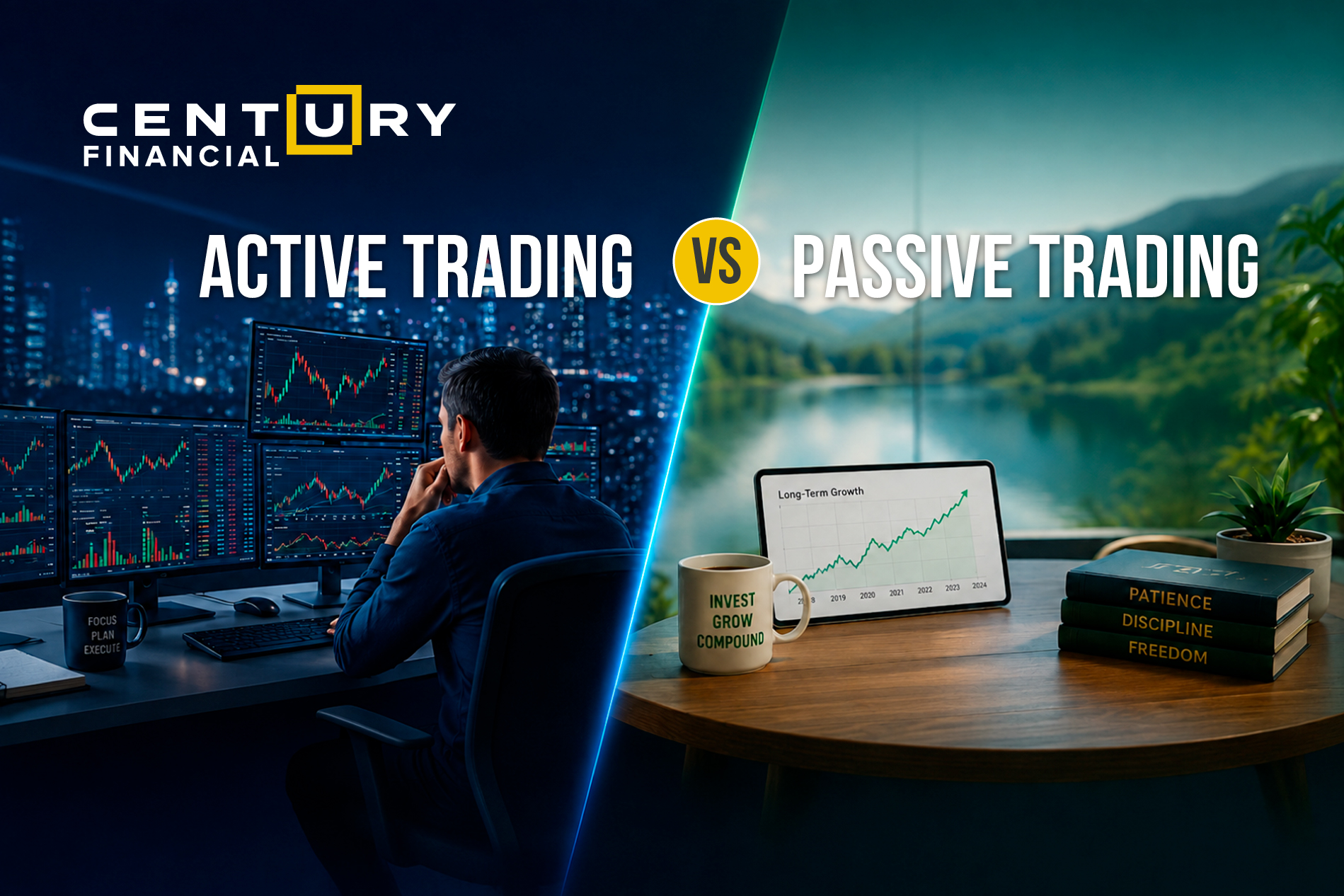
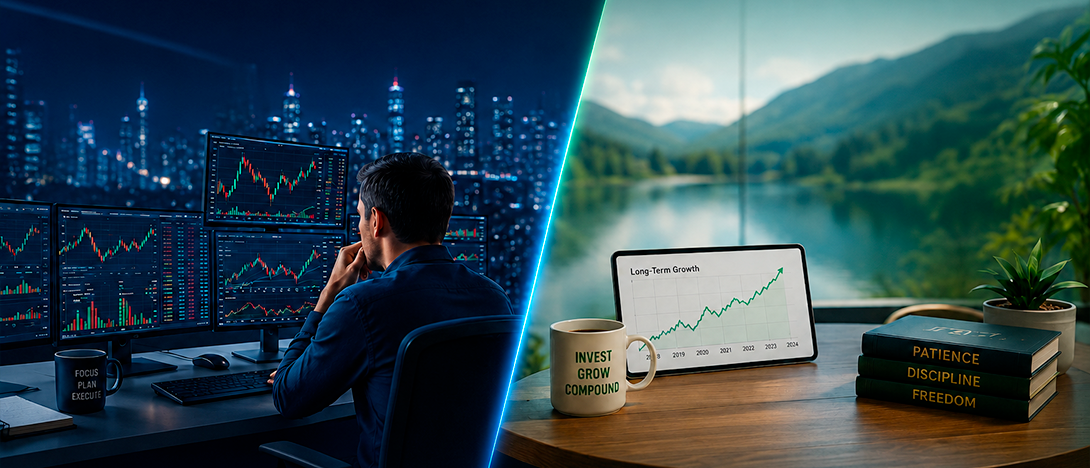
Two completely different ways to make money exist in markets. One involves constant trading—checking positions throughout the day, analyzing charts, executing dozens of trades weekly. The other means buying something and forgetting about it for years. One requires obsessive attention. The other requires patience and discipline to ignore noise.
The gap between them matters more than most traders realize.
What Is Active Trading?
Active trading means you’re in and out of positions constantly. Day traders hold for minutes or hours. Swing traders hold for days or weeks. Here, traders are trying to catch price moves before they reverse, then exit with a profit.
Active traders live in technical analysis. They watch economic calendars obsessively, and they react to news within seconds. Every trade is deliberate, with entry price, exit price, stop-loss, and position size calculated before execution.
What Is Passive Trading?
Passive investing is simpler. You buy stocks, funds, or ETFs and hold them for the long term. You rebalance quarterly or annually if markets have pushed your allocation out of balance.
Passive investors aren’t necessarily trying to outperform the market, but have a disciplined approach. The philosophy is straightforward: markets are efficient.
Active Trading vs Passive Trading: Key Differences
| Factor | Active Trading | Passive Trading |
|---|---|---|
| Frequency | Daily to weekly trades | Buy and hold years/decades |
| Goal | Beat market returns | Match market returns |
| Costs | High (commissions, spreads, slippage) | Low (minimal trading) |
| Skill Required | High (timing, execution, analysis) | Low (diversification basics) |
| Stress | High (constant monitoring) | Low (hands-off) |
| Taxes | High (short-term capital gains) | Low (long-term gains) |
Benefits of Active Trading & Passive Trading
Active Trading:
- Potential to make more money given proper strategies and analysis
- Freedom to profit during crashes with an option to short-sell
- Flexibility to respond to opportunities
Passive Trading:
- Lower trading costs compared to active trading
- Minimal time commitment
- Predictable long-term wealth building
Risks and Challenges of Active Trading & Passive Trading
Active Trading Reality:
- Active traders lose money after considering costs
- Emotional decisions like revenge trading cause losses
- Higher short-term taxes
- Execution risk during crashes
Passive Trading Reality:
- Market crashes could squeeze gains
- Returns are usually at par with the markets
- Inflation erodes returns if held in cash too long
- Discipline to hold when losing 20% on paper
Active Trading vs Passive Trading: Which Performs Better Over Time?
The data is brutal for active traders. Over 10–20 years, passive index investors usually outperform active traders because an active trader earning 15% annually but paying 3% in costs and taxes nets 12%. A passive investor earning 10% with minimal costs nets 9.5%. That 2.5% gap compounds into massive differences over decades.
Most professional fund managers can’t beat index funds after fees. If professionals struggle, individual traders face nearly impossible odds. Some active traders do make money—but they’re exceptions, not the rule. For every successful day trader, dozens of ill-prepared traders burn out.
Which Strategy Is Better for Different Types of Investors?

Beginners
Decades of experience is not a prerequisite to active trade profitably. There could be several expensive mistakes while learning. Beginners should focus on perfecting their mindset and strategies. A demo account could be a perfect platform to accomplish this.

Long-Term Investors
Markets reward patience. With the right fundamental analysis of the assets, compounding returns, and tax efficiency, passive strategies could be a great option for accomplishing long-term goals like building wealth for retirement.
Active Traders
A lot about active trading depends on having an edge. Superior analysis, faster execution, unique data, or genuine skill. A dependable platform that provides the right environment for momentum trading and quick execution is a must.

Investors Seeking
Passive Income
Dividend-paying stocks held long-term deliver both growth and cash flow. By buying dividend stocks, you can collect income annually, reinvest or withdraw. Income and wealth-building can be done with minimal stress and timely analysis.
Factors to Consider Before Choosing a Trading Style

Financial Goals
Long-term goals require passive investing. Short-term income demands active trading. Different goals deserve different approaches, and therefore, asking yourself questions about your intent matters at this stage.
Risk Tolerance
Analysis is required regardless of your approach to trading. Technical analysis gives you a snapshot of short-term trends while fundamental analysis lets you peek into the future. Learning the basics and decide on everything from your preferred asset class to your platform.
Investment Knowledge
A lot about active trading depends on having an edge. Superior analysis, faster execution, unique data, or genuine skill. A dependable platform that provides the right environment for momentum trading and quick execution is a must.
Available Time
Active trading demands hands-on participation. Your lifestyle should allow rapt attention to even the smallest market movements. Passive trading is dependent on your ability to analyze and adjust your portfolio accordingly. Though less, it does require commitment.
How Century Trader Supports Active Traders and Long-Term Investors
Active traders need speed and tools. Real-time quotes, advanced charting, fast execution, economic calendars. Passive investors need simplicity. Both need transparency and secure platforms.
Century Financial’s platforms work whether you’re trading daily or holding for years. Our platform options—the Century Trader App and MT5 cater to all types of traders and investors. Economic calendars help active traders catch major moves. Corporate action information and dividend tracking help passive investors make holding decisions. Infrastructure supports your approach, whatever it is.
Elevate your trading experience with
Century Trader App
Elevate your trading experience with
Century Trader App

Conclusion
Active trading and passive investing are opposites. And as it is with everything in the markets, the right strategy depends on your actual situation—not what sounds exciting. Your financial goals, available time, and honest risk tolerance determine which works for you. Many investors use both—passive core holdings with a small allocation for active trading. Century Financial supports both approaches through platforms built for different trading styles.
Frequently Asked Questions
Q1: What is the difference between active trading and passive trading?
A: Active trading means constant buying and selling to beat market returns. Passive trading means buying and holding for years to match market returns. Active requires hours daily; passive requires comparatively lower participation.
Q2: Which strategy is better for beginners?
A: With passive investing, a beginner could build wealth while learning markets without expensive mistakes. Active trading requires experience most beginners are short on.
Q3: Can I use both active and passive investing strategies?
A: Yes. Many investors maintain passive core holdings (index funds, dividend stocks) with small active positions (short-term trades). This limits risk while allowing active trading exposure.
Q4: What are the risks of passive investing?
A: Emotional discipline during market crashes, sequence of returns risk (crashes when you need withdrawals), and returns that are usually capped at the market average are some risks of passive trading.
Q5: What tools do active traders use to make decisions?
A: Technical analysis (charts, moving averages, support/resistance), fundamental analysis (earnings, economic data), economic calendars (Fed decisions, employment reports), and platform tools (alerts, automation, real-time quotes).
This marketing and educational content has been created by Century Financial Consultancy LLC (“Century”) for general information only. It does not constitute investment, legal, tax, or other professional advice, nor does it constitute a recommendation, offer, or solicitation to buy or sell any financial instrument. The material does not take into account your investment objectives, financial situation, or particular needs.
The opinions expressed by the hosts, speakers, or guests are their own and may change without notice. Information is based on sources we consider to be reliable; however, Century does not guarantee its accuracy, completeness, or timeliness and accepts no liability for any loss arising from reliance on this content.
Trading and investing involve significant risk, and losses may exceed initial deposits. Past performance is not indicative of future results. CFDs and other leveraged products are complex instruments that may not be suitable for all investors. Please ensure you understand how these products work, the associated risks, and seek independent professional advice if necessary.
Century is licensed and regulated by the UAE Capital Market Authority (CMA) under License Nos. 20200000028 and 301044.
Please refer to the full risk disclosure mentioned on our website.

Regulated by CMA
Century Financial Consultancy LLC


.png)


.png)
.png)

Reach us:
-
Dubai
6th Floor, Emaar Square Building 4,
Downtown, Dubai, P.O. Box 65777,
Dubai, United Arab Emirates -
Abu Dhabi
27th Floor, Office 2701,
Shining Towers, Abu Dhabi, UAE -
Sharjah
29th Floor, Office 2905,
The Business Tower, Sharjah, UAE - +971 (4) 356 2800
- info@century.ae

Disclaimer: Trading in financial products carries substantial risk. Leveraged over-the-counter (OTC) derivatives, such as Contracts for Difference (CFDs) and spot forex, may result in losses exceeding initial deposits and may not be suitable for all investors. These complex instruments do not confer ownership of the underlying assets. Investors should carefully consider their investment objectives and risk appetite, and seek independent professional advice if necessary.
Century Financial Consultancy LLC (CFC) is licensed and regulated by the Capital Market Authority (CMA) of the UAE under license numbers 20200000028 and 301044 to carry out the activities of Financial Products dealer, Trading Broker in international markets, Trading Broker of OTC derivatives and currencies in the spot market, Introduction, Financial Consultations, and Promotion. CFC is incorporated under UAE law, registered with the Dubai Economic Department (No. 768189), with its office at 601, Level 6, Building No. 4, Emaar Square, Downtown Dubai, UAE, PO Box 65777.
The content on this website is provided solely for informational and educational purposes and does not constitute an offer, recommendation, or solicitation to buy or sell any securities or financial products.
Products and services offered by CFC are not intended for use in any jurisdiction where such use or distribution would breach local laws or regulatory requirements.
⚠️ Alert: Fraudulent Activity Notice
Century Financial Consultancy LLC (“Century”) has become aware of fraudulent individuals and entities impersonating our firm through unofficial websites, social media channels, and messaging applications such as Telegram, WhatsApp, and Discord.
Please be advised:
- Century does not manage investments on behalf of clients.
- Century does not solicit funds or guarantee investment returns.
- Century does not accept or make payments in cash, cryptocurrency, or digital assets.
- We do not conduct business via social media or messaging platforms.
Our only official website is www.century.ae, and all communication is conducted exclusively through verified channels.
We strongly urge the public to remain vigilant, verify the authenticity of any communication claiming to be from Century, and report any suspicious activity. Century disclaims any responsibility for losses arising from dealings with unauthorised or fraudulent parties.
