 Loading ...

Monday, August 24, 2026
What Is Short Selling? Meaning, How It Works, Risks & Strategies
By Century Financial in 'Blog'
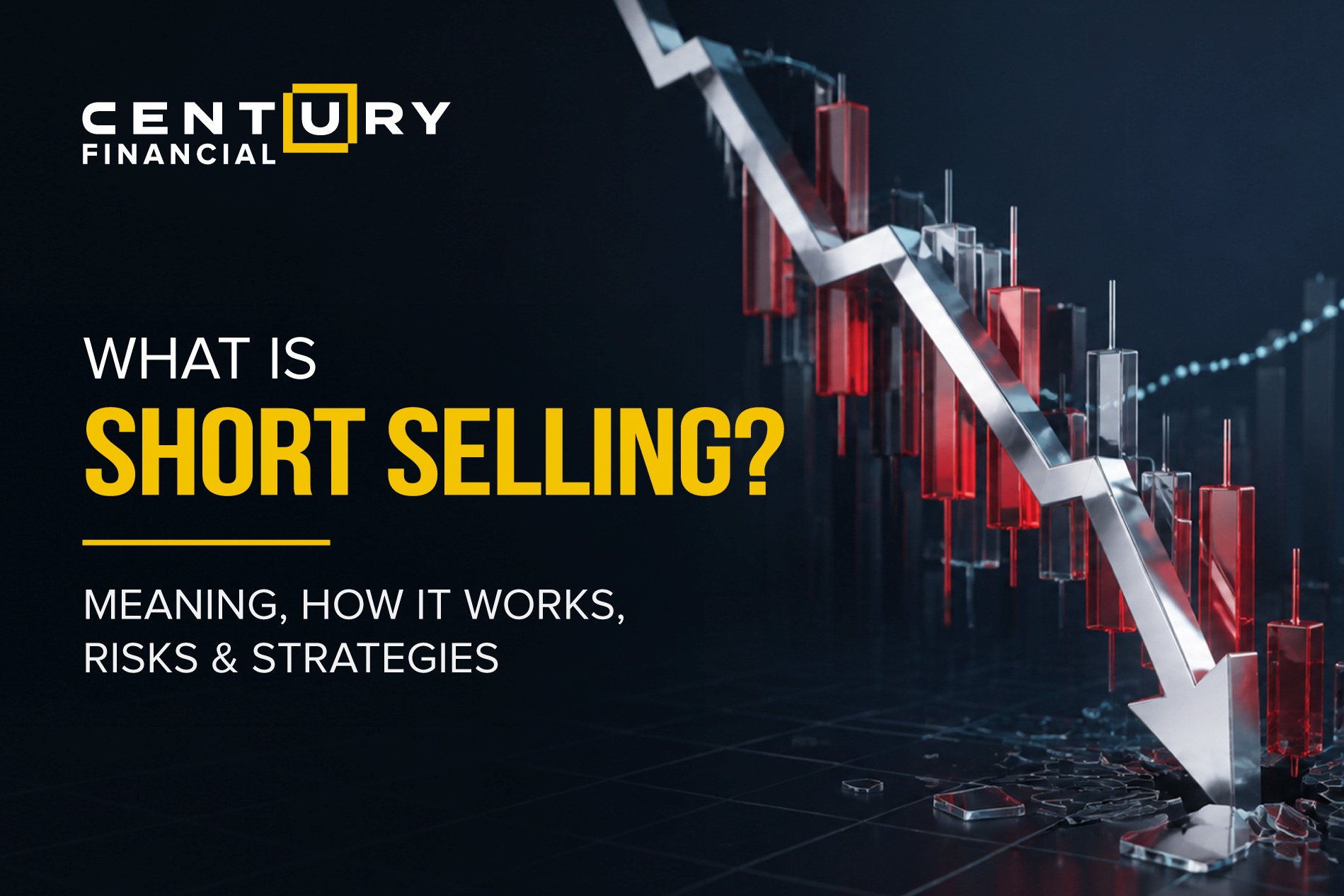

What Is Short Selling?
Short selling means selling an asset you don't own when the outlook on it is bearish. You borrow the asset from a broker, sell it immediately, then buy it back later at a lower price. The difference between the selling and buying prices is your profit.
In direct contrast to normal trading, in short selling, the asset is sold before it is bought, and gains are made when the asset price falls. Short selling has its merits in certain market conditions, as a standalone position and as a part of more elaborate trading strategies.
How Does Short Selling Work?
Here’s a breakdown of what short selling, or taking a short position, looks like:
If the market moves against the position and rises, losses happen. Another aspect to note: when you purchase the asset during the second leg of the trade, your position is closed rather than initiating a new one.
Short Selling Example
There are two ways a trade could go: in profit or loss.
For example, you open a short position by selling the shares of XYZ. The shares are trading at $100, and you short 10 shares, making your position worth $1000.
If the market follows your outlook and falls by 15%, your holdings would drop to $850, generating gains of $150. If instead the shares rise by 15%, the value of your holding goes up to $1,150, wiping $150 from your account.
What Can You Short Sell?
Shorting is not limited to a particular asset class. But most assets that can be shorted have leverage, which requires hands-on monitoring and cognizance of the risks involved.
How to Short Sell with CFDs
CFDs (Contracts for Difference) simplify short selling: no borrowing process, no lending fees (mostly). It offers a wider range of options and built-in leverage for greater exposure.
CFD short selling vs direct shorting:
| Aspect | CFD Short Selling | Direct Short Selling |
|---|---|---|
| Borrowing | No (contract-based) | Yes (borrow shares from broker) |
| Leverage | Available but amplifies gains & losses | Limited or unavailable |
| Speed | Instant | Slower |
| Costs | Spreads, overnight financing | Borrow fees, commissions |
Benefits of Short Selling
Profit from falling markets
Markets don't always rise. Factors such as recessions, earnings misses, and geopolitical crises exert downward pressure.
Hedge existing positions
You can short a CFD of the stock you hold, or a related index to protect against downside. Gains on the short position can help offset losses on the long position.
Flexible portfolio strategies
Even in a range-bound market, you can sell at resistance and capitalize on minor movements with proper analysis and strategies.
Risk management
Short selling allows tactical hedges. You don't have to exit longs; you can temporarily hedge with shorts, then close them when the threats pass.
Risks of Short Selling
What Is a Short Squeeze?
A short squeeze happens when price rises sharply and forces short sellers to panic-buy, covering their positions. This buying pressure accelerates the price rise, creating a feedback loop.
How it happens:
Key metrics showing squeeze risk:
Short interest:
High number of total shares shorted
Short interest ratio:
Short interest divided by average daily volume being high
Days to cover:
More days needed to cover all short positions at average volume

GameStop had extremely high short interest. Retail traders recognized this and began buying. Shorts panicked and bought to cover. The price exploded from $20 to $400+ within weeks. The squeeze was dramatic but short-lived—the price eventually fell back to $100-$150 as shorts covered and momentum faded.
Short Selling Strategies
Trend-Based
Downtrends can be identified using moving averages or technical indicators. A short position can be taken when the indicators and volume confirm a bearish trend; an exit can be made when the trend weakens or reverses.
Support-Level Breakdown
Support levels are recognized using horizontal price levels or moving averages. Short when price breaks below support, with a stop-loss placed above support (invalidation point).
Momentum-Based
Momentum indicators (RSI, MACD) can be used to identify overbought conditions. Traders short when momentum indicators show extreme overbought levels combined with technical resistance and exit when momentum reverses.
News-Based
Monitoring earnings, guidance misses, or regulatory announcements that trigger selling can help spot potential trades.
Hedging Strategy:
Shorting a correlated asset or index to hedge an already open long-term position is one of the more popular uses of shorting. Close the short when the threat passes.
How to Short Sell: Step-by-Step
Here’s a simple checklist for taking a short position.
Common Mistakes When Short Selling
Short selling can be a valuable addition to your trading strategy, but a slight oversight can lead to unwanted losses. Some mistakes to avoid are:
Dependable platforms equipped with built-in alerts, analytical tools, and economic calendars can make trading easier. Century Financial’s 35+ year legacy is built on trust and transparency. Our platform offerings, including Century Trader, MT5, TWS, and CQG, are widely acclaimed as secure and high-speed execution platforms.
Elevate your trading experience with
Century Trader App
Elevate your trading experience with
Century Trader App

Is Short Selling Suitable for Beginners?
Short selling can work for beginners if they first master the fundamental concepts. Some aspects beginners should understand:
Conclusion
Short selling is betting against assets—profiting when prices fall instead of rise. The mechanics are the opposite of normal trading: sell first, buy lower later, and pocket the difference.
Success requires strict risk management, detailed analysis, close monitoring, and a platform that supports speed and accuracy. Beginners need to test their strategies before they commit capital. Century Financial offers trusted platforms with demo accounts for you to trade with assurance and confidence in global markets.
Frequently Asked Questions
Q1: What is short selling?
A: Short selling is selling an asset you don't own, with the assumption that the price will fall. You borrow the asset, sell it, buy it back at a lower price, return it, and keep the profit—the reverse of normal buy-low-sell-high trading.
Q2: How does short selling work?
A: A broker lends you an asset, or you opt for derivative contracts like futures or CFDs. You sell it at the current price; if the asset falls, you make a profit by closing the position by buying it back.
Q3: Is short selling risky?
A: Yes, as losses are potentially unlimited. When buying a stock at $50, the maximum loss a trader incurs is $50. A stock has infinite growth potential, which means a $50 shorted stock can incur losses in the 3- and 4-figure ranges.
Q4: What is a short squeeze?
A: Price rises sharply, forcing short sellers to panic-buy to cover their positions. Their buying pressure accelerates the rise, creating a feedback loop. Price spikes to unsustainable levels until shorts are completely forced out.
Q5: How does leverage affect short selling?
A: Leverage amplifies both gains and losses. 50:1 leverage means a 1% move against you can lead to a 50% margin loss. A 2% move and you are fulfilling a margin call or facing a forced liquidation of the position. Conservative leverage is essential for short selling.
This marketing and educational content has been created by Century Financial Consultancy LLC (“Century”) for general information only. It does not constitute investment, legal, tax, or other professional advice, nor does it constitute a recommendation, offer, or solicitation to buy or sell any financial instrument. The material does not take into account your investment objectives, financial situation, or particular needs.
The opinions expressed by the hosts, speakers, or guests are their own and may change without notice. Information is based on sources we consider to be reliable; however, Century does not guarantee its accuracy, completeness, or timeliness and accepts no liability for any loss arising from reliance on this content.
Trading and investing involve significant risk, and losses may exceed initial deposits. Past performance is not indicative of future results. CFDs and other leveraged products are complex instruments that may not be suitable for all investors. Please ensure you understand how these products work, the associated risks, and seek independent professional advice if necessary.
Century is licensed and regulated by the UAE Capital Market Authority (CMA) under License Nos. 20200000028 and 301044.
Please refer to the full risk disclosure mentioned on our website.




Regulated by CMA
Century Financial Consultancy LLC








Reach us:
-
Dubai
6th Floor, Emaar Square Building 4,
Downtown, Dubai, P.O. Box 65777,
Dubai, United Arab Emirates -
Abu Dhabi
27th Floor, Office 2701,
Shining Towers, Abu Dhabi, UAE -
Sharjah
29th Floor, Office 2905,
The Business Tower, Sharjah, UAE - +971 (4) 356 2800
- info@century.ae

Disclaimer: Trading in financial products carries substantial risk. Leveraged over-the-counter (OTC) derivatives, such as Contracts for Difference (CFDs) and spot forex, may result in losses exceeding initial deposits and may not be suitable for all investors. These complex instruments do not confer ownership of the underlying assets. Investors should carefully consider their investment objectives and risk appetite, and seek independent professional advice if necessary.
Century Financial Consultancy LLC (CFC) is licensed and regulated by the Capital Market Authority (CMA) of the UAE under license numbers 20200000028 and 301044 to carry out the activities of Financial Products dealer, Trading Broker in international markets, Trading Broker of OTC derivatives and currencies in the spot market, Introduction, Financial Consultations, and Promotion. CFC is incorporated under UAE law, registered with the Dubai Economic Department (No. 768189), with its office at 601, Level 6, Building No. 4, Emaar Square, Downtown Dubai, UAE, PO Box 65777.
The content on this website is provided solely for informational and educational purposes and does not constitute an offer, recommendation, or solicitation to buy or sell any securities or financial products.
Products and services offered by CFC are not intended for use in any jurisdiction where such use or distribution would breach local laws or regulatory requirements.
⚠️ Alert: Fraudulent Activity Notice
Century Financial Consultancy LLC (“Century”) has become aware of fraudulent individuals and entities impersonating our firm through unofficial websites, social media channels, and messaging applications such as Telegram, WhatsApp, and Discord.
Please be advised:
- Century does not manage investments on behalf of clients.
- Century does not solicit funds or guarantee investment returns.
- Century does not accept or make payments in cash, cryptocurrency, or digital assets.
- We do not conduct business via social media or messaging platforms.
Our only official website is www.century.ae, and all communication is conducted exclusively through verified channels.
We strongly urge the public to remain vigilant, verify the authenticity of any communication claiming to be from Century, and report any suspicious activity. Century disclaims any responsibility for losses arising from dealings with unauthorised or fraudulent parties.
