 Loading ...

Wednesday, August 19, 2026
Gold CFD vs Physical Gold: What's the Difference?
By Century Financial in 'Blog'

Gold CFD vs Physical Gold: What's the Difference?
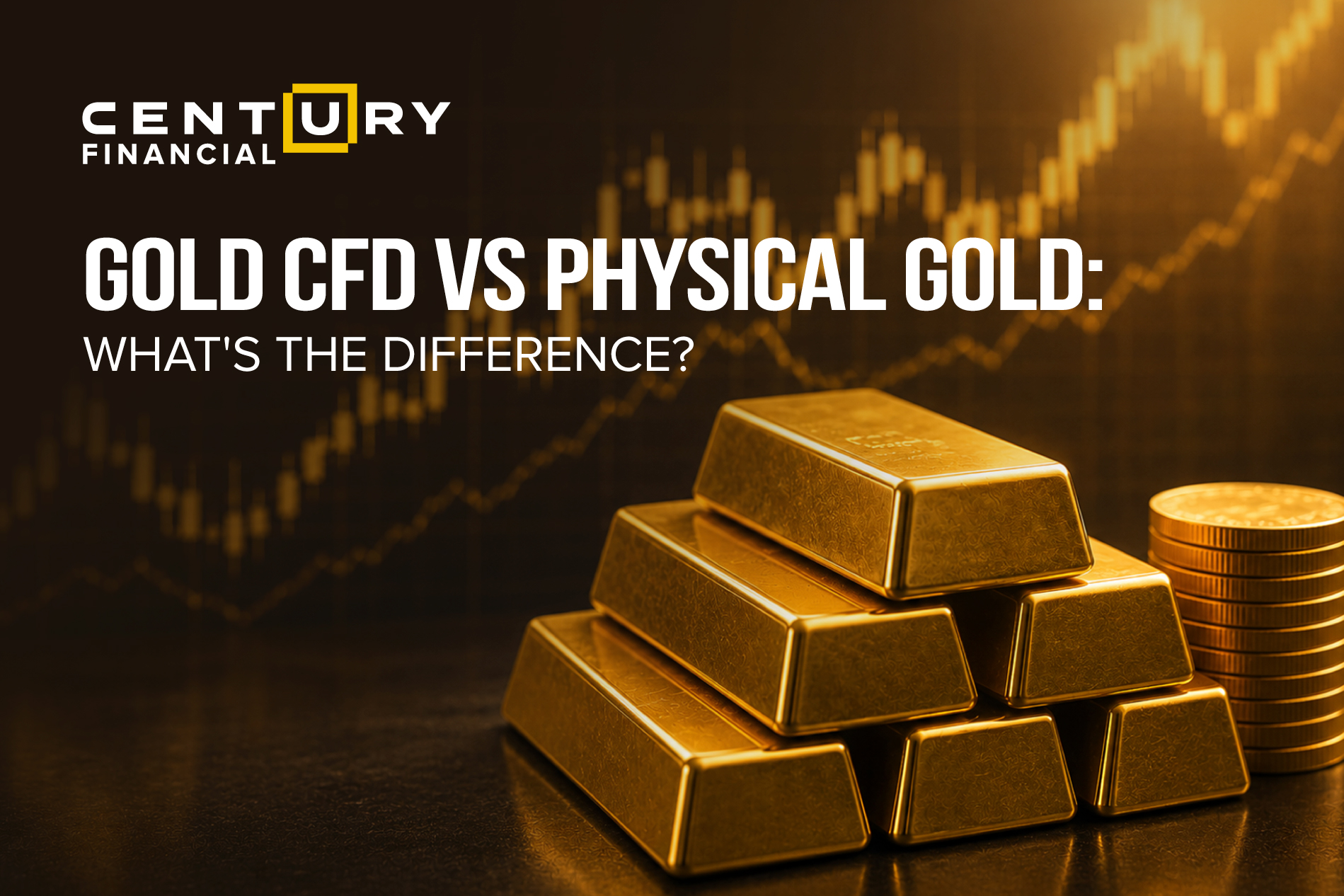
There are two completely different ways to invest in gold. One involves owning actual metal—bars, coins, or jewelry. The other involves trading price contracts without touching physical gold. The difference determines everything from costs to profits and everything in between.
Understanding both helps you choose the approach that better matches your intent.
What Is Gold CFD Trading
What Is a Gold CFD?
A CFD (Contract for Difference) is a contract tracking an underlying asset's price movement. A gold CFD tracks the spot price of gold, and your profit or loss is based on price movement alone.
CFDs are leveraged instruments, which means you can hold a position with a fraction of the required capital. But leverage amplifies both gains and losses; if prices move by even 1%, it could wipe out your entire account. Proper risk management and position sizing are crucial when trading CFDs or any leveraged instruments.
How Gold CFD Trading Works
You open a position with a broker. Specify whether you want to buy or sell, the quantity, and the leverage. The broker holds your position against the live gold price.
No physical gold changes hands, nor is any storage required. With gold CFDs, you close the position whenever you want during trading hours by clicking sell (or buy to cover shorts).
Key Features of Gold CFDs

Leverage
You can control large positions with small capital.

No ownership
You hold a gold contract, not actual gold—no gold exchanges hands.
24-hour trading
Gold trades constantly across global markets. You can enter/exit positions at any time.

Tight spreads
Major CFD providers offer tight bid-ask spreads during peak hours (London and New York sessions).
Short selling
You can profit when gold falls. Physical gold ownership offers no profits during falls.
What Is Physical Gold Trading?
Buying Physical Gold
Gold has been a trusted asset for generations. Investing in physical gold means owning actual metal in the form of bars, coins, or jewelry, just the way it has been for centuries. The gold sits in your possession or in a vault you pay to secure.
With physical ownership, it is permanent until you sell. No leverage, no expiration dates, and no counterparty risk applies here, as the purchase is a closed transaction.
Types of Physical Gold Investments
Gold bars: 1 oz, 10 oz, or 1 kg bars of standardized weight and purity.
Gold coins: Bullion coins that trade at near-spot prices or numismatic coins that have collector premiums.
Gold jewelry: Wearable gold. Premiums are highest as manufacturing costs are added. Resale value is lowest because jewelers pay near-spot but at lower prices than dealers.
Gold ETFs: Exchange-traded funds that track gold prices. You own shares representing gold holdings: no physical possession but similar price exposure to physical gold.
Gold CFD vs Gold ETFs vs Physical Gold: Risk Comparison
| Factor | Gold CFDs | Gold ETFs | Physical Gold |
|---|---|---|---|
| Leverage | Available (amplifies gains/losses) | None | None (100% capital required) |
| Ownership | Contract only (no physical gold) | Shares of fund | Actual metal ownership |
| Storage | None required | ETF handles storage | Vault storage costs |
| Trading Hours | 24 hours | Market hours | Dealer hours |
| Costs | Spreads, overnight financing | Expense ratios | Premiums, storage, insurance |
| Liquidity | High (instant entry/exit) | High (sell anytime market is open) | Medium (dealers close, prices vary) |
| Price Discovery | Real-time | Real-time (market price) | Dealer-dependent |
| Volatility Risk | High (leverage amplifies moves) | Medium (no leverage) | Medium (no leverage) |
| Counterparty Risk | Broker bankruptcy | Fund closure risk | None (you own the gold) |
Advantages and Disadvantages of Gold CFDs
 Leverage amplifies
profits on margins
Trade 24 hours andreact to global
news immediately
Short-selling allowsprofit during price
declines
No storage orinsurance costs
Fast entry/exit (clickto open/close)
Tight spreadsduring peak hours
Capital efficiency
accounts on losses

costs accumulate
on long-held
positions
(broker solvency
matters)
possession
from leverage and
daily volatility
overnight moves
past stop-losses
treatments
Advantages and Disadvantages of Physical Gold
Actual gold in your hands or vault
No leverage risk since you own what you paid for
No counterparty risk
Inflation hedge because gold maintains purchasing power
No daily volatility stress
No financing costs
Historical store of value throughout centuries
How to Trade Gold CFDs with Century Financial
Century Financial offers gold CFD trading (XAU/USD) through multiple platforms, including the Century Trader App, which provides intuitive mobile and desktop access, and MT5, which provides advanced charting and technical analysis.
With fast order execution and segregated client funds, your trades are processed on a secure, transparent platform. Economic calendars built into platforms show which announcements move gold prices. Real-time quotes update continuously during 24-hour trading, offering a bird's-eye view of live markets on the go.
Elevate your trading
experience with
Century Trader App
Elevate your trading experience
with
Century Trader App

Conclusion
Gold CFDs and physical gold serve different purposes. CFDs enable leverage, 24-hour trading, and short-selling for active traders. Physical gold provides tangible ownership, storage security, and inflation hedging for long-term investors.
The selection depends on your goals, risk tolerance, and time commitment. Conservative investors usually prefer physical gold while active traders prefer CFDs. Most successful investors use both—physical gold as a core holding and CFDs for tactical positions. With Century Financial as your trading companion, you can trade in gold and other assets globally without sacrificing speed or efficiency.
Frequently Asked Questions
Q1: What is a Gold CFD?
A: A contract tracking gold's price movement. You don't own physical gold but profit or lose based on spot price changes. Leverage available amplifies both gains and losses.
Q2: Is Gold CFD better than buying physical gold?
A: Neither is universally better. CFDs suit active traders (24-hour access, leverage, short-selling). Physical gold suits long-term investors (tangible ownership, no leverage risk). The intent is what matters more.
Q3: Can I own real gold through a CFD?
A: No. CFDs are contracts, not physical gold ownership. You own the price exposure, not the metal. If you need tangible gold ownership, physical gold or ETFs are some options.
Q4: Is Gold CFD trading suitable for beginners?
A: Yes, but with caution. Conservative leverage and strict position sizing make CFDs beginner-accessible. Try trading in a simulated environment through a demo account before using real money.
This marketing and educational content has been created by Century Financial Consultancy LLC (“Century”) for general information only. It does not constitute investment, legal, tax, or other professional advice, nor does it constitute a recommendation, offer, or solicitation to buy or sell any financial instrument. The material does not take into account your investment objectives, financial situation, or particular needs.
The opinions expressed by the hosts, speakers, or guests are their own and may change without notice. Information is based on sources we consider to be reliable; however, Century does not guarantee its accuracy, completeness, or timeliness and accepts no liability for any loss arising from reliance on this content.
Trading and investing involve significant risk, and losses may exceed initial deposits. Past performance is not indicative of future results. CFDs and other leveraged products are complex instruments that may not be suitable for all investors. Please ensure you understand how these products work, the associated risks, and seek independent professional advice if necessary.
Century is licensed and regulated by the UAE Capital Market Authority (CMA) under License Nos. 20200000028 and 301044.
Please refer to the full risk disclosure mentioned on our website.






Regulated by CMA
Century Financial Consultancy LLC








Reach us:
-
Dubai
6th Floor, Emaar Square Building 4,
Downtown, Dubai, P.O. Box 65777,
Dubai, United Arab Emirates -
Abu Dhabi
27th Floor, Office 2701,
Shining Towers, Abu Dhabi, UAE -
Sharjah
29th Floor, Office 2905,
The Business Tower, Sharjah, UAE - +971 (4) 356 2800
- info@century.ae

Disclaimer: Trading in financial products carries substantial risk. Leveraged over-the-counter (OTC) derivatives, such as Contracts for Difference (CFDs) and spot forex, may result in losses exceeding initial deposits and may not be suitable for all investors. These complex instruments do not confer ownership of the underlying assets. Investors should carefully consider their investment objectives and risk appetite, and seek independent professional advice if necessary.
Century Financial Consultancy LLC (CFC) is licensed and regulated by the Capital Market Authority (CMA) of the UAE under license numbers 20200000028 and 301044 to carry out the activities of Financial Products dealer, Trading Broker in international markets, Trading Broker of OTC derivatives and currencies in the spot market, Introduction, Financial Consultations, and Promotion. CFC is incorporated under UAE law, registered with the Dubai Economic Department (No. 768189), with its office at 601, Level 6, Building No. 4, Emaar Square, Downtown Dubai, UAE, PO Box 65777.
The content on this website is provided solely for informational and educational purposes and does not constitute an offer, recommendation, or solicitation to buy or sell any securities or financial products.
Products and services offered by CFC are not intended for use in any jurisdiction where such use or distribution would breach local laws or regulatory requirements.
⚠️ Alert: Fraudulent Activity Notice
Century Financial Consultancy LLC (“Century”) has become aware of fraudulent individuals and entities impersonating our firm through unofficial websites, social media channels, and messaging applications such as Telegram, WhatsApp, and Discord.
Please be advised:
- Century does not manage investments on behalf of clients.
- Century does not solicit funds or guarantee investment returns.
- Century does not accept or make payments in cash, cryptocurrency, or digital assets.
- We do not conduct business via social media or messaging platforms.
Our only official website is www.century.ae, and all communication is conducted exclusively through verified channels.
We strongly urge the public to remain vigilant, verify the authenticity of any communication claiming to be from Century, and report any suspicious activity. Century disclaims any responsibility for losses arising from dealings with unauthorised or fraudulent parties.
