 Loading ...

Thursday, August 13, 2026
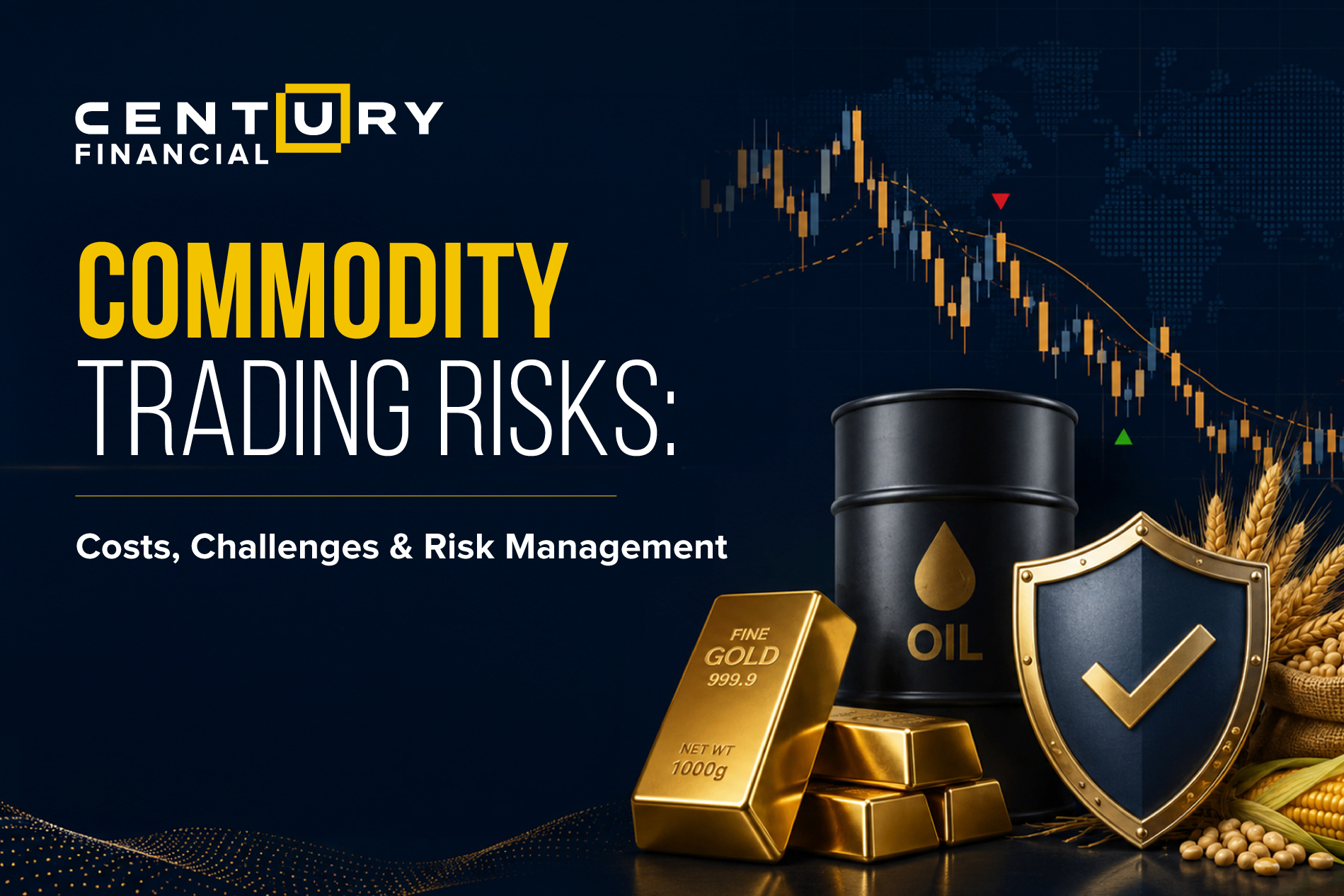
Commodity Trading Risks: Costs, Challenges & Risk Management
By Century Financial in 'Blog'
What Is Commodity Trading?
Commodity trading is the buying and selling of raw materials like oil, gold, wheat, copper, and natural gas. Traders aim to profit from price changes between when they enter and exit a trade. For most retail traders, physical delivery almost never happens. Instead, they usually trade futures contracts or CFDs that follow commodity prices.
Leverage is common in commodity trading. For example, with $1,000, a trader can control $100,000 worth of crude oil using 100:1 leverage.
Popular Commodities Traded in Global Markets
Commodities are broadly bifurcated into perishables (agro products) and non-perishables (metals, oils).
Commodity Trading in the UAE
UAE commodity trading operates under Capital Markets Authority (CMA) regulation. Licensed brokers like Century Financial provide access to global commodity markets. Most UAE traders access commodities through CFDs or futures rather than physical delivery.
What Are the Main Risks in Commodity Trading?
Market Price Volatility
Commodity prices can change quickly and sharply. For example, oil might drop 5% after a production announcement, gold could rise 3% following comments from the Federal Reserve, and wheat prices may jump 10% after a crop report. These changes often happen within hours or even minutes.
Leverage and Margin Risk
Leverage lets you control large positions with small capital. It also means leverage can destroy your account with small price moves. To secure both parties, brokers set margin requirements. If your position drops past the margin level, a margin call is issued, and the position is closed on non-response.
Liquidity Risk
Most commodities have high trading volumes during peak hours. During off-hours, however, trading volume drops and spreads can become five to ten times wider than usual. Large positions can also create liquidity risk. If you try to exit a $500,000 position, the market might move against you before your trade is completed.
Geopolitical and Economic Risks
Wars in oil-producing regions can cause crude oil prices to spike, and sanctions on major producers can change supply levels. Central bank policy announcements can move precious metals right away. Unexpected economic data can also surprise the markets. These events create gap risk, so it helps to monitor the market closely and set up alerts.
Currency Exchange Risk
Commodities are traded worldwide in U.S. dollars. When the dollar gets stronger, commodities become more expensive for buyers using other currencies, which can lower demand. If you are betting that gold will go up, you also want the dollar to weaken.
Supply and Demand Risk
Unexpected supply disruptions, such as mining accidents, production shutdowns, port closures, or bad weather, can reduce supply. On the other hand, surprises in demand, like an economic slowdown or changes in consumption habits, can lower demand. Both situations can cause sharp price changes.
What Costs Are Involved in Commodity Trading?
Bid-Ask Spread: Every commodity has a bid price (what you receive when selling) and an ask price (what you pay when buying). Major commodities (crude, gold) trade tight spreads while minor commodities or off-hours spreads widen dramatically.
Brokerage and Commission Fees: Some brokers charge per-trade commissions. Others charge spreads only (no commissions). It is smarter to compare total costs and not just one component.
Overnight Financing (Swap) Charges: If you keep a commodity position overnight, your broker will charge you a financing fee. The amount depends on the commodity and the broker.
Exchange and Regulatory Fees: Exchange fees and regulatory charges are small but can add up as they accumulate across many trades.
Slippage: The difference between anticipated and actual execution price is called slippage and has a high probability of happening during volatility.
Commodity Trading Risk Management Strategies
Common Mistakes Commodity Traders Should Avoid
As mentioned earlier, there are several common mistakes in commodity trading that you can avoid with some planning and discipline. Watch out for these:
Commodity Trading in the UAE: Key Considerations
Elevate your trading experience with
Century Trader App
Elevate your trading experience with
Century Trader App

Conclusion
Commodity trading offers many opportunities, but it also comes with significant risks. To succeed, you need to understand these risks, accurately calculate trading costs, and use disciplined risk management. Profitable traders use position sizing, stop-loss orders, portfolio diversification, and careful leverage to protect their accounts.
Even the best trading strategy can fail without the right broker and platform. Century helps traders stay connected, informed, and secure with the Century Trader app, market insights, and a regulated platform that offers 24x5 multilingual support. You can open an account or try out your commodity trading strategies on our demo account today.
Frequently Asked Questions
Q1: What are the biggest risks in commodity trading?
A: Price volatility, leverage amplification, gap risk, liquidity risk, and geo-political/supply shocks are some of the major risks involved in commodity trading.
Q2: What costs should I consider before trading commodities?
A: You should consider bid-ask spreads, brokerage commissions, overnight financing charges, exchange fees, and slippage when trading. Calculate your total annual costs before choosing a strategy, because these costs can take a big bite out of your profits over time.
Q3: How can I manage risk in commodity trading?
A: A good rule of thumb is to risk no more than 1-2% of your account on each trade. You should also use stop-losses on every trade, aim for a risk-to-reward ratio of at least 1:2, manage your leverage carefully, diversify across different commodities, and keep an eye on economic calendars.
Q4: Is commodity trading suitable for beginners?
A: Many beginners overleverage and end up blowing up their accounts within weeks. Commodity trading can work for beginners if they use conservative leverage, strict position sizing, and practice on demo accounts before trading capital.
Q5: Is commodity trading legal in the UAE?
A: Yes, through licensed brokers regulated by the Capital Markets Authority like Century Financial. Only trade through licensed, CMA-regulated brokers, and verify licenses before funding the account.
This marketing and educational content has been created by Century Financial Consultancy LLC (“Century”) for general information only. It does not constitute investment, legal, tax, or other professional advice, nor does it constitute a recommendation, offer, or solicitation to buy or sell any financial instrument. The material does not take into account your investment objectives, financial situation, or particular needs.
The opinions expressed by the hosts, speakers, or guests are their own and may change without notice. Information is based on sources we consider to be reliable; however, Century does not guarantee its accuracy, completeness, or timeliness and accepts no liability for any loss arising from reliance on this content.
Trading and investing involve significant risk, and losses may exceed initial deposits. Past performance is not indicative of future results. CFDs and other leveraged products are complex instruments that may not be suitable for all investors. Please ensure you understand how these products work, the associated risks, and seek independent professional advice if necessary.
Century is licensed and regulated by the UAE Capital Market Authority (CMA) under License Nos. 20200000028 and 301044.
Please refer to the full risk disclosure mentioned on our website.


Regulated by CMA
Century Financial Consultancy LLC








Reach us:
-
Dubai
6th Floor, Emaar Square Building 4,
Downtown, Dubai, P.O. Box 65777,
Dubai, United Arab Emirates -
Abu Dhabi
27th Floor, Office 2701,
Shining Towers, Abu Dhabi, UAE -
Sharjah
29th Floor, Office 2905,
The Business Tower, Sharjah, UAE - +971 (4) 356 2800
- info@century.ae

Disclaimer: Trading in financial products carries substantial risk. Leveraged over-the-counter (OTC) derivatives, such as Contracts for Difference (CFDs) and spot forex, may result in losses exceeding initial deposits and may not be suitable for all investors. These complex instruments do not confer ownership of the underlying assets. Investors should carefully consider their investment objectives and risk appetite, and seek independent professional advice if necessary.
Century Financial Consultancy LLC (CFC) is licensed and regulated by the Capital Market Authority (CMA) of the UAE under license numbers 20200000028 and 301044 to carry out the activities of Financial Products dealer, Trading Broker in international markets, Trading Broker of OTC derivatives and currencies in the spot market, Introduction, Financial Consultations, and Promotion. CFC is incorporated under UAE law, registered with the Dubai Economic Department (No. 768189), with its office at 601, Level 6, Building No. 4, Emaar Square, Downtown Dubai, UAE, PO Box 65777.
The content on this website is provided solely for informational and educational purposes and does not constitute an offer, recommendation, or solicitation to buy or sell any securities or financial products.
Products and services offered by CFC are not intended for use in any jurisdiction where such use or distribution would breach local laws or regulatory requirements.
⚠️ Alert: Fraudulent Activity Notice
Century Financial Consultancy LLC (“Century”) has become aware of fraudulent individuals and entities impersonating our firm through unofficial websites, social media channels, and messaging applications such as Telegram, WhatsApp, and Discord.
Please be advised:
- Century does not manage investments on behalf of clients.
- Century does not solicit funds or guarantee investment returns.
- Century does not accept or make payments in cash, cryptocurrency, or digital assets.
- We do not conduct business via social media or messaging platforms.
Our only official website is www.century.ae, and all communication is conducted exclusively through verified channels.
We strongly urge the public to remain vigilant, verify the authenticity of any communication claiming to be from Century, and report any suspicious activity. Century disclaims any responsibility for losses arising from dealings with unauthorised or fraudulent parties.
