 Loading ...

Monday, August 03, 2026
What Influences Gold Prices? Key Factors Every Trader Should Know
By Century Financial in 'Blog'
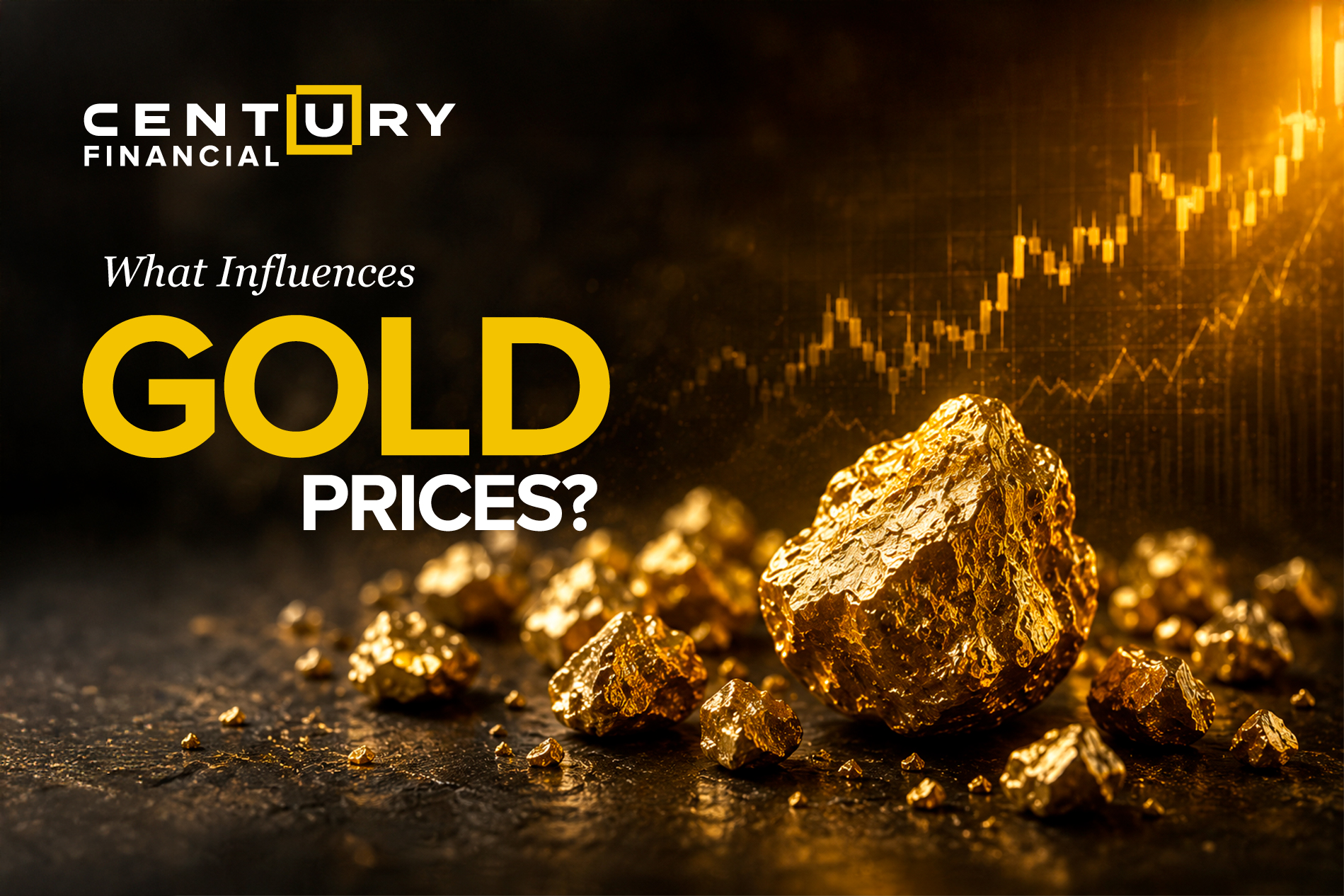

Gold is more than simply a commodity. It acts as a hedge, a safe-haven asset, and a trading tool at the same time. Gold price changes have clear trends and influences, and traders who know these factors usually have an advantage.
Many things affect gold prices, like political events, economic activity, and market mood. Knowing these factors helps you spot and benefit from gold price trends.
Importance of Understanding Gold Price Movements
Gold is traded around the world, 24 hours a day. Its price changes all the time due to economic reports, central bank decisions, and world events. If you know what moves gold prices, you can act before the market moves instead of reacting after the fact.
Gold price movements also correlate with larger market conditions. When stocks fall sharply, gold typically rises. When inflation accelerates, gold often rallies. These relationships create trading opportunities if you understand the mechanics.
Top Factors That Influence Gold Prices
Inflation and Purchasing Power
Inflation reduces what your money can buy because as prices go up, cash loses value. Gold has a history of rising during times of inflation because it holds its value when money does not. For example, if inflation hits 5 percent, investors often buy gold to protect themselves.
Typical trends are:
Interest Rates and Monetary Policy
Interest rates create opportunity cost for holding gold. Higher rates make interest-bearing assets (bonds, savings accounts) more attractive. Since investors shift capital away from gold toward these higher-yielding options, gold prices typically fall when central banks raise rates.
Typical trends are:
Strength of the US Dollar
Gold is bought and sold worldwide using U.S. dollars. When the dollar gets stronger, gold costs more for people using other currencies, so demand drops. If the dollar weakens, gold becomes cheaper for international buyers, which helps support prices.
Typical trends are:
Central Bank Gold Reserves
Central banks own large amounts of gold and trade in it regularly in great volumes. When major central banks like China, India, or Russia buy a lot of gold, it shows confidence and helps prices go up. Traders watch these moves closely.
Typical trends are:
Global Economic Uncertainty
When stock markets crash, people worry about a recession, or politics become unstable, investors look for safety. Gold acts like insurance and is a safe place to put money when other markets seem risky. Economic uncertainty commonly causes gold prices to rise.
Uncertainty triggers include:
Geopolitical Events and Market Sentiment
Wars, sanctions, political crises, and regional conflicts push investors toward safer financial assets. Gold prices spike during these events as nervous investors pursue protection.
Examples of major events include:
Supply and Demand Movements
Like all commodities, gold responds to supply and demand balance. Mining disruptions, production changes, and demand changes from jewelry and industrial sectors all affect prices.
Supply/demand factors include:
Gold Mining Production
Gold mining production changes slowly. It takes years to open new mines, and old mines run out over time. Problems like labor strikes, environmental rules, or political issues in mining areas can also reduce supply.
Factors influencing production trends are:
Jewelry and Industrial Demand
About half of all gold demand comes from jewelry. Industrial uses make up another 10 to 15 percent. When the economy grows and people spend more, jewelry demand goes up, which helps gold prices.
Major demand sources are:
How Inflation and Interest Rates Affect Gold Trading
Inflation and interest rates represent the core drivers of gold price movements. Knowing their relationship helps traders position correctly. High inflation, without rate hikes, ordinarily supports gold, and the opposite happens during rate cuts.
How these factors interact is important. When central banks raise rates quickly to fight inflation, it sends mixed signals. Inflation helps gold, but higher rates hurt it. The market focuses on whichever factor is stronger. If people worry more about inflation than rate hikes, gold goes up. If rate hikes are the bigger concern, gold can fall even if inflation is high.
Traders pay attention to 'real yields,' which means interest rates minus inflation. If real yields are positive, bonds are more attractive than gold. This measure aids traders see if gold prices match the current interest rate and inflation situation.
Why Gold Is Considered a Safe-Haven Asset
Gold acts like insurance. When stocks drop sharply, bonds seem risky, or currencies lose value, gold tends to hold its worth. Because of this safe-haven role, gold often goes up when other assets fall, which is different from most other commodities.
Gold doesn't produce income (no dividends, no interest), so it carries opportunity cost during normal markets. But during crises, investors accept zero income in exchange for safety. This pattern makes gold valuable during recessions, market crashes, and international crises but pressures gold during strong economic growth.
Common Mistakes Traders Make When Trading Gold
Trading gold may seem easy, but there are common mistakes to watch out for. Knowing about these errors can help you avoid them.
- Gold vs. Other Assets: Some traders buy gold without thinking about their whole portfolio. Gold usually moves in the opposite direction of stocks and the dollar. If stocks are rising and the dollar is strong, gold can struggle even if its own outlook seems good.
- Overweighting International Events: War news and political crises trigger gold spikes, but these often fade quickly. Traders pile into gold on headline risk, then exit when tensions ease. Jumping on geopolitical moves without confirmed trend changes burns capital.
- Neglecting Real Yields Analysis: Traders track inflation and interest rates separately but miss real yields (rates minus inflation). Real yields determine gold's attractiveness versus bonds. Negative real yields support gold; positive real yields favor bonds. Analyzing one without the other distorts your outlook.
- Using Too Much Leverage: Economic announcements and Fed decisions make gold volatile. Leverage amplifies these swings into account-destroying losses. Calculated and conservative position-sizing protects against surprise moves.
- Uncovered Positions During Major Moves: Central bank decisions, inflation data, and employment reports move gold drastically. Traders often hold unprotected positions through these events, and a surprise announcement against their position can create sudden, large losses.
Trading Gold Online with
Century Financial
Century Financial gives you regulated access to gold trading on several platforms. The Century Trader App, MT5, and CQG all offer real-time gold prices and fast execution.
These platforms include economic calendars to help you follow inflation reports, interest rate decisions, and other events that move gold prices. You can also use demo accounts to try out trading strategies before risking real money.
Trading Gold Online with
Century Financial
Century Financial gives you regulated access to gold trading on several platforms. The century Trader App, MT5, and CQG all offer real-time gold prices and fast execution.
These platforms include economic calendars to help you follow inflation reports, interest rate decisions, and other events that move gold prices. You can also use demo accounts to try out trading strategies before risking real money.
.png)
Conclusion
Gold prices react to many things, including inflation levels, interest rates, the strength of the dollar, central bank measures, economic uncertainty, world events, and supply and demand. Knowing what affects gold prices assists traders get ready for market moves.
You can avoid common mistakes like ignoring correlations, using too much leverage, or holding positions unprotected during big announcements by using good analysis and risk management.Century Financial offers the tools, real-time data, highly acclaimed platforms like the Century Trader and MT5, and support you need to trade gold successfully in any market.
Frequently Asked Questions
Q1: What affects gold prices the most
A: Interest rates and dollar strength are usually the primary drivers. Inflation and international uncertainty support gold prices. The balance among these factors determines gold's direction.
Q2: Why does gold often rise during economic uncertainty?
A: Gold is widely regarded as a safe-haven. When stock markets crash, recessions threaten, or global disputes rise, investors tend to buy gold. This demand supports gold prices during economic stress.
Q3: How do interest rates influence gold prices?
A: Higher interest rates make bonds and savings accounts more attractive, reducing gold demand, and lower rates reduce the opportunity cost of holding gold, typically supporting prices.
Q4: What is the relationship between gold and the US dollar?
A: Gold trades in U.S. dollars globally. A stronger dollar makes gold more expensive for foreign buyers, reducing demand and pushing prices lower, and vice versa. The inverse relationship is consistent.
Q5: Do central banks impact gold prices?
A: Yes, significantly. Central banks hold massive gold reserves and occasionally buy or sell large quantities. Central bank purchases demonstrate confidence and support prices. Market participants track central bank gold flows closely.
This marketing and educational content has been created by Century Financial Consultancy LLC (“Century”) for general information only. It does not constitute investment, legal, tax, or other professional advice, nor does it constitute a recommendation, offer, or solicitation to buy or sell any financial instrument. The material does not take into account your investment objectives, financial situation, or particular needs.
The opinions expressed by the hosts, speakers, or guests are their own and may change without notice. Information is based on sources we consider to be reliable; however, Century does not guarantee its accuracy, completeness, or timeliness and accepts no liability for any loss arising from reliance on this content.
Trading and investing involve significant risk, and losses may exceed initial deposits. Past performance is not indicative of future results. CFDs and other leveraged products are complex instruments that may not be suitable for all investors. Please ensure you understand how these products work, the associated risks, and seek independent professional advice if necessary.
Century is licensed and regulated by the UAE Capital Market Authority (CMA) under License Nos. 20200000028 and 301044.
Please refer to the full risk disclosure mentioned on our website.


Regulated by CMA
Century Financial Consultancy LLC


.png)


.png)
.png)

Reach us:
-
Dubai
6th Floor, Emaar Square Building 4,
Downtown, Dubai, P.O. Box 65777,
Dubai, United Arab Emirates -
Abu Dhabi
27th Floor, Office 2701,
Shining Towers, Abu Dhabi, UAE -
Sharjah
29th Floor, Office 2905,
The Business Tower, Sharjah, UAE - +971 (4) 356 2800
- info@century.ae

Disclaimer: Trading in financial products carries substantial risk. Leveraged over-the-counter (OTC) derivatives, such as Contracts for Difference (CFDs) and spot forex, may result in losses exceeding initial deposits and may not be suitable for all investors. These complex instruments do not confer ownership of the underlying assets. Investors should carefully consider their investment objectives and risk appetite, and seek independent professional advice if necessary.
Century Financial Consultancy LLC (CFC) is licensed and regulated by the Capital Market Authority (CMA) of the UAE under license numbers 20200000028 and 301044 to carry out the activities of Financial Products dealer, Trading Broker in international markets, Trading Broker of OTC derivatives and currencies in the spot market, Introduction, Financial Consultations, and Promotion. CFC is incorporated under UAE law, registered with the Dubai Economic Department (No. 768189), with its office at 601, Level 6, Building No. 4, Emaar Square, Downtown Dubai, UAE, PO Box 65777.
The content on this website is provided solely for informational and educational purposes and does not constitute an offer, recommendation, or solicitation to buy or sell any securities or financial products.
Products and services offered by CFC are not intended for use in any jurisdiction where such use or distribution would breach local laws or regulatory requirements.
⚠️ Alert: Fraudulent Activity Notice
Century Financial Consultancy LLC (“Century”) has become aware of fraudulent individuals and entities impersonating our firm through unofficial websites, social media channels, and messaging applications such as Telegram, WhatsApp, and Discord.
Please be advised:
- Century does not manage investments on behalf of clients.
- Century does not solicit funds or guarantee investment returns.
- Century does not accept or make payments in cash, cryptocurrency, or digital assets.
- We do not conduct business via social media or messaging platforms.
Our only official website is www.century.ae, and all communication is conducted exclusively through verified channels.
We strongly urge the public to remain vigilant, verify the authenticity of any communication claiming to be from Century, and report any suspicious activity. Century disclaims any responsibility for losses arising from dealings with unauthorised or fraudulent parties.
