 Loading ...

Tuesday, September 29, 2026
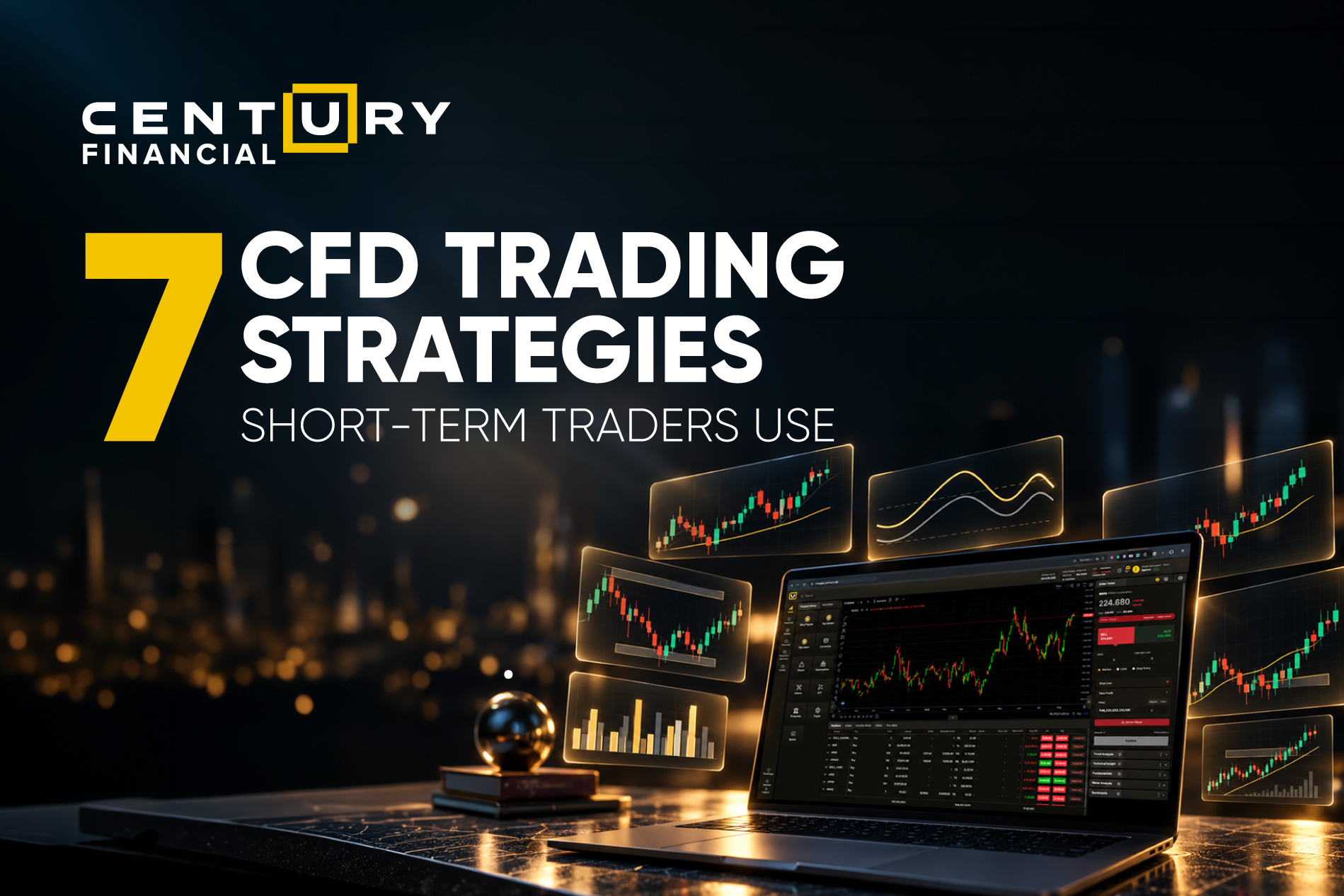
7 CFD Trading Strategies Short-Term Traders Use
By Century Financial in 'Blog'

Introduction
CFD trading lets a trader take a position on price movement without owning the underlying asset. That framework helps explain why it draws so many short-term traders. Traders can open and close positions within minutes or hours, size them precisely, and apply them across markets that would otherwise require separate accounts or instruments.
This piece covers what CFD trading actually involves, why the instrument suits shorter holding periods specifically, and seven strategies commonly used to trade it, along with how to match a strategy to current market conditions, the platform features that matter most for fast-moving trades, and the risk management rules and mistakes that tend to separate consistent short-term traders from the rest.
What Is CFD Trading?
A CFD, or contract for difference, is an agreement between a trader and a broker to exchange the difference in an asset's price between opening and closing a position, without either side owning the underlying asset.
CFDs typically trade on margin, and most instruments have no fixed expiry date. That combination of flexible sizing, no expiry to manage, and access to multiple asset classes through one account is what makes CFDs a common vehicle for strategies built around shorter holding periods.
Why CFD Trading Appeals to Short-Term Traders
Short-term traders need to enter and exit positions quickly, size them precisely, and move between markets without friction, and CFDs are structured around exactly that. You can open a position in minutes, size it to a specific dollar risk rather than a fixed contract size, and close it within the same session without waiting for settlement or an expiry date.
The ability to go short as easily as long also matters here. Short-term traders often look to profit from moves in either direction, and a CFD's structure treats both the same way, unlike instruments where short selling requires borrowing the underlying asset first.
How to Choose the Best Strategy for CFD Trading
No single strategy fits every short-term trader, since the right choice depends on the trader's available time, risk tolerance, and the market conditions at any given moment. A strategy built for a strong trend behaves very differently in a sideways market, and a strategy that suits someone watching charts all day doesn't necessarily suit someone checking in a few times a session.
A more useful approach is adapting the strategy to the conditions and constraints at hand: how much time you can realistically spend monitoring a position, how the market is behaving (trending, ranging, or volatile), and how much risk per trade feels manageable. The seven strategies below, and the market-condition breakdown that follows, are built to help you make that match.
7 Best CFD Trading Strategies for Short-Term Trading Opportunities
Each strategy is commonly used in short-term CFD trading, and each is built around a different assumption about how price behaves over a short window.
| Strategy | Best Suited To | Key Risk |
|---|---|---|
| Trend following | Markets with a clear, sustained direction | A sudden reversal against the trend |
| Breakout trading | Price approaching a well-defined range boundary | A false breakout that reverses |
| Momentum trading | Fast, strong moves backed by volume | Momentum fading before the target is reached |
| Scalping | Highly liquid markets with tight spreads | Costs eroding profit on very small moves |
| Range trading | Markets moving sideways between clear levels | A breakout that ends the range |
| News trading | Scheduled high-impact economic releases | Volatility and slippage around the release |
| Pullback trading | A trend that has paused before continuing | The pullback turning into a full reversal |
1. Trend Following Strategy
Trend following enters in the direction of an established move, using tools like moving averages to confirm the trend is intact before entering. It usually suits short-term trading well when a market moves decisively, since one could close the position once the trend shows signs of stalling rather than holding through a full reversal.
2. Breakout Trading Strategy
Breakout trading happens as price moves beyond a defined support or resistance level, expecting the move to continue once the boundary gives way. Short-term traders use it around known levels going into a session, and often a quick reversal is the main way this strategy loses.
3. Momentum Trading Strategy
Momentum trading follows fast, high-volume price moves already in progress, entering while the move is accelerating rather than waiting for a pullback. It could fit short-term trading because traders typically hold the position only while momentum holds, closing it once volume or price speed starts to fade.
4. Scalping Strategy
Scalping takes many small, quick trades throughout a session, aiming for a small price move on each one rather than a large move on a few trades. It typically depends heavily on tight spreads and fast execution, since costs that would be negligible on a larger move can meaningfully cut into a scalp-sized profit.
5. Range Trading Strategy
Range trading buys near a market's support level and sells near resistance, working within the limits of a non-trending market. It suits short-term traders in sideways conditions specifically, since the strategy depends on the range holding rather than breaking.
6. News Trading Strategy
News trading strategies focus on scheduled economic releases, interest rate decisions, or earnings reports, when a market's price can move quickly once the data is out. Short-term traders using this approach need to account for wider spreads and faster price movement that usually happen around the release.
7. Pullback Trading Strategy
Pullback trading enters during a brief pause in an established trend, expecting the trend to resume after the pause. It usually gives a short-term trader a chance to enter closer to the trend's starting point than trend following alone would allow, though the risk is that the pullback becomes a genuine reversal.
Note: The seven strategies above aren't interchangeable across every market condition, and matching one to the current environment, proper risk management, and position sizing are crucial here.
Common Mistakes Short-Term CFD Traders Make
In the markets, mistakes usually come with a cost. You can avoid mistakes like the ones below with discipline and planning.
Taking frequent positions without a clear signal behind each one
Re-entering a market quickly to recover a loss
Holding a position through a scheduled high-impact release
Moving a stop further away once a position is already losing
Chasing a strategy that isn't suited to current conditions
CFD Trading Strategies for Beginners
Leveraged instruments like CFDs are complex because even a slight movement can have a huge impact on a position, making close monitoring and precise margin and leverage calculations paramount. Beginners could adapt the following measures to their strategy.
Starting with one strategy:
Learning a single approach thoroughly—range trading or trend following are common starting points—tends to build a clearer sense of what's working than switching between several at once.
Focusing on risk management:
Position sizing and stop-loss placement matter more early on than which strategy you use, since poor risk control can undo an otherwise sound approach.
Practice with a demo account:
A demo account lets you practice entering, managing, and closing a CFD position without risking capital, before applying the same process live.
CFD Trading Tips and Tricks for Steady Results
Risk Management Rules Every CFD Trader Must Follow
Choosing the Right CFD Trading Platform
Short-term traders interact with their platform far more often per session than longer-term traders do, so small frictions, slow order entry, unclear pricing, and limited chart tools compound quickly across a high volume of trades. Platform choice tends to matter as much as strategy choice once trading frequency increases.
Elevate your trading experience with
Century Trader App
Elevate your trading experience with
Century Trader App

Trade CFDs Across Multiple Markets With Century Trader
Century Trader platform gives traders access to CFDs across shares, indices, currencies, and commodities from a single account, alongside MT5, CQG, and TWS for traders who need broader charting or execution tools. The platform's charting and order management features support the fast entry and exit that short-term strategies, scalping, and news trading in particular depend on.
Conclusion
CFD trading suits short-term strategies well because of its structure: flexible position sizing, no fixed expiry on most instruments, and the ability to go short as easily as long. The seven strategies covered here—trend following, breakout, momentum, scalping, range trading, news trading, and pullback trading—each depend on different market conditions, which is why matching strategy to condition matters more than settling on a single approach permanently.
Century Trader and Century Financial's extended platform lineup give short-term traders the execution speed, charting tools, and multi-market access this kind of trading depends on. For traders refining a short-term approach, testing a strategy against current market conditions before committing full size is a practical way to see how the two actually line up.

Frequently Asked Questions
Q1: What is the best strategy for CFD trading?
A: There isn't a single best strategy. The right one depends on the trader's timeframe, risk tolerance, and current market conditions—trending, ranging, or volatile.
Q2: How can I manage risk when trading CFDs?
A: Risk management can begin with capping risk per trade as a percentage of capital, using a stop-loss on every position, and tracking combined exposure across all open trades rather than one at a time.
Q3: Which markets can I trade using CFDs?
A: CFDs are available across shares, indices, currencies, commodities, and other asset classes, depending on what a given broker's platform offers.
Q4: What is the difference between CFD trading and investing?
A: CFD trading takes a position on price movement without owning the underlying asset, typically over a shorter timeframe, while investing usually involves owning the asset directly over a longer horizon.
Q5: What should I look for in a short-term trading platform?
A: Execution speed, tight spreads, charting tools with built-in order management, and access to multiple markets all matter more for short-term trading than for longer-term approaches.
This marketing and educational content has been created by Century Financial Consultancy LLC (“Century”) for general information only. It does not constitute investment, legal, tax, or other professional advice, nor does it constitute a recommendation, offer, or solicitation to buy or sell any financial instrument. The material does not take into account your investment objectives, financial situation, or particular needs.
The opinions expressed by the hosts, speakers, or guests are their own and may change without notice. Information is based on sources we consider to be reliable; however, Century does not guarantee its accuracy, completeness, or timeliness and accepts no liability for any loss arising from reliance on this content.
Trading and investing involve significant risk, and losses may exceed initial deposits. Past performance is not indicative of future results. CFDs and other leveraged products are complex instruments that may not be suitable for all investors. Please ensure you understand how these products work, the associated risks, and seek independent professional advice if necessary.
Century is licensed and regulated by the UAE Capital Market Authority (CMA) under License Nos. 20200000028 and 301044.
Please refer to the full risk disclosure mentioned on our website.



Regulated by CMA
Century Financial Consultancy LLC


.png)


.png)
.png)

Reach us:
-
Dubai
6th Floor, Emaar Square Building 4,
Downtown, Dubai, P.O. Box 65777,
Dubai, United Arab Emirates -
Abu Dhabi
27th Floor, Office 2701,
Shining Towers, Abu Dhabi, UAE -
Sharjah
29th Floor, Office 2905,
The Business Tower, Sharjah, UAE - +971 (4) 356 2800
- info@century.ae

Disclaimer: Trading in financial products carries substantial risk. Leveraged over-the-counter (OTC) derivatives, such as Contracts for Difference (CFDs) and spot forex, may result in losses exceeding initial deposits and may not be suitable for all investors. These complex instruments do not confer ownership of the underlying assets. Investors should carefully consider their investment objectives and risk appetite, and seek independent professional advice if necessary.
Century Financial Consultancy LLC (CFC) is licensed and regulated by the Capital Market Authority (CMA) of the UAE under license numbers 20200000028 and 301044 to carry out the activities of Financial Products dealer, Trading Broker in international markets, Trading Broker of OTC derivatives and currencies in the spot market, Introduction, Financial Consultations, and Promotion. CFC is incorporated under UAE law, registered with the Dubai Economic Department (No. 768189), with its office at 601, Level 6, Building No. 4, Emaar Square, Downtown Dubai, UAE, PO Box 65777.
The content on this website is provided solely for informational and educational purposes and does not constitute an offer, recommendation, or solicitation to buy or sell any securities or financial products.
Products and services offered by CFC are not intended for use in any jurisdiction where such use or distribution would breach local laws or regulatory requirements.
⚠️ Alert: Fraudulent Activity Notice
Century Financial Consultancy LLC (“Century”) has become aware of fraudulent individuals and entities impersonating our firm through unofficial websites, social media channels, and messaging applications such as Telegram, WhatsApp, and Discord.
Please be advised:
- Century does not manage investments on behalf of clients.
- Century does not solicit funds or guarantee investment returns.
- Century does not accept or make payments in cash, cryptocurrency, or digital assets.
- We do not conduct business via social media or messaging platforms.
Our only official website is www.century.ae, and all communication is conducted exclusively through verified channels.
We strongly urge the public to remain vigilant, verify the authenticity of any communication claiming to be from Century, and report any suspicious activity. Century disclaims any responsibility for losses arising from dealings with unauthorised or fraudulent parties.
