 Loading ...

Thursday, June 25, 2026
Inflation: Definition, Types, Causes, and Its Impact on Financial Markets
By Century Financial in 'Blog'
.jpg)
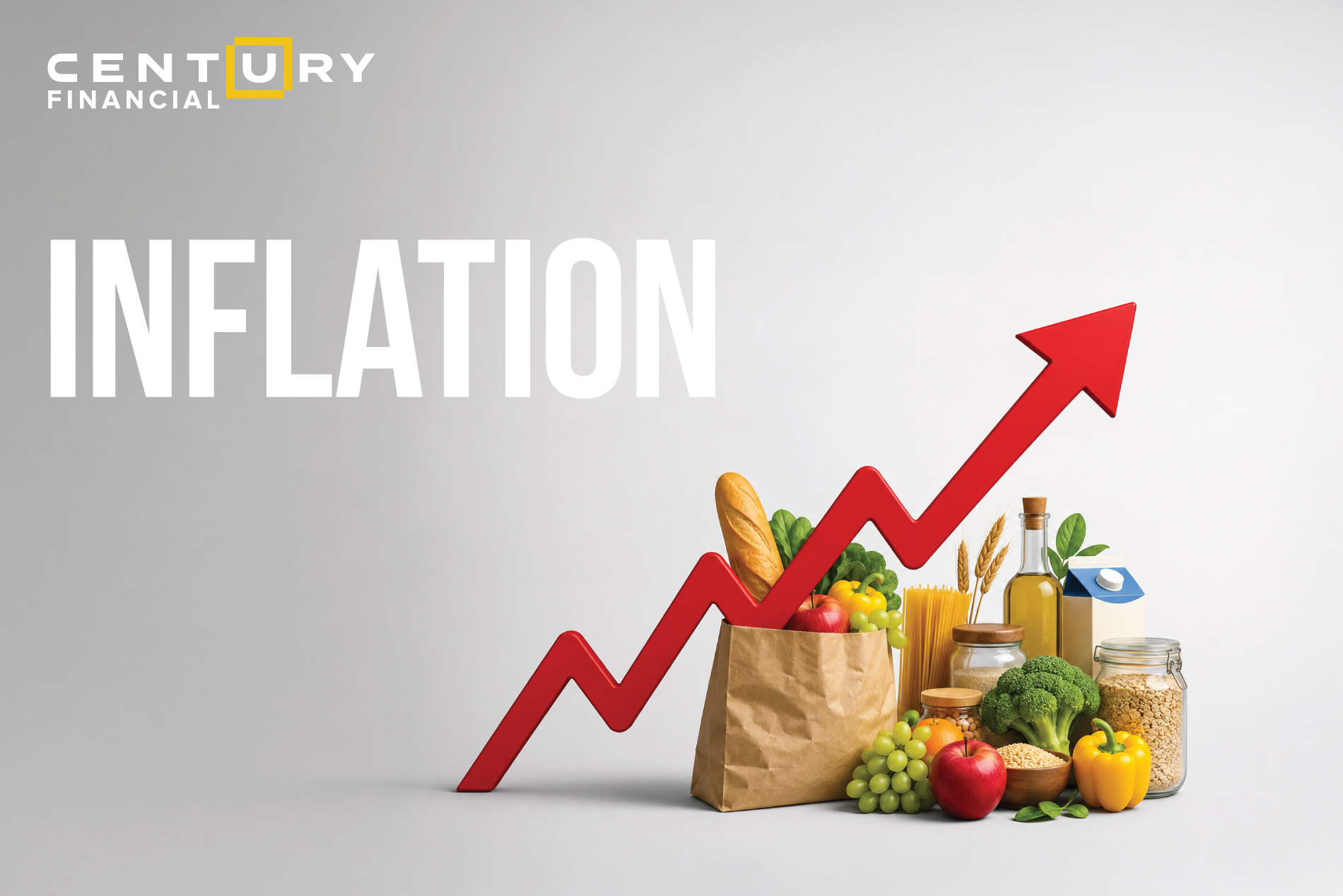
Inflation is a gradual decline in buying power. The inflation rate, which shows how much prices change each year as a percentage, is a common way to measure it. Investors and traders need to understand this phenomenon because it directly affects interest rates, currency values, the stock market, and commodities.
Inflation, whether cost-push, demand-pull, or driven by other economic factors, affects asset prices globally, regardless of class. By examining inflation trends and economic data, traders can make informed decisions. They can capitalize on market opportunities and manage risk efficiently.
What Does Inflation Mean?
In economics, the formal definition of inflation is the rate at which the price level of all goods and services rises, making money less valuable. When inflation increases, the value or the purchasing power of money decreases. In simple terms, you need more money to buy the same products or services compared to the past.
How Inflation Affects Purchasing Power
When inflation is moderate and controlled it can suggest economic growth. However, extremely high inflation can disrupt an economy. Even small annual increases compound over time, significantly affecting long-term savings and financial returns. When inflation rises:
Types of Inflation: Demand Pull Inflation and Cost Push Inflation
Economists broadly classify inflation into demand-pull inflation and cost-push inflation based on the factors driving price increases. While demand-pull inflation is triggered by excess demand in the economy, cost-push inflation arises from rising production costs. Identifying the type of inflation present helps analyze interest rate trends, currency movements, and share market performance.
Demand Pull Inflation
Demand-pull inflation occurs when demand for goods and services exceeds supply. When consumers have more money to spend, and production cannot keep up, prices increase. For example, during economic expansion, rising employment and income increase spending, pushing prices higher.
Common demand pull inflation causes include:
Cost Push Inflation
Cost-push inflation happens when production costs increase, forcing businesses to raise prices to maintain profit margins. For example, a rise in oil prices directly increases transportation and production costs, thereby raising consumer prices. Common cost push inflation causes:
Other Forms of Inflation
| Type | Description |
|---|---|
| Core Inflation | Excludes food and energy prices to show underlying trends |
| Hyperinflation | Extremely high and uncontrollable inflation |
| Stagflation | High inflation combined with slow growth and unemployment |
Major Inflation Causes and Economic Drivers
Inflation does not happen randomly. Several macroeconomic factors drive it, and understanding these inflation causes helps investors and traders anticipate market movements.
Monetary Policy and Money Supply
When central banks increase the money supply, market liquidity increases. This means there is more money chasing the same amount of goods.
Supply Chain Disruptions
Global supply shortages, global political tensions, and trade restrictions reduce the availability of goods, pushing prices higher.
Exchange Rate Movements
Currency depreciation makes imports more costly. Countries dependent on imports often experience import inflation.
Wage Growth
When wages increase significantly, businesses raise prices to maintain profitability. This can trigger a wage-price spiral.
Impact of Inflation on Financial Markets plus Trading.
Inflation directly affects different asset classes, making it one of the most closely monitored financial indicators on global markets. Changes in inflation rate influence interest rate decisions, currency strength, corporate earnings and overall investor outlook.
Inflation and Share Market
Moderate price increases often support corporate earnings because companies can increase prices. However, high inflation reduces consumer spending and increases costs, negatively affecting stocks.
Inflation may impact:
Inflation and commodities.
Commodities historically act as hedge against inflation. This could create opportunities in the oil, gold and broader commodities markets. When inflation rises:
Inflation and Forex Trading
Inflation influences the currency strength. Countries with high inflation often see their currencies depreciate. Key impacts include:
Inflation and CFD Trading
CFD Trading lets traders capitalize on price movements without actually owning the asset. Inflation causes prices to rise and fall across indices, commodities, and currencies, creating many short-term opportunities.
Using platforms such as Century Trader, traders can quickly react to inflation announcements and economic releases.
Elevate your
trading experience with
Century Trader App
Elevate your trading
experience with
Century Trader App

Conclusion
Understanding what inflation is is vital for every investor and trader. Inflation rate trends influence interest rates, exchange rates, commodity prices, and overall market performance. If driven by demand pull, cost push, or monetary expansion, inflation's effects flow through global financial markets.
At Century Financial, we provide advanced tools, including the Century Trader App and MT5 Platform, to help traders navigate inflation-driven markets with confidence. With access to CFD trading, diversified share baskets, and live data analysis, investors can position themselves strategically in both rising and falling market conditions.
FAQs
Q1: What is inflation in simple words?
A: Inflation is when the prices of goods and services rise over time, making money less valuable.
Q2: What causes inflation in an economy?
A: Inflation could be caused by increased demand, rising production costs, a higher money supply, supply shortages, and currency depreciation.
Q3: What is the difference between demand pull inflation and cost push inflation?
A: Demand-pull inflation occurs when demand exceeds supply, while cost-push inflation occurs when production costs rise, and businesses increase prices.
Q4: How does inflation affect the share market?
A: Moderate inflation can support corporate earnings, but high inflation increases costs and reduces consumer spending, potentially negatively impacting stock valuations.
Q5: How does inflation affect the share market?
A: Controlled inflation is normal and signals growth. However, high inflation can erode real returns unless investors diversify into assets such as commodities or actively trade on advanced platforms.
This marketing and educational content has been created by Century Financial Consultancy LLC (“Century”) for general information only. It does not constitute investment, legal, tax, or other professional advice, nor does it constitute a recommendation, offer, or solicitation to buy or sell any financial instrument. The material does not take into account your investment objectives, financial situation, or particular needs.
The opinions expressed by the hosts, speakers, or guests are their own and may change without notice. Information is based on sources we consider to be reliable; however, Century does not guarantee its accuracy, completeness, or timeliness and accepts no liability for any loss arising from reliance on this content.
Trading and investing involve significant risk, and losses may exceed initial deposits. Past performance is not indicative of future results. CFDs and other leveraged products are complex instruments that may not be suitable for all investors. Please ensure you understand how these products work, the associated risks, and seek independent professional advice if necessary.
Century is licensed and regulated by the UAE Capital Market Authority (CMA) under License Nos. 20200000028 and 301044.
Please refer to the full risk disclosure mentioned on our website.



Regulated by CMA
Century Financial Consultancy LLC








Reach us:
-
Dubai
6th Floor, Emaar Square Building 4,
Downtown, Dubai, P.O. Box 65777,
Dubai, United Arab Emirates -
Abu Dhabi
27th Floor, Office 2701,
Shining Towers, Abu Dhabi, UAE -
Sharjah
29th Floor, Office 2905,
The Business Tower, Sharjah, UAE - +971 (4) 356 2800
- info@century.ae

Disclaimer: Trading in financial products carries substantial risk. Leveraged over-the-counter (OTC) derivatives, such as Contracts for Difference (CFDs) and spot forex, may result in losses exceeding initial deposits and may not be suitable for all investors. These complex instruments do not confer ownership of the underlying assets. Investors should carefully consider their investment objectives and risk appetite, and seek independent professional advice if necessary.
Century Financial Consultancy LLC (CFC) is licensed and regulated by the Capital Market Authority (CMA) of the UAE under license numbers 20200000028 and 301044 to carry out the activities of Financial Products dealer, Trading Broker in international markets, Trading Broker of OTC derivatives and currencies in the spot market, Introduction, Financial Consultations, and Promotion. CFC is incorporated under UAE law, registered with the Dubai Economic Department (No. 768189), with its office at 601, Level 6, Building No. 4, Emaar Square, Downtown Dubai, UAE, PO Box 65777.
The content on this website is provided solely for informational and educational purposes and does not constitute an offer, recommendation, or solicitation to buy or sell any securities or financial products.
Products and services offered by CFC are not intended for use in any jurisdiction where such use or distribution would breach local laws or regulatory requirements.
⚠️ Alert: Fraudulent Activity Notice
Century Financial Consultancy LLC (“Century”) has become aware of fraudulent individuals and entities impersonating our firm through unofficial websites, social media channels, and messaging applications such as Telegram, WhatsApp, and Discord.
Please be advised:
- Century does not manage investments on behalf of clients.
- Century does not solicit funds or guarantee investment returns.
- Century does not accept or make payments in cash, cryptocurrency, or digital assets.
- We do not conduct business via social media or messaging platforms.
Our only official website is www.century.ae, and all communication is conducted exclusively through verified channels.
We strongly urge the public to remain vigilant, verify the authenticity of any communication claiming to be from Century, and report any suspicious activity. Century disclaims any responsibility for losses arising from dealings with unauthorised or fraudulent parties.
