 Loading ...

Tuesday, September 15, 2026
CFD vs Futures: Key Differences, Costs & Risks
By Century Financial in 'Blog'

Introduction
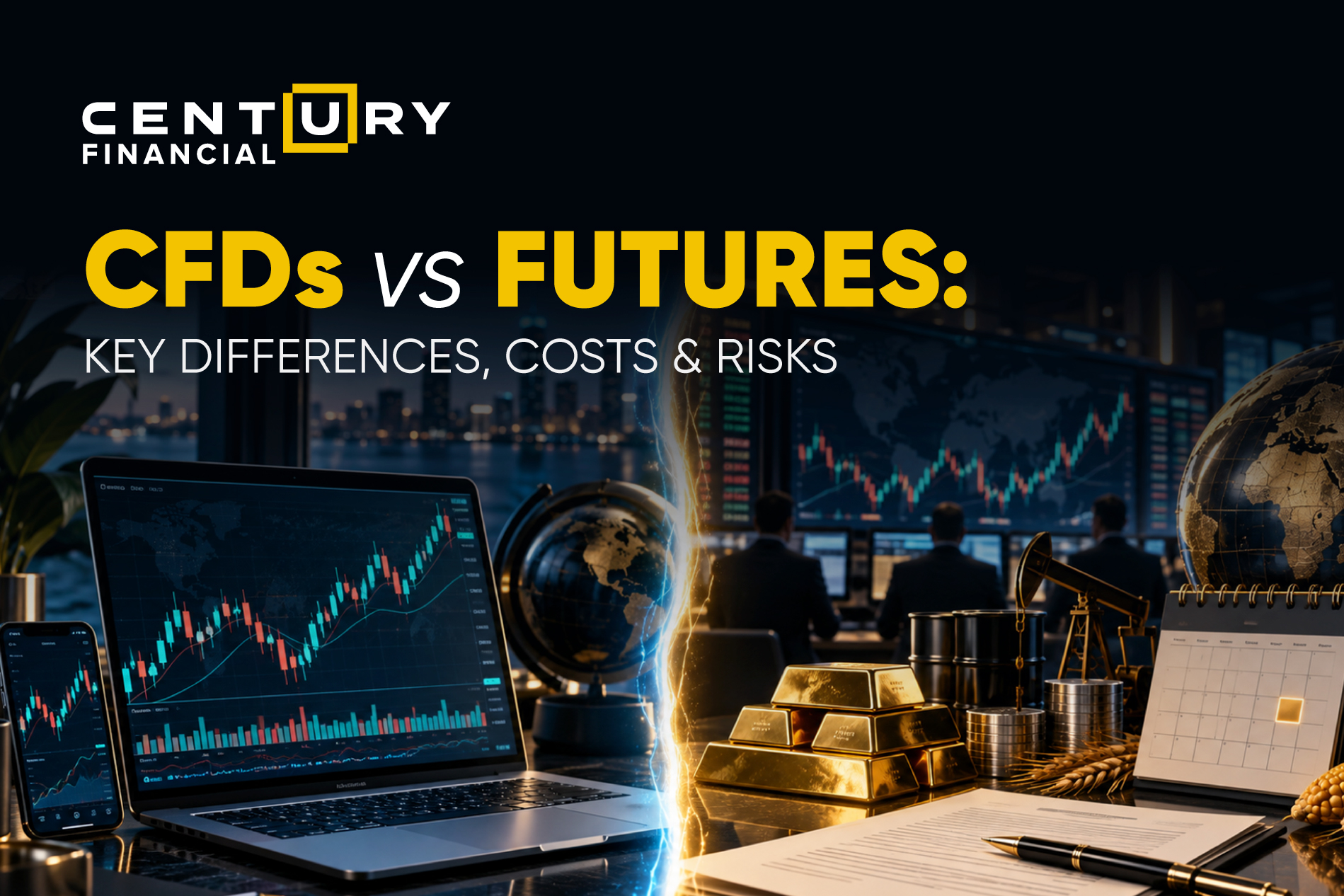
Both CFDs and futures let a trader take a position on where a market is headed without ever owning the underlying asset. That's about where the similarity ends. They diverge on expiry, contract size, cost structure, and how leverage is calculated.
Which one fits better depends on the trader's objectives, the market involved, and how much risk they're set up to manage. Walk through how each instrument works, where they genuinely differ, and how leverage and margin behave differently enough to change the real risk picture even when two positions look similar on paper.
What Is CFD Trading?
How CFDs Work
A CFD, or contract for difference, is an agreement between a trader and a broker to exchange the difference in an asset's price between opening and closing a position, without either side owning the underlying asset. Profit or loss is calculated purely on that price movement.
Key Features of CFD Trading
Some key features of CFDs are:
- No fixed expiry
- Broker-set margin requirements
- Multi-asset access
When CFDs May Be Suitable
CFDs tend to fit situations that call for flexible position sizing or shorter holding periods, since you can generally open or close a position without working around a fixed contract date.
What Is Futures Trading?
How Futures Contracts Work
A futures contract is a standardized agreement to buy or sell an underlying asset at a set price on a specific future date, traded on a regulated exchange. Unlike a CFD, the exchange sets the contract size and expiry, not the broker.
Key Features of Futures
Features of futures contracts include:
When Futures May Be Suitable
Futures suit traders with larger, standardized position sizes or a longer, defined timeframe, since the contract structure is fixed rather than adjustable.
CFD vs Futures: What Is the Difference?
CFDs and futures both remove the need to own the underlying asset. Still, the mechanics diverge in several places, including how long a position can run and how it eventually settles.
Expiry Dates and Contract Rollover
CFDs generally carry no fixed expiry, so a position can stay open as long as margin and financing costs are covered. Futures expire on a set date, so a trader wanting continued exposure typically needs to roll into a new contract before then.
Contract Size and Position Flexibility
CFD position sizes are generally more flexible, set by the broker in smaller increments. Futures come in standardized lot sizes fixed by the exchange, which can make it harder to size a position to an exact amount.
Trading Costs and Fees
CFD costs typically include the spread and, for overnight positions, a financing charge. Futures costs typically center on a commission per contract plus the spread, with no separate financing charge since the contract price already reflects the cost of carry to expiry.
Market Access and Trading Hours
CFDs are typically available across a broad range of markets through a single broker platform, often with extended trading hours. Futures trade on their listing exchange's specific hours, which vary by contract and exchange.
Settlement and Delivery
CFDs are typically cash-settled, with no delivery of the underlying asset involved. Futures can be cash-settled or physically settled depending on the contract, which matters most for traders who don't intend to take delivery of a physical commodity.
Short Selling
Both instruments let you take a short position and target a falling price without first borrowing the underlying asset.
Liquidity and Execution
Futures liquidity is concentrated on a single exchange order book, which can make pricing more transparent for heavily traded contracts. CFD liquidity depends on the broker's own pricing and execution model, since CFDs aren't exchange-traded instruments.
| Feature | CFDs | Futures |
|---|---|---|
| Contract expiry | Generally no fixed expiry | Fixed expiry |
| Contract size | More flexible | Standardised |
| Leverage | Available | Available |
| Short selling | Possible | Possible |
| Trading costs | Spread, financing and other applicable costs | Commission, spread and other applicable costs |
| Rollover | No traditional futures-style expiry rollover | Contracts may need to be rolled |
| Flexibility | Generally higher | More standardised |
| Settlement | Typically cash-settled | Cash or physical settlement depending on contract |
CFD vs Futures: Leverage and Risk
Leverage and margin work distinctly across the two instruments, and that difference is where much of the real risk comparison lives.
How Leverage Works With CFDs
A CFD position typically requires posting only a percentage of the position's full value as margin, set by the broker based on the instrument and applicable regulatory limits. A smaller move in the underlying market then has a proportionally larger effect on the account.
How Margin Works With Futures
Futures margin is set by the exchange or clearinghouse, not the broker, and it's typically recalculated daily based on the contract's price volatility. A trader may face a margin call, a request to add funds, if the account balance drops below a maintenance threshold.
Why Leverage Can Increase Losses
Leverage magnifies outcomes in both directions, and a loss can exceed the initial margin posted, depending on the instrument and the account's protections. This applies to both CFDs and futures, since leverage is a feature of both, not just one.
Risk Management Considerations
Position sizing, stop-loss positions, and margin-level monitoring apply to both instruments, though the mechanics differ. Brokers typically set a CFD stop-out level, while futures margin calls follow the exchange's rules.
CFD vs Futures: Which Is Better?
Neither instrument is universally better, so the more useful question is which one lines up with what a trader is actually trying to do.
In Case of CFDs
A trader looking to adjust position size frequently, or hold a position for anywhere from minutes to a few weeks without an expiry date to work around, is often better served by the flexibility CFDs offer.
Considering Futures
A trader with larger, more standardized exposure, or one who values trading on a regulated exchange with centralized clearing, may find futures align more smoothly with that approach.
CFDs vs Futures for Beginners
Newer traders often find CFDs more approachable initially, given the smaller position sizes and simpler account structure, though both instruments carry meaningful leverage risk regardless of experience level.
CFDs vs Futures for Experienced Traders
Experienced traders sometimes use both side by side, CFDs for flexible, shorter-term positioning and futures for larger, longer-view exposure on the same underlying market.
| CFDs | Futures | |
|---|---|---|
| Advantages | No fixed expiry, flexible position sizing, broad market access through one platform | Exchange-traded transparency, centralized clearing, standardized contract terms |
| Limitations | Pricing and execution depend on the broker, financing costs accumulate on positions held over time | Fixed expiry requires managing rollover, standardized sizes can be harder to fit to a specific exposure amount |
Common Mistakes When Choosing Between CFDs and Futures
Markets carry risks, and leverage can often amplify them. Since both use leverage, both carry major risk, and the following mistakes can increase the likelihood of an undesired outcome:
Trading CFDs and Futures With Century Financial
Century Financial's trading platforms support both instrument types without requiring traders to switch accounts. MT5 and the Century Trader App typically cover CFD access across shares, indices, currencies, and commodities. Meanwhile, CQG, TWS, and IBKR extend into futures and other exchange-traded contracts across global markets. Risk management tools, including stop-loss and margin monitoring features, apply across both instrument types on these platforms, which matters because CFD and futures margin are calculated differently.
Conclusion: CFD vs Futures, Which Should You Choose?
CFDs and futures both provide exposure to an underlying market without owning the asset itself. Still, they diverge in nearly every mechanical detail. Which instrument fits better usually comes down to the trader's objectives, position size, and how much standardization versus flexibility actually matters for a given strategy.
Century Financial's trading platforms, including MT5, CQG, TWS, IBKR, and the Century Trader App, give traders access to both CFDs and futures across global markets, along with risk management tools relevant to each. For traders weighing the two, comparing the actual margin and cost mechanics side by side, rather than headline leverage figures alone, tends to be the more useful starting point.
FAQs About CFDs vs Futures
Q1. What is the difference between CFDs and futures?
A: CFDs are broker-based contracts with no fixed expiry, while futures are standardized, exchange-traded contracts with a set expiry date and centralized clearing.
Q2. Is CFD trading better than futures trading?
A: Neither is universally better. The right choice depends on a trader's objectives, position size, and preference for flexibility versus standardized contract terms.
Q3. Which has more leverage, CFDs or futures?
A: Both offer leverage, though the actual margin percentage depends on the broker for CFDs or the exchange's volatility-based calculation for futures.
Q4. Do CFDs and futures have expiry dates?
A: Futures have a fixed expiry date set by the exchange. CFDs generally don't carry a fixed expiry, allowing positions to stay open as long as margin is maintained.
Q5. Are CFDs riskier than futures?
A: Risk depends on position size, leverage used, and how margin is managed, not the instrument type alone. Both carry meaningful leverage-related risk.
This marketing and educational content has been created by Century Financial Consultancy LLC (“Century”) for general information only. It does not constitute investment, legal, tax, or other professional advice, nor does it constitute a recommendation, offer, or solicitation to buy or sell any financial instrument. The material does not take into account your investment objectives, financial situation, or particular needs.
The opinions expressed by the hosts, speakers, or guests are their own and may change without notice. Information is based on sources we consider to be reliable; however, Century does not guarantee its accuracy, completeness, or timeliness and accepts no liability for any loss arising from reliance on this content.
Trading and investing involve significant risk, and losses may exceed initial deposits. Past performance is not indicative of future results. CFDs and other leveraged products are complex instruments that may not be suitable for all investors. Please ensure you understand how these products work, the associated risks, and seek independent professional advice if necessary.
Century is licensed and regulated by the UAE Capital Market Authority (CMA) under License Nos. 20200000028 and 301044.
Please refer to the full risk disclosure mentioned on our website.


Regulated by CMA
Century Financial Consultancy LLC








Reach us:
-
Dubai
6th Floor, Emaar Square Building 4,
Downtown, Dubai, P.O. Box 65777,
Dubai, United Arab Emirates -
Abu Dhabi
27th Floor, Office 2701,
Shining Towers, Abu Dhabi, UAE -
Sharjah
29th Floor, Office 2905,
The Business Tower, Sharjah, UAE - +971 (4) 356 2800
- info@century.ae

Disclaimer: Trading in financial products carries substantial risk. Leveraged over-the-counter (OTC) derivatives, such as Contracts for Difference (CFDs) and spot forex, may result in losses exceeding initial deposits and may not be suitable for all investors. These complex instruments do not confer ownership of the underlying assets. Investors should carefully consider their investment objectives and risk appetite, and seek independent professional advice if necessary.
Century Financial Consultancy LLC (CFC) is licensed and regulated by the Capital Market Authority (CMA) of the UAE under license numbers 20200000028 and 301044 to carry out the activities of Financial Products dealer, Trading Broker in international markets, Trading Broker of OTC derivatives and currencies in the spot market, Introduction, Financial Consultations, and Promotion. CFC is incorporated under UAE law, registered with the Dubai Economic Department (No. 768189), with its office at 601, Level 6, Building No. 4, Emaar Square, Downtown Dubai, UAE, PO Box 65777.
The content on this website is provided solely for informational and educational purposes and does not constitute an offer, recommendation, or solicitation to buy or sell any securities or financial products.
Products and services offered by CFC are not intended for use in any jurisdiction where such use or distribution would breach local laws or regulatory requirements.
⚠️ Alert: Fraudulent Activity Notice
Century Financial Consultancy LLC (“Century”) has become aware of fraudulent individuals and entities impersonating our firm through unofficial websites, social media channels, and messaging applications such as Telegram, WhatsApp, and Discord.
Please be advised:
- Century does not manage investments on behalf of clients.
- Century does not solicit funds or guarantee investment returns.
- Century does not accept or make payments in cash, cryptocurrency, or digital assets.
- We do not conduct business via social media or messaging platforms.
Our only official website is www.century.ae, and all communication is conducted exclusively through verified channels.
We strongly urge the public to remain vigilant, verify the authenticity of any communication claiming to be from Century, and report any suspicious activity. Century disclaims any responsibility for losses arising from dealings with unauthorised or fraudulent parties.
